
AI-Powered Content Generation: How to Maintain Quality at Scale

TL;DR
- ✓ Shift from chaotic AI experimentation to a governed content supply chain.
- ✓ Use agentic workflows to maintain brand consistency across long-form projects.
- ✓ Implement a brand governance layer to ensure factual accuracy and tone.
- ✓ Transition your role from manual writer to strategic curator of automated output.
The era of throwing a prompt at a chatbot and praying for a finished article is dead. By 2026, the novelty of AI-generated text has worn off. It’s been replaced by a ruthless, bottom-line demand for operational precision.
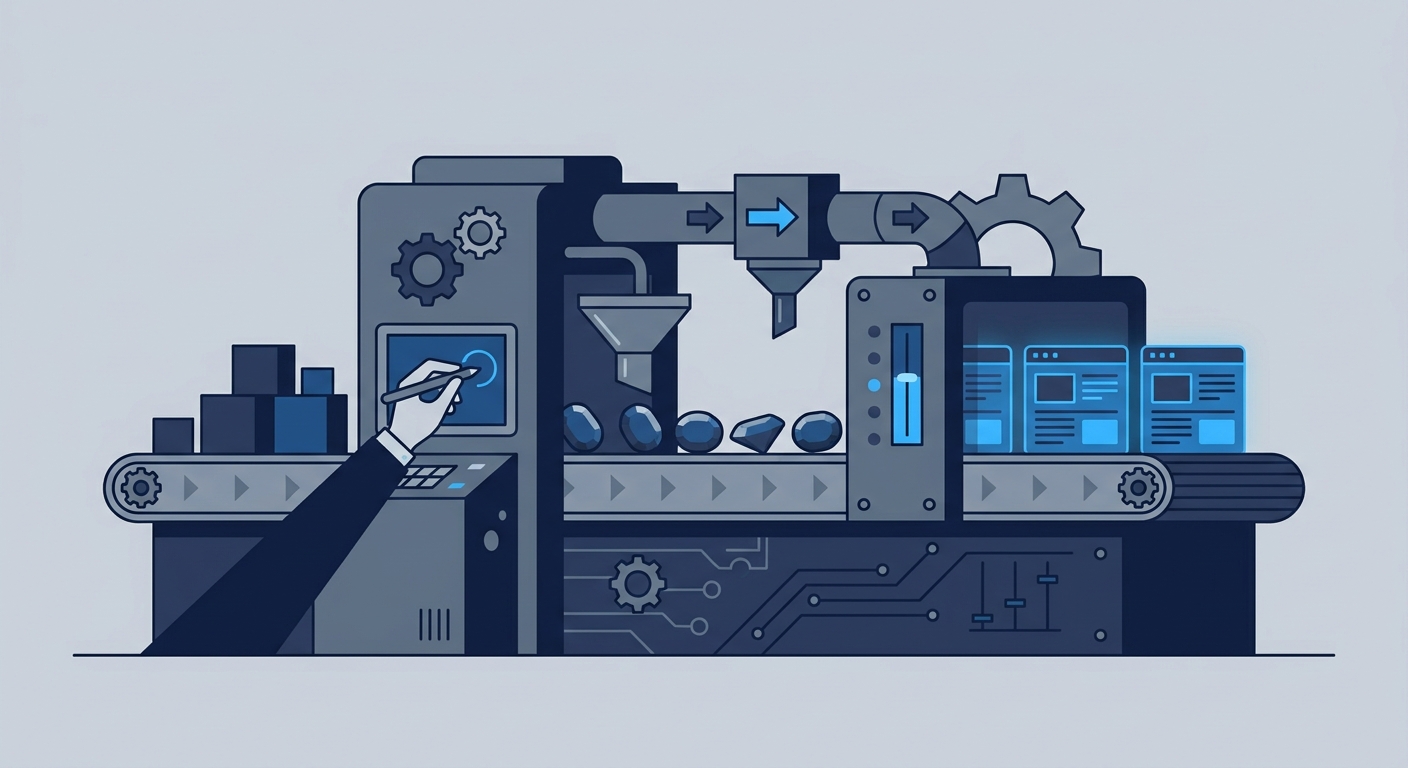
If you’re still treating AI like a "magic button" to pump out volume, you aren't scaling. You’re just diluting your brand into a puddle of irrelevance. Maintaining quality at scale isn’t about playing with prompts; it’s about shifting from chaotic experimentation to a governed content supply chain. You need AI to act as a disciplined engine, not an unpredictable freelancer who ghosts you right before a deadline.
Why "More" is No Longer the Goal
The "AI Experimentation" phase of 2023 and 2024 was a gold rush for volume. Marketing teams were obsessed with a single metric: how many blog posts could they churn out in an hour? It was a race to the bottom. Today, the focus has shifted to "Operationalization." We’ve learned the hard way that volume without a governance layer leads to "Quality Drift"—that specific, hollow feeling where your brand voice starts sounding like a generic, soulless synthesis of every mediocre post on the internet.
Quality at scale isn’t about writing faster. It’s about building a repeatable, governed pipeline. Every piece of content, whether produced by a human or an agent, should meet the same rigorous standards of accuracy, tone, and strategic intent you’d expect from your most senior writer.
The "Agentic Shift" and Quality Control
We are moving away from simple, linear text generation toward autonomous "agentic" workflows. In the old days—which was basically last year—you gave a prompt to a model, got a response, and moved on. That process is fragmented and brittle.
Agentic systems are different. They maintain context across long-form projects. They can research, draft, cross-reference, and refine content based on a persistent set of instructions. ANALYSIS — an earlier version of this article cited a "State of AI Content 2026 Report" for a 40% reduction in editorial rework. No report by that title could be found from any identifiable publisher, and no link was given. The claim has been removed. Why? Because agents don't "forget" the brand guide halfway through a 2,000-word white paper. They operate within a closed loop, ensuring every paragraph stays locked onto the initial strategic brief.
Building a Governed Content Supply Chain
To master quality, you need a "Brand IQ" layer. Think of this as a digital gatekeeper sitting between your LLM and your CMS. It’s an automated enforcement mechanism that checks for stylistic consistency, factual accuracy, and compliance with your brand guidelines.
This transition fundamentally changes the human role. You aren't a "writer" anymore; you’re a strategist. You stop editing for commas and start curating the output of an intelligent system.
In this model, the "Human-in-the-loop" is elevated. Your job is to define the boundaries of the system, not to polish the edges of the output. By automating the guardrails, you free your team to focus on high-level narrative arcs and market positioning.
Preventing Hallucinations through Retrieval-Augmented Generation
The biggest enemy of quality is the "hallucination"—that moment an AI confidently states something that is entirely, embarrassingly false. You mitigate this by anchoring your AI to your own proprietary data via Retrieval-Augmented Generation (RAG).
Stop relying on the model’s internal, generalized training data. Force it to search your specific knowledge base—past white papers, internal reports, and product documentation—before it writes a single word.
Generic prompting is a relic of the past. If you don't provide your AI with context, you deserve the generic output you get. When you connect your intelligence layer to a curated data repository, the quality of the output shifts from "plausible" to "authoritative." For those building these pipelines, utilizing specialized AI Writing Tools is the most efficient way to ensure your stack remains robust and integrated.
Generative Engine Optimization (GEO)
Traditional SEO was about keywords and backlinks. Generative Engine Optimization (GEO) is about being cited as an objective authority by AI models. When a user asks an AI, "What is the best solution for X?", your brand needs to be the source the AI cites.
This requires a shift toward structured data and entity-based authority. You aren't writing for bots to crawl; you are writing to make it easy for an LLM to index your expertise. As noted in industry discussions on Generative Engine Optimization (GEO), the goal is to provide clear, high-signal content that AI models find indispensable for constructing their own answers.
Multimodal Scaling: Beyond the Written Word
Quality at scale isn't limited to text. Modern AI platforms can take a single, high-fidelity strategic brief and repurpose it into video content, audio scripts, and interactive assets. The danger here is brand consistency.
According to insights on The Future of AI in Marketing, the winners in 2026 will be those who can maintain a cohesive "brand DNA" across all media. If your video script sounds like a marketing brochure, but your blog post sounds like a technical manual, you have failed to scale. Your governance layer must be multimodal, ensuring that the same voice and strategic intent permeate every asset, regardless of the medium.
Human-in-the-Loop Oversight
Where do you start? You start by defining the role of the "AI Content Strategist." This person isn’t a writer; they are a systems engineer for your brand’s voice. They audit the workflow—the way the AI researches, the way it structures its arguments, and the way it handles citations—rather than checking every individual adjective in a draft.
If you find that your team is getting bogged down in the minutiae of managing these complex pipelines, it may be time to look into professional Content Strategy Services to help you build the necessary infrastructure. Scaling isn't about doing more; it's about doing it right, every single time.
The Power of Less: Focusing on Evergreen Assets
There is a counter-intuitive truth to scaling: sometimes, the best way to grow is to stop creating new content and start optimizing what you already have. AI is exceptionally good at auditing existing, high-performing evergreen assets to identify gaps in data or outdated information.
By focusing your AI resources on refreshing your existing library, you increase the authority of your domain without adding to the noise of the internet. The "Governance Model" shown above ensures that when you update an asset, it remains compliant with your current brand standards, effectively compounding the value of your historical work.
Frequently Asked Questions
How can I ensure AI-generated content doesn't sound generic or robotic?
Focus on fine-tuning your AI with proprietary data and specific style guides. Avoid "zero-shot" prompting; instead, feed the AI examples of your best-performing, human-written content so it learns the cadence, sentence structure, and vocabulary that define your brand.
How does AI impact my SEO strategy in 2026?
The focus has shifted from keyword density to entity-based authority. You must now optimize for "answerability," ensuring your content is structured in a way that AI models can easily cite as the definitive source of truth for your industry topics.
What are the biggest risks to quality when scaling content with AI?
The primary risks are brand dilution, factual hallucinations, and a loss of strategic intent. Without a governance layer, you risk publishing content that follows your SEO rules but contradicts your company's values or expertise.
How do I integrate AI into my existing content workflow without starting from scratch?
Start by mapping your current workflow and identifying the "bottleneck" (usually research or drafting). Deploy an AI agent specifically to handle that single task, refine the output using your existing brand guidelines, and slowly expand that integration as you build trust in the system.
What metrics should I track to measure the quality of AI-scaled content?
Move beyond vanity metrics like "page views." Track "citation rate" (how often AI models reference your content), "conversion impact" (the quality of leads generated by AI-assisted content), and "editorial velocity" (how much time your team saves on high-quality, high-impact asset production).