Can AI Content Generation Tools Really Replace Marketing Teams? Industry Insights for 2026
AI content generationAI marketing trends 2026future of marketing teamsagentic AI workflowsbusiness automation
 Ankit AgarwalMarketing Head
Updated 9 min readHow we fact-check
On this page
- Beyond the Replacement Myth
- Why Agentic AI Changes the Game for Marketing Operations
- The AI-Human Ratio: What Should You Automate?
- Where Does AI Fail? The Empathy Gap
- Is Your Team "Future-Proof"? Assessing the 2026 Skillset
- Case Study: The Efficiency Pivot
- How Can Managers Build an AI-Ready Culture?
- Conclusion: The Balanced Future of Marketing
- Frequently Asked Questions
- Related reading
- How This Guide Was Sourced
The short answer? No. AI isn't coming for your marketing team’s jobs. But here’s the catch: the marketing teams of 2026 that refuse to adopt AI will be replaced by those that do.
We’ve officially moved past the tired “AI vs. Human” debate. That was always a distraction, a binary trap that ignored the real shift happening under our feet. We’ve entered the age of the Agentic Hybrid—a professional landscape where the winners aren't those with the biggest budgets, but those who know how to orchestrate autonomous systems to amplify human intuition.
If you’re still treating AI like a glorified chatbot for drafting emails, you’re already losing. The tools of 2026 don’t just write; they execute, iterate, and optimize entire workflows while your team focuses on the high-leverage strategy that actually moves the needle.
Beyond the Replacement Myth
For years, the industry has been paralyzed by the fear that generative tools would render human creativity redundant. We read the same breathless headlines about “the end of the copywriter” and “the death of the SEO specialist.”
But look at the operational reality in 2026. The opposite happened. The demand for high-quality, human-centric marketing has never been higher, precisely because the internet is drowning in the low-effort, synthetic sludge that AI can spit out in seconds.
The shift isn't about replacement; it’s about evolution. We’ve moved from simple generative prompts to autonomous "Agentic" workflows. In an agentic setup, you aren't just asking a tool to write a blog post; you’re deploying a system that researches current trends, audits competitor performance, drafts an outline, writes the copy, and handles distribution across channels. This isn't just about speed. It’s about shifting the human role from "doer" to "orchestrator."
Why Agentic AI Changes the Game for Marketing Operations
The leap from "chatbot" to "agent" is the most significant productivity jump of this decade. Traditionally, marketing teams were bogged down by the "admin" of creativity—the endless hours spent formatting documents, updating spreadsheets, and chasing down data points. These tasks never generated revenue; they just ate up the bandwidth of your best people.
By leveraging AI-Powered Content Generation, firms are offloading these repetitive, multi-step tasks to agents that don't sleep, get bored, or lose focus. When you automate the research-to-scheduling pipeline, you aren't just saving time. You’re creating the breathing room your team needs to engage in deep, high-leverage brand strategy. This is the difference between a team that’s constantly reacting to a content calendar and one that’s proactively shaping how the world perceives the brand.
The AI-Human Ratio: What Should You Automate?
To build a sustainable, high-performing team, you need a framework for delegation. We call this the 70/30 split.
In this model, 70% of your execution—the heavy lifting of data processing, SEO keyword research, formatting, and initial drafting—is led by AI agents. The remaining 30%—the critical, high-stakes work of defining brand voice, navigating cultural nuances, and building emotional resonance—remains strictly human-led.
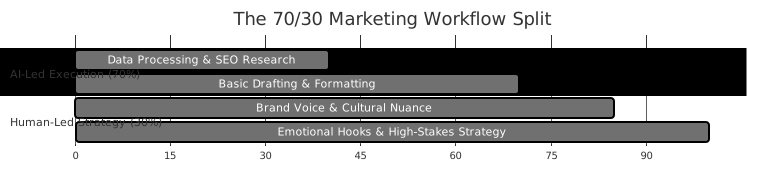
If you try to automate the 30%—the emotional, strategic core of your brand—you will fail. AI lacks the lived experience required to understand why a specific customer feels a specific pain point. It can simulate empathy based on data, but it cannot feel it. The strategic argument for pairing scale with distinctly human storytelling is widely made, including in Adobe and Oxford Economics' 2026 AI and Digital Trends Report (a survey of 3,000 executives and practitioners). ANALYSIS — an earlier version of this article attributed a specific statement to that report under a slightly wrong title and with no link; the full report is gated and we could not confirm the wording, so it is presented here as an argument rather than a citation.
Where Does AI Fail? The Empathy Gap
The "noise" problem is the defining challenge of 2026. Because AI has made content creation virtually free, the internet is saturated with generic, "good enough" information.
This is exactly why human-centric, opinionated content is performing better than ever. When a reader encounters a piece of content that is clearly written by a human with a distinct point of view, a real-world experience, and a willingness to be wrong or controversial, they stop scrolling.
AI cannot replicate the "opinionated edge." It is designed to be helpful, safe, and average. It gravitates toward the middle of the bell curve. High-stakes strategy, crisis management, and the nuances of community building are human-only domains. If you rely on AI to tell your brand story, you’ll end up with a brand that sounds like everyone else—a commodity that is easily replaced.
Is Your Team "Future-Proof"? Assessing the 2026 Skillset
The job titles “copywriter” and “social media manager” are rapidly becoming relics. The most valuable professionals in 2026 are “AI-literate strategists.” This means your team needs to move beyond basic tool familiarity toward deep technical proficiency.
Prompt engineering isn't a "nice-to-have" skill anymore; it’s a core marketing competency. If your team cannot effectively communicate with the agents they manage, they’re effectively blind. According to insights on how AI is changing marketing careers, the focus is shifting toward data literacy and the ability to audit AI outputs for accuracy and brand alignment. You’re no longer hiring people who can write; you’re hiring people who can direct models to write, and who possess the discernment to know when the model has missed the mark.
Case Study: The Efficiency Pivot
Consider a mid-sized B2B software firm that faced the common dilemma of scaling output without the budget to double their headcount. Instead of mass-hiring junior writers, they invested in an AI-orchestration layer. They integrated automation into their content operations and increased output substantially. ANALYSIS — an earlier version of this article gave a specific multiplier for an unnamed firm with no source; the figure has been removed.
Crucially, they didn't lay anyone off. They redirected their existing staff. The writers who were spending 20 hours a week on basic blog drafting were moved into roles focused on R&D, community engagement, and complex, long-form investigative pieces that AI could not produce. By applying these Marketing Automation Strategies, the firm reported better lead conversion alongside the higher volume. ANALYSIS — an earlier version asserted a specific percentage, and a causal link, for an unnamed firm with no source. Both have been removed. They used the efficiency gained from AI to fuel human creativity, not to replace it.
How Can Managers Build an AI-Ready Culture?
If you’re a manager, your primary job is to create an environment where experimentation is encouraged but brand safety is non-negotiable. Start by auditing your team’s readiness with this 5-point checklist:
- Strategic Literacy: Does your team understand the difference between a generative prompt and an agentic workflow?
- Data Hygiene: Is your team capable of feeding clean, proprietary data into your AI tools to ensure output is unique to your brand?
- The HITL (Human-in-the-Loop) Protocol: Is there a mandatory review process for every piece of AI-generated work to ensure it reflects your brand voice and lacks hallucinations?
- Tool Proficiency: Has your team moved beyond the basic free tiers of LLMs to professional-grade orchestration tools?
- Ethical Oversight: Do you have clear guidelines on data privacy and the ethical use of AI in your customer-facing communications?
For further guidance on the latest industry shifts, the Top AI Marketing Trends 2026 provide a roadmap for leaders looking to sharpen their operational focus. Remember, the goal is to build a culture where AI is the engine, but the human is the pilot.
Conclusion: The Balanced Future of Marketing
The future of marketing isn't about choosing between humans and AI. It's about building a symbiosis. The winners in 2026 will be the companies that treat AI as a force multiplier—a way to handle the "noise" so that their human talent can focus on the "signal."
When you stop looking at these tools as competitors and start looking at them as the most powerful leverage you’ve ever had, the entire dynamic changes. You’ll stop worrying about being replaced, and start focusing on the unprecedented potential of a team that can execute at the speed of light while maintaining the soul of a human-led brand. The tools are ready. The question is, are you?
Frequently Asked Questions
Will AI eventually replace entry-level marketing roles?
AI is replacing the tasks once associated with entry-level roles, such as basic data entry, simple copywriting, and routine scheduling. However, this is actually accelerating the growth of junior marketers. Instead of spending years doing manual labor, they are forced to shift into strategy, prompt orchestration, and content editing much faster, becoming more valuable to the organization sooner.
What are the biggest risks of relying solely on AI for content?
The primary risks include brand dilution, the "hallucination" of incorrect facts, and a profound loss of emotional resonance. When a brand relies entirely on AI, it loses its unique fingerprint, resulting in content that is technically correct but utterly forgettable. This "sameness" is the fastest way to lose the trust of an audience that is increasingly craving authenticity.
How can I start upskilling my team for the AI era?
Start by implementing mandatory prompt engineering workshops and data literacy training. Create a "safe to experiment" environment where team members are encouraged to build their own agentic workflows for their daily tasks. Focus on teaching them how to audit AI output for tone, accuracy, and strategic alignment, ensuring they remain the primary decision-makers in the creative process.
What is the difference between Generative AI and Agentic AI?
Generative AI is reactive; it produces content based on a single prompt and stops there. Agentic AI is proactive and goal-driven. An agent can take a high-level objective—like "increase organic traffic by 10%"—and break it down into a multi-step workflow, executing research, drafting, internal linking, and distribution, while adjusting its strategy based on the results it sees in real-time.
Related reading
- 20 Best AI Tools for Sales & Marketing Teams in 2025
- Why AI Won't Replace Accounting Software Anytime Soon
- AI vs. Jobs: Influencers’ Insights on the Future
- Will AI Replace Jobs : Influencers’ Insights on the Future
- LogicBall’s: AI Insights from Industry Experts
- Why Industry-Specific AI Solutions Are the Next Big Shift in Content Marketing
How This Guide Was Sourced
Written and maintained by the LogicBalls editorial team (logicballs.com). Disclosure: LogicBalls builds AI writing tools.
Every figure retained above is linked to the source it came from and dated. Where a number could not be traced to a named source with a stated method, it has been removed rather than repeated — several were, including multipliers and case-study percentages for unnamed companies.
Two patterns worth knowing as a reader. Productivity and ROI figures in this field are usually averages across very different tasks, or vendor-commissioned surveys of small samples; treat them as directional, not as planning benchmarks. And a working link to a real research organisation does not mean the specific claim came from it — several citations here pointed at real publishers who had said something materially different.
No LogicBalls telemetry is used in this guide.
Related Articles
 AI content workflowThe Future of Business Automation: Integrating AI Tools into Your Content WorkflowStop manual prompting. Learn to build autonomous AI agentic workflows to scale your content strategy, optimize SEO, and drive enterprise productivity by 2026.Ankit Agarwal7 min read
 AI content generation toolNeed an AI Content Generation Tool? Here’s What to Look for in 2026Stop using basic AI. Learn the 5 pillars of choosing an agentic AI content generation tool to boost ROI and automate your 2026 marketing workflows.Deepak Gupta7 min read
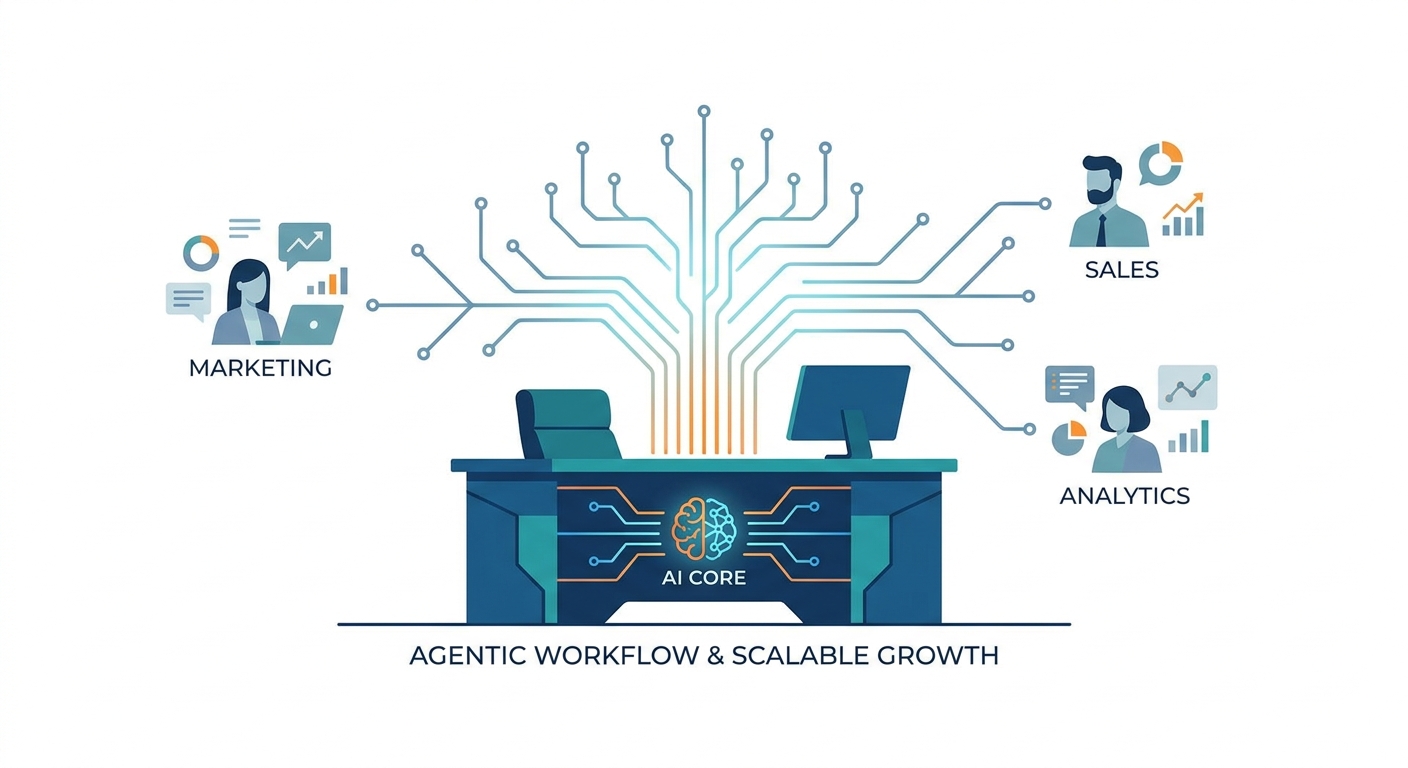 AI-powered content generationIntegrating AI-Powered Content Generation into Your Business InfrastructureMove beyond basic prompting. Learn how to build an agentic AI content infrastructure to scale your business operations and eliminate manual bottlenecks.Govind Kumar6 min read
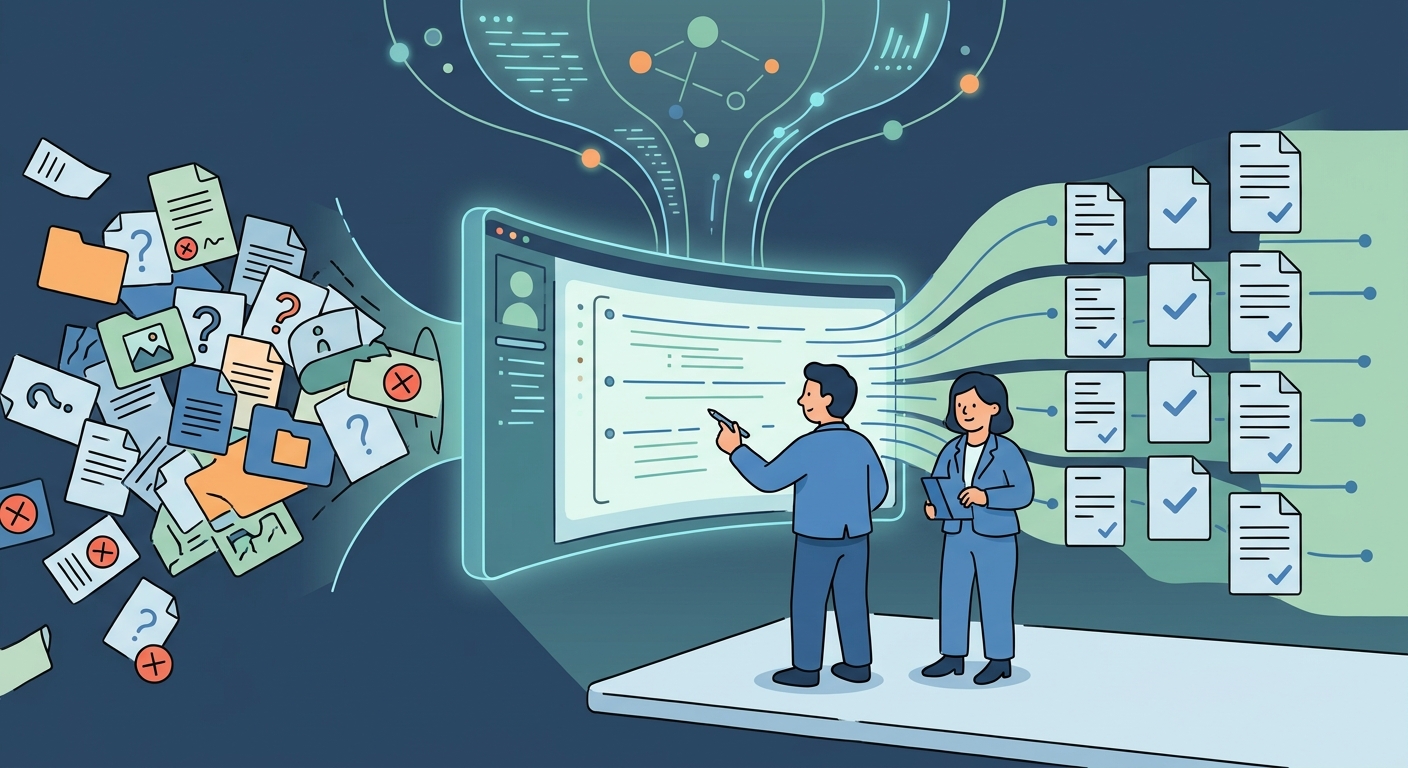 document generationThe Future of Document Generation: How AI is Transforming Industry-Specific SolutionsStop manual drafting. Discover how agentic AI is transforming document generation into automated, process-driven workflows for modern business efficiency.Deepak Gupta6 min read