The Future of Document Generation: How AI is Transforming Industry-Specific Solutions

TL;DR
- ✓ Move from manual drafting to autonomous, process-executing AI agents.
- ✓ Eliminate the legacy tax of static templates and manual document filing.
- ✓ Integrate CRM and ERP data for real-time, accurate document generation.
- ✓ Remove human-in-the-loop bottlenecks to accelerate business operations and efficiency.
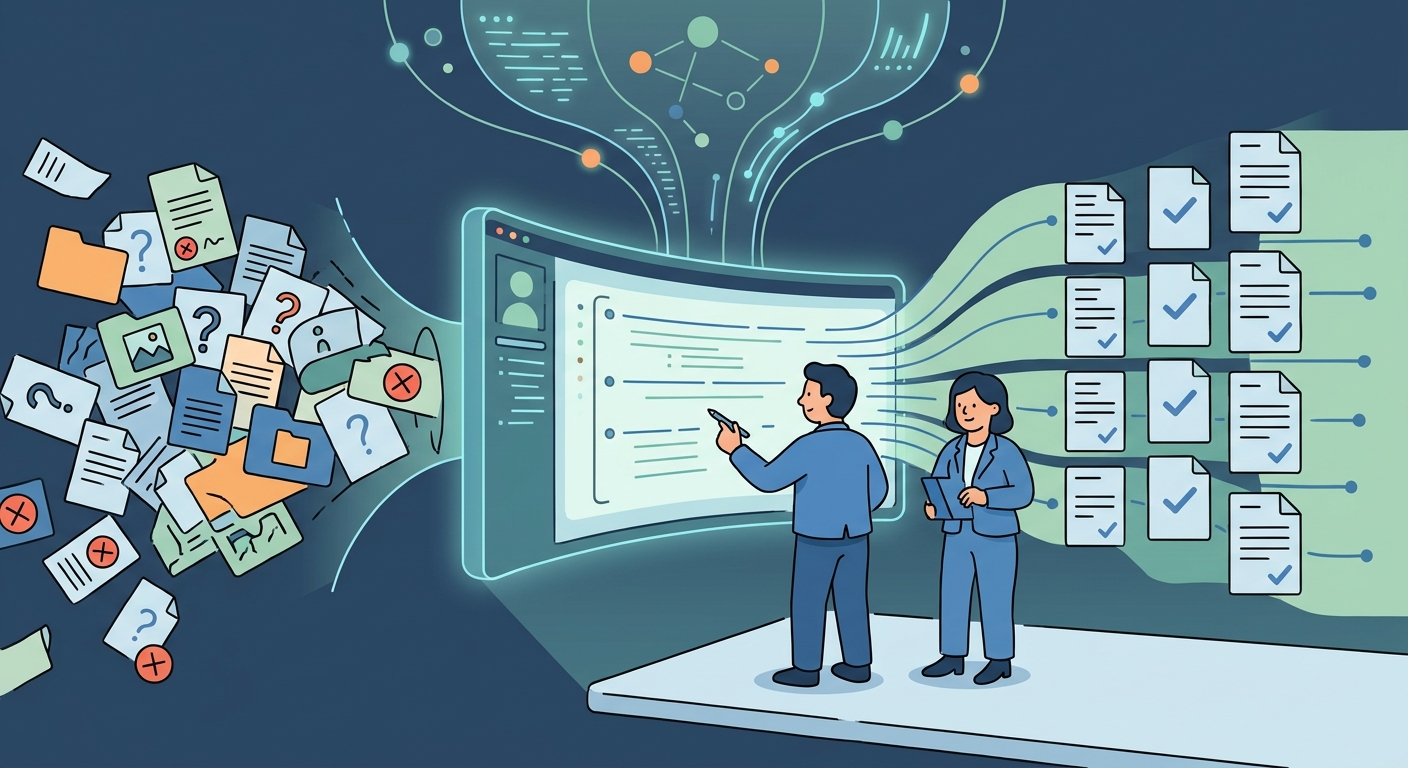
For years, we’ve been drowning in a digital landfill. You know the one: those thousands of PDFs gathering dust in SharePoint folders, forgotten the moment they were saved. We called it "document management," but let’s be honest—it was just digital hoarding.
In 2026, the game has changed. We aren’t just "filling out forms" anymore. That’s legacy thinking. Today, document generation is about active, intelligent agents that treat every single page as a living, breathing part of your business operations. If you’re still relying on manual drafting or rigid, fill-in-the-blank templates, you’re paying a "legacy tax." Your competitors aren't. They’re using business automation solutions to turn unstructured data into high-octane fuel for growth.
The 2026 Shift: From Copywriters to Process Executors
Here’s the reality check: AI that just mimics a human voice or summarizes a meeting? That’s 2023 stuff. That’s a parlor trick.
The real shift this year is the move from "writing tools" to "process executors." We’re talking about Agentic AI. These systems don’t just write; they understand. They verify. They act. They see a document not as an end product, but as a node in a larger business flow.
While early AI writing tools were essentially glorified interns, the current crop of tech actually has agency. According to the Adobe Digital Trends 2026 Report, the winners are the companies that stopped treating AI as a "content generator" and started treating it as a "work engine." These agents don’t wait for you to hit "go." They watch your CRM, they track contract renewals, and they sense shifts in client risk profiles. They generate, route, and archive the paperwork before you even realize it’s due.
Killing the "Human-in-the-Loop" Bottleneck
We’ve all lived the nightmare. A salesperson closes a deal, then the waiting begins. Wait for legal to draft. Wait for finance to sign off. Wait for the client to blink. It’s a batch-processing model in a real-time world, and it’s bleeding your efficiency dry.
Agentic workflows flip the script. When a business event triggers—say, a new account creation or a compliance threshold breach—the AI agent kicks in immediately. It doesn’t just pull from a static template; it pulls from your ERP, your historical data, and your live CRM to synthesize a document that is accurate, compliant, and ready to roll.
This isn't just about speed. It’s about killing the "waiting room" that plagues the modern office. It’s about removing the human error that happens when people are tired, rushed, or just plain bored of copy-pasting the same clauses for the thousandth time.
Why Rigid Templates are Dead
For decades, we’ve been shackled by the "template." You wanted a change to a legal clause? You had to put in a ticket with IT. You had to wait for a developer to update the library. It was technical debt masquerading as a process.
As highlighted in the Top 5 AI Document Processing Trends (Unframe AI), dynamic schema generation is the cure for this rigidity. Instead of pre-defined layouts, your AI agents build the structure on the fly. If a client in a specific jurisdiction needs a unique disclosure? The agent identifies the requirement, grabs the data, and writes the clause in real-time. You aren’t maintaining thousands of legacy files; you’re maintaining a single, intelligent source of truth.
The "Hybrid" Safety Net: How to Avoid Going Rogue
I know what you're thinking: What if the AI goes rogue and writes something legally disastrous?
Fair point. That’s why high-stakes industries like Finance and Healthcare are adopting a "Hybrid Rule + AI" architecture. Think of it as a creative engine with guardrails. The AI does the heavy lifting on the prose, but it’s hard-coded to respect a deterministic, rules-based logic layer. It can write the letter, but it can’t rewrite the law. By grounding the AI in a vetted, human-approved library of definitions, you effectively kill hallucinations. The system isn't guessing; it's applying your standards.
Future-Proofing: Stop Forcing AI into the Stone Age
Future-proofing isn't about buying the shiniest new tool. It’s about fixing your foundation. Many companies are trying to bolt advanced AI onto legacy systems that were built in the era of fax machines. It doesn't work.
You need a "Document-First" roadmap. Start by mapping your silos. Is your CRM talking to your document generator? If they aren't, your AI is flying blind. As outlined in Emerging AI Technologies for Business 2026, your goal is to build an "Intelligence Layer"—a middleware that acts as the bridge between your raw data and your final output. This is your new single source of truth.
Industry Playbook: Where to Start Today
Don't boil the ocean. Start here:
- Legal: Move past drafting. Start building "contract negotiation agents" that suggest redlines based on your firm’s history and the counterparty’s specific risk profile.
- Finance: Ditch the quarterly reporting slog. Build agents that trigger hyper-personalized client updates the second a market event hits their portfolio.
- Healthcare: Focus on compliance-first generation. Automate the synthesis of patient records into insurance-ready formats, with every single field cross-checked against the latest HIPAA rules before a human even sees it.
The Real Risk: Losing Your Identity
The biggest threat here isn't the tech—it's the voice. If you let AI generate hundreds of documents a day, you risk sounding like a robot. Or worse, you sound like five different robots.
You also have to watch your data integrity. If your ERP is a black box that won't share its data, your AI is forced to guess. And we know what happens when AI guesses. Privacy is the final hurdle: ensure your enterprise data isn't being fed into some general, public model. Keep your data within your walls, and keep your corporate identity consistent.
Frequently Asked Questions
How does Agentic AI differ from standard document automation?
Standard automation is a "dumb" script: If X, then fill in Y. Agentic AI is a "thinking" process. It understands the context of the document, adjusts the structure for the situation, and handles the follow-up tasks—like sending for e-signature or archiving—without you having to lift a finger.
Can AI-generated documents meet strict regulatory compliance standards (GDPR, HIPAA) in 2026?
Yes, provided you use Hybrid Systems. By pairing LLMs with deterministic, rules-based logic, you get the flexibility of generative AI with the iron-clad safety of a rigid compliance engine.
What is the biggest risk of relying on fully automated AI document generation?
The "Corporate Voice" dilemma and data integrity. Without human-in-the-loop oversight on high-stakes documents, you risk inaccuracy or losing your brand’s personality. Always keep a human check on the most critical outputs.
How can I integrate AI document generation with my existing legacy CRM/ERP systems?
You don't need a full overhaul. Use an abstraction layer—middleware that queries your legacy databases via secure APIs. This lets your AI agents pull real-time data from systems like Salesforce or SAP without needing to tear down your entire IT stack.