Why Industry-Specific AI Solutions Are the Next Big Shift in Content Marketing
industry-specific AIVertical AIAI content marketing trendsB2B content strategycontent marketing authority
 Ankit AgarwalMarketing Head
Updated 7 min readHow we fact-check
On this page
- The Death of the "General AI" Honeymoon
- Defining Vertical AI: The Shift to Domain Expertise
- The Core Problem: Why General-Purpose AI Fails at "Deep" Content
- How Agentic Workflows Are Changing the Content Lifecycle
- The Compliance Advantage: Security and Privacy in 2026
- The "Build vs. Buy" Debate: Should You Fine-Tune Your Own Model?
- Success Metrics: Moving Beyond Output Volume to ROI
- How to Audit Your Current AI Stack for "Vertical Readiness"
- The Future Outlook: Consolidation and Specialization
- Frequently Asked Questions
- Related reading
The era of the "all-knowing" general-purpose AI is dead. If you’re still relying on generic LLMs to churn out bland, middle-of-the-road marketing copy, you aren’t just falling behind—you’re actively diluting your brand’s authority.
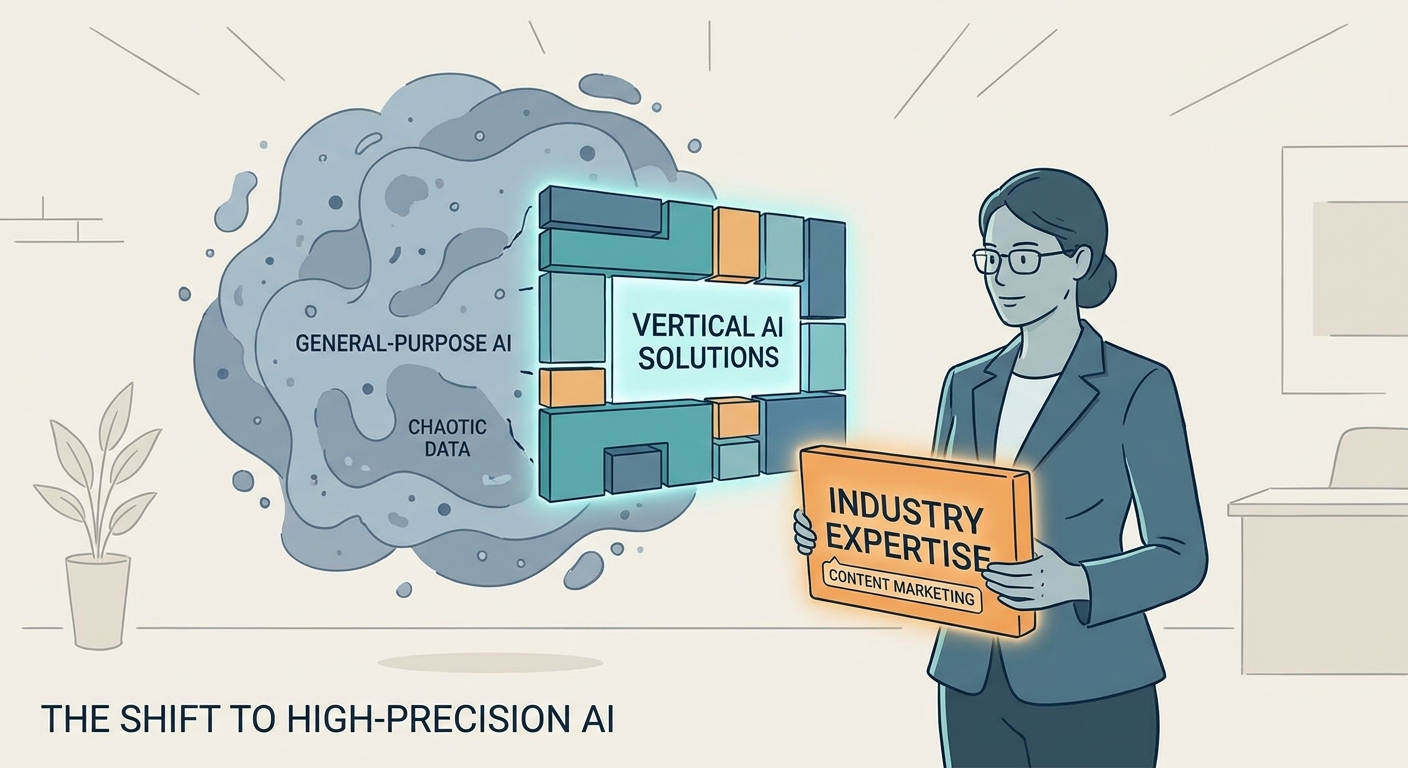
By 2026, the game has changed. The competitive edge in content marketing isn't about novelty anymore; it's about precision. We’ve entered the age of "Vertical AI." These are specialized engines trained on industry-specific datasets, strict regulatory frameworks, and the kind of niche terminology that makes a human expert nod in approval. They are rapidly replacing the jack-of-all-trades tools that dominated the last few years.
The Death of the "General AI" Honeymoon
For a brief, shiny moment, having an AI that could write a coherent sentence felt like a miracle. But as McKinsey’s State of AI Report 2026 points out, the novelty has worn off. Now, we face a ruthless demand for ROI and functional accuracy.
General-purpose models suffer from the "average" trap. Because they’re trained on the entire internet, they default to the median of human expression. In a professional context, that’s a disaster. You end up with content that is technically correct but strategically hollow—the kind of fluff that fails to influence high-value B2B buyers or navigate the complexities of, say, fintech compliance.
When you use a generic model to write a white paper on healthcare innovation, you aren’t getting an expert. You’re getting a high-functioning parrot. This leads to brand voice dilution—where every piece of content sounds like it was written by the same tired robot—and, more dangerously, a high risk of hallucinations. For firms where accuracy is a legal requirement, "good enough" is a liability you can't afford.
Defining Vertical AI: The Shift to Domain Expertise
Vertical AI isn't just a fancy wrapper on a standard model. It’s a fundamental architecture shift. As explored in this HBR analysis on Vertical vs. Horizontal AI, the core difference comes down to training data and guardrails. A horizontal model tries to know a little bit about everything. A vertical model is purpose-built to know everything about your specific corner of the world.
Think of it this way: a general practitioner is great for a cold, but you wouldn't ask them to perform open-heart surgery. If you're building a strategy for a legal firm, you need an AI that understands case law, regional statutes, and the specific tone required to maintain professional credibility. A vertical tool is fine-tuned on verified data. It doesn't just "guess" what the next word should be based on internet chatter; it generates content based on the established facts of your field.
The Core Problem: Why General-Purpose AI Fails at "Deep" Content
General-purpose AI struggles with "Deep Content" because it lacks a grounding in reality. It treats a complex medical diagnosis with the same linguistic weight as a recipe for sourdough bread.

In finance, legal, or healthcare, this failure is catastrophic. A hallucination in a marketing blog post might seem minor, but it erodes the trust that took years to cultivate. Vertical AI mitigates this by applying industry-specific guardrails. It doesn't just write; it verifies.
How Agentic Workflows Are Changing the Content Lifecycle
We are moving past the age of "prompt engineering"—the tedious, soul-crushing practice of wrestling with a generic model to get a specific output. The new standard? The "Agentic Workflow."
Instead of a human spending hours typing prompts, specialized agents now function as autonomous contributors to the marketing team. These agents handle the heavy lifting: deep-web research, cross-referencing industry reports, optimizing for SEO, and distributing content across specific platforms. If you are looking to scale your operations, these 10 best AI content marketing tools for 2026 represent the shift toward systems that don't just generate, but execute.
The Compliance Advantage: Security and Privacy in 2026
In 2026, data privacy isn't a "nice-to-have." It’s a boardroom imperative. Generic AI tools often use your input to train their next iteration, which is a non-starter for companies dealing with proprietary data or sensitive client info.
Vertical AI solutions solve this by offering siloed, private environments. By aligning with frameworks like the NIST Privacy Framework, these tools ensure that your industry-specific data stays within your control. They are built for enterprise-grade security, ensuring your strategy doesn't inadvertently leak trade secrets into a public model's training set.
The "Build vs. Buy" Debate: Should You Fine-Tune Your Own Model?
Many companies fall into the trap of thinking they need to build their own proprietary model from scratch. Don't. It’s almost always a mistake. The hidden costs of model drift, data cleaning, and ongoing infrastructure maintenance are a nightmare.
The smartest play is to adopt industry-ready SaaS platforms that offer the best of both worlds. Tools like these AI writing assistant platforms act as a bridge. They provide the customization of a proprietary tool—allowing you to inject your own brand guidelines and internal data—while relying on the robust, tested infrastructure of an established provider. You get the specialized intelligence without the engineering headache.
Success Metrics: Moving Beyond Output Volume to ROI
The era of measuring content success by "number of posts published" is dead. In the current landscape, the only metric that matters is how your content moves the needle on revenue. Vertical AI integrates directly into your CRM, allowing you to track exactly how a piece of industry-specific content influences a lead’s journey through the pipeline.

By connecting your AI engine to your conversion data, you stop guessing what works and start knowing. You can see which specific industry insights resonate with your high-value accounts, allowing the AI to iterate on what actually drives sales.
How to Audit Your Current AI Stack for "Vertical Readiness"
If you’re still using the same tools you were using in 2024, you’re operating at a disadvantage. Run your current stack through this audit:
- Jargon Fluency: Does the tool intuitively understand your niche, or do you have to explain basic concepts in every prompt?
- Security Layer: Is your data siloed, or is it being used to train the provider’s public model?
- Integration: Does it feed back into your CMS and CRM, or is it an isolated "content island"?
- Multimodality: Can it generate compliant imagery and data-rich infographics, or just text?
- Validation: Does the tool provide citations or links to industry-specific data sources?
The Future Outlook: Consolidation and Specialization
The market is heading toward a massive consolidation. We expect to see the decline of general-purpose "one-size-fits-all" SaaS platforms. The winners of 2027 will be those that provide hyper-personalized, domain-expert AI that functions as a seamless extension of the human team. The future of content isn't more content—it's more relevant content, scaled with a level of precision that was impossible just a few years ago.
Frequently Asked Questions
Why should I pay for an industry-specific AI tool when I already have a subscription to a general LLM?
General LLMs are jack-of-all-trades tools that lack the domain-specific training, compliance guardrails, and industry-niche vocabulary required for professional-grade content. Industry-specific tools provide higher accuracy, lower hallucination rates, and a deeper understanding of your brand’s unique market position.
Will industry-specific AI replace my content marketing team?
No. It will replace the "manual labor" aspects of the job—research, initial drafting, and formatting. This allows your team to shift from being "content writers" to "content strategists," focusing on high-level direction, editorial judgment, and audience engagement.
How do I ensure my industry-specific AI tool complies with data privacy regulations?
Look for enterprise-grade platforms that offer private, siloed data environments. Ensure the provider follows established standards like the NIST Privacy Framework and can demonstrate that your proprietary data is not being used to train the base model for other users.
What is the biggest difference between "Horizontal" and "Vertical" AI in practice?
Horizontal AI is built for breadth, covering the entire internet to provide a generalized response. Vertical AI is built for depth, trained on industry-specific datasets and governed by domain-specific rules, making it significantly more reliable and relevant for business applications.
How can I integrate specialized AI tools without disrupting my existing workflow?
Start by integrating the AI into your existing CRM or CMS. Most modern vertical AI tools are designed as API-first platforms, meaning they can plug into your current tech stack, allowing you to maintain your established publishing cadence while upgrading the intelligence behind it.
Related reading
- Industry Pioneers: How Sector-Specific AI Applications Are Driving Competitive Advantage
- The Future of Document Generation: How AI is Transforming Industry-Specific Solutions
- Can AI Content Generation Tools Really Replace Marketing Teams? Industry Insights for 2026
- The 2026 Landscape: How Artificial Intelligence is Changing Content Marketing Forever
Related Articles
 cybersecurity content marketingHow to Create Cybersecurity Content That Educates and Converts B2B BuyersStruggling to turn cybersecurity leads into buyers? Discover how to create authoritative content that builds trust and drives conversions in the B2B space.Deepak Gupta4 min read
 content marketingThe 2026 Landscape: How Artificial Intelligence is Changing Content Marketing ForeverStop using AI for shortcuts. Learn why the 2026 content landscape demands a shift from volume to human-verified expertise to survive the era of AI saturation.Ankit Agarwal8 min read
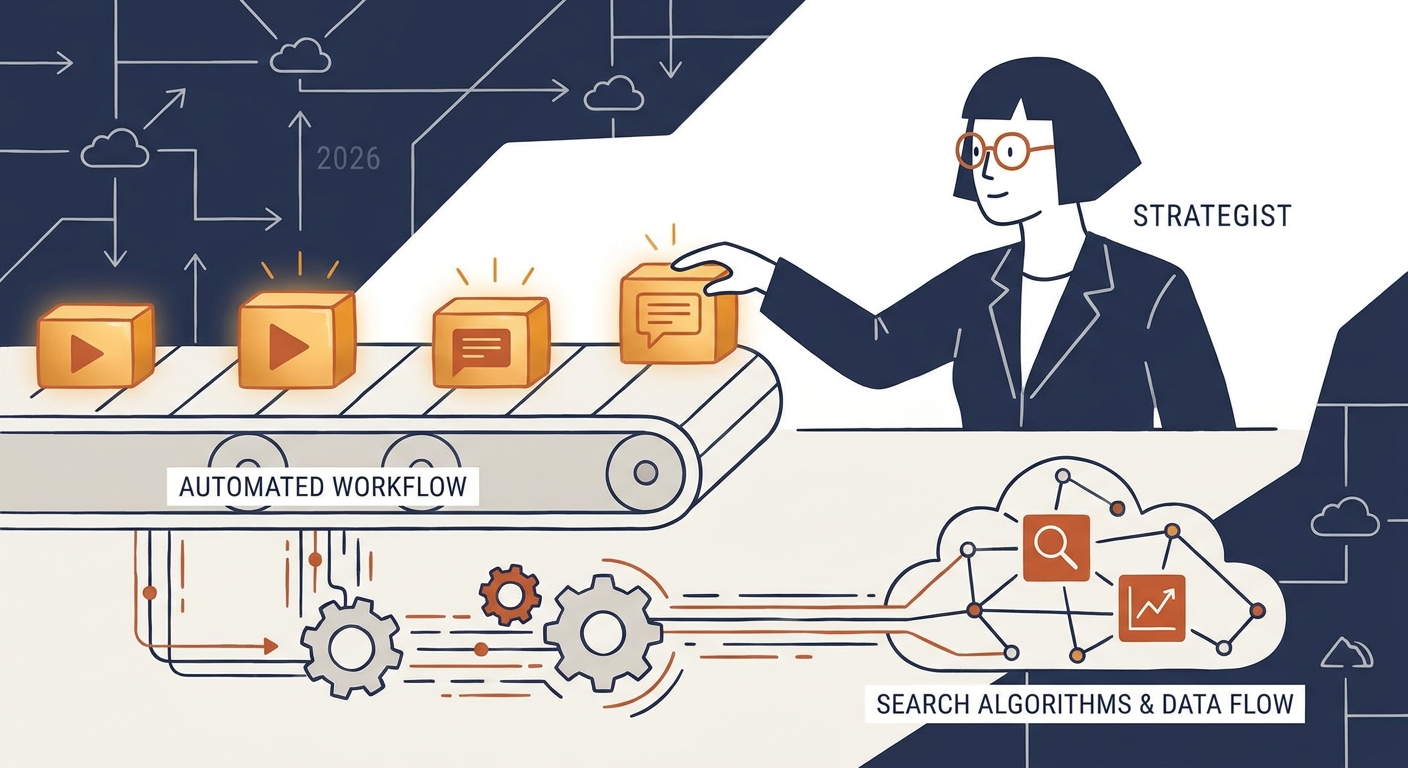 scaling content creationWhy Automation is the Secret to Scaling Content Creation in 2026Stop manual content churn. Learn how to use content automation to scale production, build modular assets, and maintain human-centric authority in 2026.Ankit Agarwal8 min read
 AI-powered SEO agentsHow AI-Powered SEO Agents Are Changing Content MarketingDiscover how ai-powered seo agents and automation are transforming content marketing, from predictive analytics to hyper-personalization and document generation.Hitesh Kumar Suthar17 min read