
The 2026 Landscape: How Artificial Intelligence is Changing Content Marketing Forever

TL;DR
- ✓ AI content volume is no longer a viable competitive strategy for modern brands.
- ✓ Readers now reject generic AI prose due to high levels of synthetic saturation.
- ✓ Successful brands must transition to a human-in-the-loop content production infrastructure.
- ✓ Subject matter expertise is now the primary driver of brand equity and growth.
- ✓ AI should function as an operational layer rather than a primary content creator.
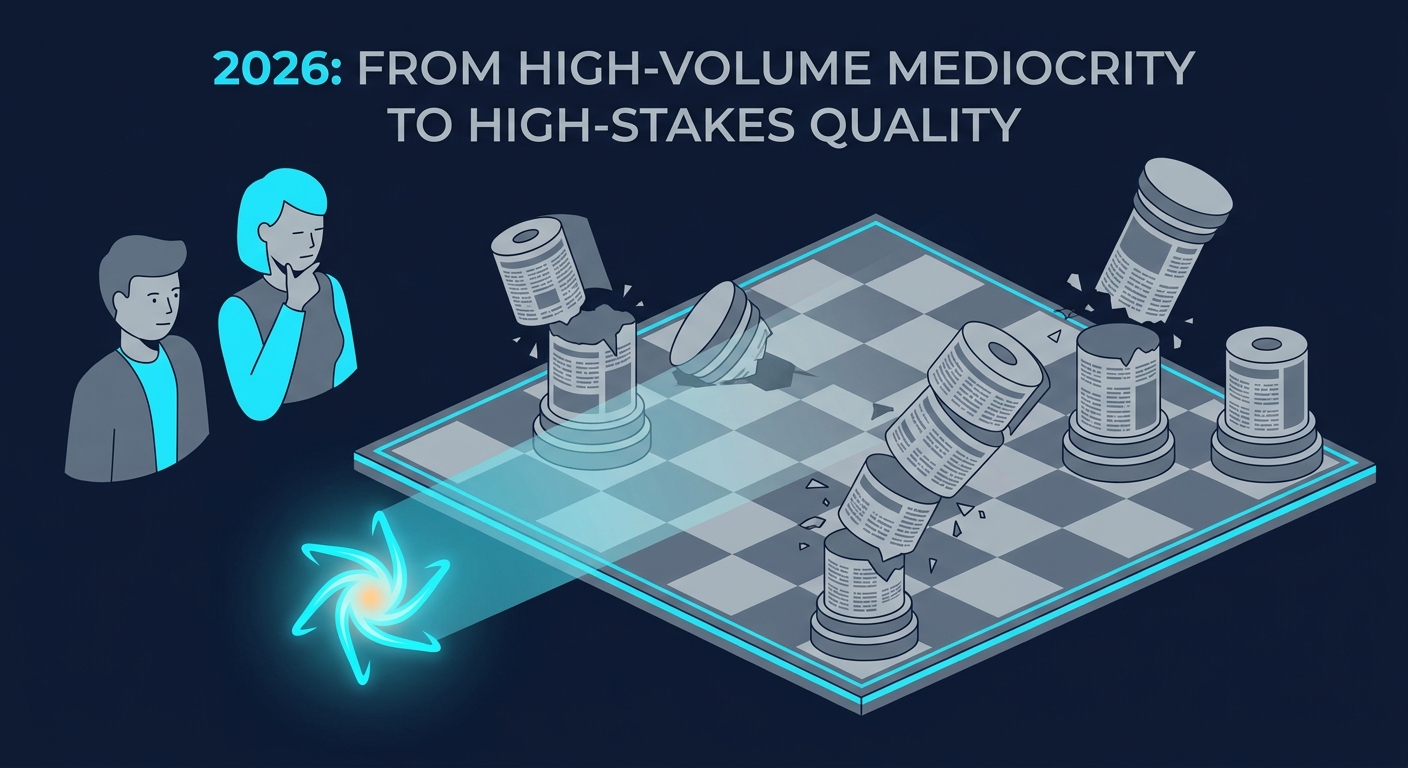
By 2026, the era of "AI-assisted content" has officially expired. We’ve moved past the novelty phase. We are now in a brutal, high-stakes reality where artificial intelligence is merely the baseline infrastructure for survival.
If you are still treating generative AI as a shortcut to crank out volume, you aren't just behind the curve—you are actively accelerating your brand’s irrelevance. The winners in this new landscape aren't the ones producing the most words. They are the ones who have successfully transitioned from content publishers to architects of high-fidelity, machine-readable, and human-verified expertise.
Why Is the "More Content" Strategy Officially Dead?
For years, the industry operated under a delusion: content marketing was a game of SEO volume. The math was simple—if you could churn out enough articles, you would eventually capture the lion’s share of search traffic.
That strategy is a relic. The Content Marketing Institute and MarketingProfs' B2B Content and Marketing Trends: Insights for 2026 reports that "65% say creative capabilities have improved" and "58% say content quality has improved" with AI, while 12% say quality decreased (CMI, published 8 October 2025, retrieved 2026-09-02). SOURCED CMI's own framing of the problem is sharper than a trust collapse: AI helps marketers type faster, not think better. ANALYSIS — an earlier version of this article cited CMI for a "total collapse in audience trust"; the report contains no finding on audience trust, its quality findings run mildly positive, and the link pointed at CMI's homepage rather than at any research a reader could check.
We have reached the peak of the "AI Ick" factor. You know the feeling. A reader lands on a page, scans two paragraphs, and immediately detects that hollow, robotic, overly polite tone of a standard LLM output. It’s flavorless. It’s beige. When content lacks teeth, specific examples, and a discernible pulse, the reader closes the tab.
The "more content" approach isn't just ineffective; it is actively damaging your brand’s equity. In a world where AI can summarize the internet in seconds, producing another ten-thousand-word guide on "The Basics of X" is a waste of digital real estate. It’s noise. And in 2026, noise is the enemy of growth.
What Does Your New Content Infrastructure Look Like?
The transition from "AI as a writer" to "AI as an operational layer" is the defining shift of this year. Stop asking ChatGPT to write your blog posts. That’s for amateurs. Instead, build a pipeline where AI handles the grunt work—data synthesis, source organization, and modular formatting—leaving the actual "thinking" to your subject matter experts.
If your process involves a human staring at a blank screen and typing, you are working too hard. If your process involves dumping a prompt into a bot and hitting "publish" without a heavy human edit, you are failing.
The new infrastructure requires a "human-in-the-loop" model. AI handles the heavy lifting of ingestion and structure, and your team provides the final, non-negotiable layer of judgment. For brands looking to scale your production without sacrificing the human element, the workflow now prioritizes modularity over monolithic drafting.
Why Is "Human Judgment" the New Competitive Moat?
There is a "Judgment Gap." It’s the space between a machine’s ability to aggregate data and a human’s ability to interpret it.
Anyone can ask an LLM to "summarize the pros and cons of cloud migration." You’ll get a perfectly average, middle-of-the-road answer. Is it accurate? Sure. Is it useful for a business leader trying to make a high-stakes decision? Absolutely not. It’s a safe, vanilla summary.
To build trust in the AI era, as discussed by experts at MarketingProfs, you must move beyond information and into interpretation. This means taking a side. It means stating, "While the industry suggests X, we believe Y is the superior route because of Z."
AI models are trained to avoid controversy. They are programmed to be neutral. By leaning into professional bias, controversial stances, and specific trade-offs, you create content that is impossible for a generic model to replicate. Your moat isn't your information; it’s your perspective.
How Do You Engineer Content for "Machine Customers"?
We are no longer just writing for people. We are writing for the AI agents that represent our buyers. If a potential customer asks Perplexity or a future iteration of search to "find a vendor that solves X," your content needs to be discoverable by that agent.
This requires a shift from traditional SEO to AI Search Optimization (ASO).
This isn't about keyword stuffing. It is about mastering AI search optimization by creating a "Machine-Readable Architecture." AI agents thrive on structured data. They want H2s that clearly state a problem, H3s that provide the solution, and bulleted summaries that act as the "answer" to a query. If you use modern content generation solutions to structure your data into modular blocks, you make it significantly easier for an AI engine to cite your brand as the primary source of truth.
The "Decision-First" Framework: Turning Data Into Action
Generic stats are cheap. Everyone has access to the same public datasets. When you write, "80% of companies report increased efficiency," you are just contributing to the noise.
A sentence of the shape "we analysed our own deployment data and found X" is proprietary insight — provided you have actually done the analysis and can show the method. ANALYSIS — an earlier version of this article used a fully specified fake example with invented percentages, written in the first person on our own blog. That is exactly the text an answer engine lifts and repeats as a LogicBalls finding, so the numbers have been removed. That is the difference between a bot and a business partner.
The Decision-First framework mandates that every piece of content must solve a specific business problem. It should take raw data, filter it through your brand’s unique experience, and result in an actionable recommendation. If your content doesn’t help the reader make a decision, it shouldn't exist.
How Will Distribution Evolve in an Agent-First World?
The "website-only" mindset is dying. In the near future, your buyers will spend less time browsing blogs and more time interacting with personal AI assistants. These assistants will consolidate information from across the web to provide a single, curated response.
Your distribution strategy must shift from "driving clicks to the homepage" to "becoming the reference layer for AI." This means your content needs to be high-density, fact-rich, and structurally perfect. You want your brand’s voice, research, and data to be the foundational knowledge the AI uses to answer your prospect’s question. You are no longer just writing a post; you are feeding the intelligence that will eventually recommend—or disqualify—your product.
Frequently Asked Questions
If everyone is using AI for content, how can I still rank on search engines?
Ranking in 2026 relies on E-E-A-T (Experience, Expertise, Authoritativeness, Trustworthiness). Since AI can easily mimic expertise, your primary differentiator is "Experience." Use proprietary data, internal case studies, and personal anecdotes that cannot be scraped from public forums. If you are the only source of a specific insight, you are the only source the AI can cite.
What is the "AI Ick," and how do I know if my content has it?
The "AI Ick" is that uncanny-valley feeling a reader gets when content sounds like it was written by a committee of robots. You have it if your content is filled with empty adjectives ("game-changing," "seamless," "unleash"), lacks concrete examples, or fails to take a firm, opinionated stance on the topic at hand. If you can swap your brand name for a competitor’s and the article still makes sense, you have the "Ick."
Should I stop writing for humans and start writing for AI agents?
It is a false dichotomy. You must adopt a "Dual-Audience" strategy. Humans need emotional resonance, clear logic, and a strong POV to build trust. AI agents need modular structure, clear headings, and schema-ready data to understand and index your content. If you write for the machine, you lose the human; if you write for the human, you might confuse the machine. Master both by using a modular, structured writing approach that puts the "answer" at the top and the "depth" in the supporting blocks.
How can I make my brand's voice stand out when AI is flattening everything?
Inject trade-offs and professional bias. AI models are trained to be balanced and avoid controversy. By explicitly saying what your brand does not do, who your product is not for, and why you disagree with common industry practices, you create a voice that is distinctly human. Friction is the only thing that prevents your brand from being flattened into the generic middle.
Related reading
- Influence of Artificial Intelligence on Digital Marketing
- How AI-Powered SEO Agents Are Changing Content Marketing
- AI Trends to Watch in 2025
- Can AI Content Generation Tools Really Replace Marketing Teams? Industry Insights for 2026
How This Guide Was Sourced
Written and maintained by the LogicBalls editorial team (logicballs.com).
Source, retrieved 2026-09-02: Content Marketing Institute and MarketingProfs, B2B Content and Marketing Trends: Insights for 2026, published 8 October 2025.
Corrections. An earlier version attributed a "total collapse in audience trust" to CMI's research; the report contains no such finding, and its quality findings run mildly positive. Two further citations — to MarketingProfs and Search Engine Journal — pointed at those publishers' homepages rather than at any article, which meant a reader could not check them; they have been removed rather than left as decoration. And an illustrative example containing invented first-person statistics has had its numbers stripped, because a fake statistic written in our own voice is one scrape away from becoming a real-looking citation.
No LogicBalls telemetry is used in this guide.