How to Choose the Right AI Writing Assistance for Your Business Needs
AI writing assistantbusiness AI toolsAI content ecosystementerprise AI securityAI workflow integration

On this page
- The "Hidden Cost" of Choosing the Wrong AI Tool
- How Do You Audit Your Business Writing Needs?
- Does Your Current Workflow Support AI Integration?
- Evaluating Model Performance for Your Specific Use Cases
- The "Human-in-the-Loop" (HITL) Process
- How Do You Build a Scalable AI Governance Strategy?
- Making the Final Choice: A Summary Framework
- Frequently Asked Questions
- Related reading
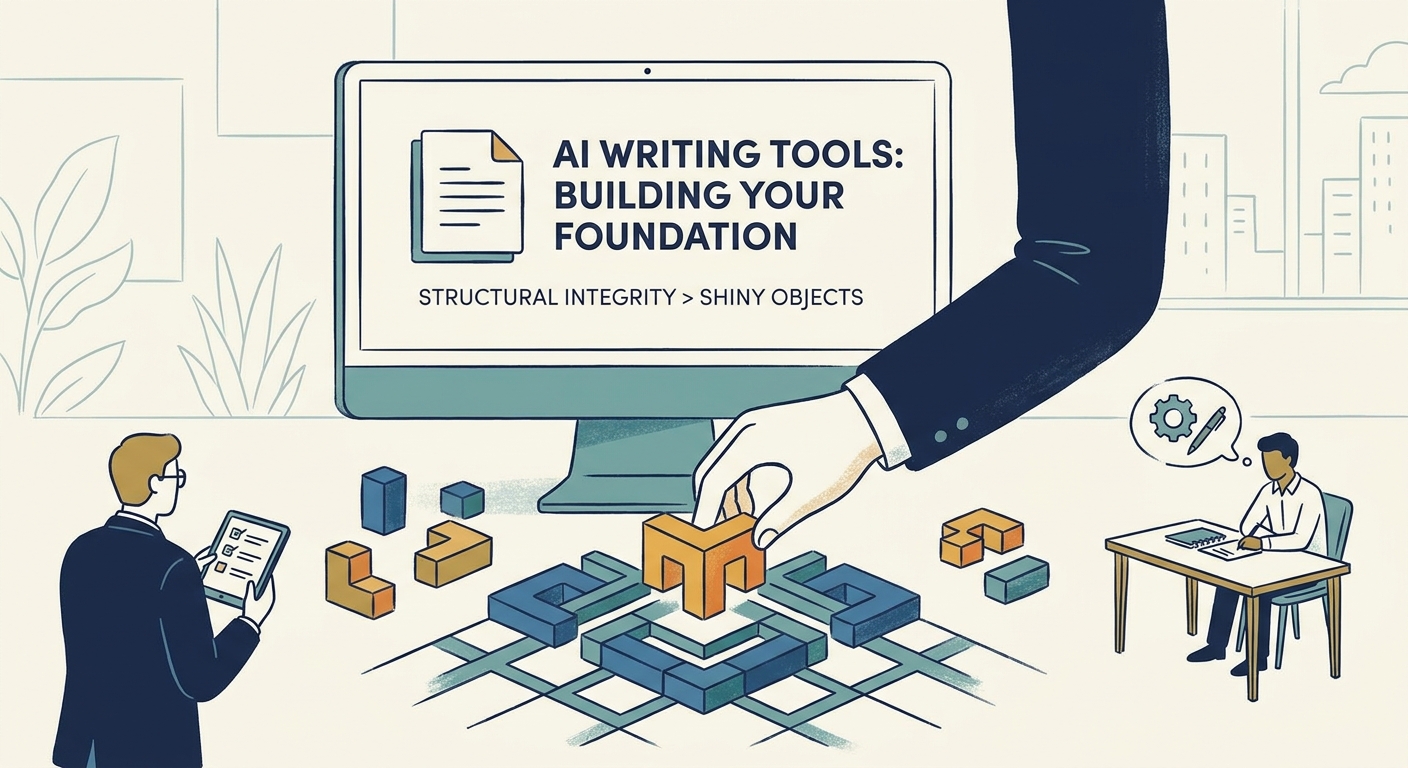
Choosing an AI writing tool for your company isn't about chasing the latest chatbot that everyone on LinkedIn is talking about. It’s about building a foundation. You’re looking for an infrastructure layer that treats your data with respect, captures your brand’s personality, and actually fits into the way your team works.
Too many businesses trip at the starting line because they’re seduced by "shiny object" features—like those viral social media generators—while ignoring the boring, mission-critical stuff like security, governance, and workflow integration. According to McKinsey’s analysis on the future of workplace productivity, the real magic of generative AI isn't in the novelty of its output; it’s in the raw efficiency it brings to the gears of your business.
If you want to win, stop shopping for a "writing assistant" and start building an AI-enabled content ecosystem.
The "Hidden Cost" of Choosing the Wrong AI Tool
The most expensive AI tool isn't the one with the highest monthly bill. It’s the one that breaks your team’s flow.
Think about it: if your staff has to jump between windows, copy-paste text, scrub data for privacy, and format outputs manually, you’re losing money. This "tab-switching tax" is a silent killer. When an AI tool lives in a silo outside your primary workspace, it creates friction. Friction leads to low adoption. And low adoption leads to a wasted investment—a glorified novelty that gathers digital dust.
Then, there’s the security chasm. Enterprise-grade compliance isn't a "nice-to-have" you can skip to save a few bucks. If your team is dumping proprietary strategy docs, client data, or unreleased product specs into a free-tier app, you are effectively training a public model on your own intellectual property.
And let’s talk about the "Generic Content" problem. If your AI isn't tuned to your specific voice, it produces output that sounds like... well, everyone else. When your brand voice becomes a hollow, robotic mimicry of your competitors, you aren't just wasting time—you’re diluting your market position.
How Do You Audit Your Business Writing Needs?
Before you demo a single piece of software, look under your own hood. Not all writing is created equal. Categorize your output based on two simple axes: risk and complexity.
A high-risk, high-complexity task—like drafting a whitepaper or a legal response—needs a tool with deep reasoning and a grounding in facts. On the flip side, a low-risk, high-volume task—like internal updates or basic social captions—can be handled by simple, template-driven automation.
To simplify this, use the following decision matrix to align your needs with the right tech:

By mapping these tasks, you avoid using a sledgehammer to crack a nut—or worse, a plastic spoon to dig a foundation. For those ready to standardize, consider how you can streamline your content workflow by spotting where the bottlenecks are hiding right now.
Does Your Current Workflow Support AI Integration?
The best AI implementation is the one you don't notice. It lives in the margins of your existing tools—your document editor, your project management dashboard, or your internal comms. If your people have to leave their primary workspace to generate content, you’ve already lost. Platform-native AI (think Microsoft Copilot or Notion AI) brings the intelligence to the data, rather than forcing you to move your data to the intelligence.
Don't overlook the "Prompt Library." Please, do not treat prompting as a secret skill that employees learn in isolation. Build a centralized repository of refined, high-quality, pre-tested prompts. When a team member nails the company tone for a quarterly report, that prompt becomes a shared asset. It ensures everyone produces output that hits the same high bar, regardless of their individual experience level.
Evaluating Model Performance for Your Specific Use Cases
One size rarely fits all. Some models are built for creative flair; others are workhorses for logic, coding, and structural precision. You can get a general sense of how models stack up by comparing LLM reasoning capabilities, but don't live and die by benchmark scores.
The only real test is "Real Work." Take five of your most punishing, past assignments—the ones that usually take a senior writer four hours—and feed them to the models you’re considering. Don't use "toy prompts" like "write a blog post about marketing." Use the messy, complex briefs your team actually uses.
Evaluate the results based on three things: accuracy, adherence to your style guide, and the editing effort required to reach a "publishable" state. If the tool requires more time to fix than it would have taken to write from scratch, it’s not an assistant. It’s a hurdle.
The "Human-in-the-Loop" (HITL) Process
AI is a world-class drafter, but it’s a mediocre author. The human-in-the-loop (HITL) process is your safety net. It’s what prevents hallucinated facts and off-brand nonsense from reaching your customers. In a mature enterprise, view AI as an intern. A smart, fast, capable intern—but one that always needs a senior editor to sign off on the work.
Governance is non-negotiable. Define who has the authority to publish, how facts are verified against internal sources, and who is responsible for the final polish. Following guidelines for responsible AI in business ensures your usage remains ethical and minimizes the risk of bias. Your goal is to amplify human expertise, not replace the judgment that built your brand’s reputation in the first place.
How Do You Build a Scalable AI Governance Strategy?
Governance is the barrier between a chaotic free-for-all and a strategic business asset. A scalable strategy rests on three pillars: data privacy, role-based access, and auditability. Ensure your vendor offers SOC2 compliance and, ideally, private instances where your data is never used to train the base model.
The following lifecycle ensures that every piece of content remains compliant and on-brand:

By tracking an asset from prompt to publication, you can troubleshoot process failures. If a team consistently produces off-brand work, look at the audit logs. Are they using outdated prompts? Are they skipping the HITL review? You can explore our AI tool suite overview to see how these governance features integrate into your day-to-day operations.
Making the Final Choice: A Summary Framework
When you reach the procurement stage, keep your focus on four non-negotiable metrics:
- Security: Does the vendor provide an enterprise-grade, private environment?
- Integration: Does the tool live where your work happens, or does it force a workflow pivot?
- Model Capability: Does the model handle your most complex tasks with high accuracy?
- Cost-per-Usable-Output: Are you paying for "time saved" or just "words generated"?
Stop chasing the trendiest tool. Start building the most resilient system. By treating AI as an integrated, governed, and human-led capability, you transform your writing workflow from a labor-intensive chore into a serious competitive advantage.
Frequently Asked Questions
How do I ensure my AI writing tool doesn't leak sensitive business data?
Look for enterprise-grade plans that explicitly state they do not train their models on your input data. Ensure the vendor is SOC2 Type II compliant and offers a private instance or a data-processing agreement (DPA) that guarantees your proprietary information remains within your control.
Is a free AI tool enough for my business, or should I pay for enterprise subscriptions?
Free tools are excellent for individual experimentation but lack the critical governance features your business needs. Enterprise subscriptions provide centralized user management, audit logs, team-wide prompt libraries, and, most importantly, the data privacy protections that prevent your company's intellectual property from being leaked into public model training sets.
How do I stop my AI-generated content from sounding like "everyone else"?
To avoid the "robotic" tone, you must move beyond generic prompts. Invest in fine-tuning or custom instructions that reflect your specific brand voice. Build a repository of "Golden Prompts"—high-quality, human-refined templates that bake in your brand's unique tone, vocabulary, and stylistic preferences. The more specific your context, the less generic the output.
What should I look for in an AI tool's "governance" features?
Focus on three things: granular user permissions, audit logs, and guardrails. You need to control who has access to which features, see a history of what was generated, and have the ability to set "negative constraints"—rules that prevent the AI from using certain words, making unsubstantiated claims, or drifting outside your brand’s established tone of voice.
Related reading
Related Articles
 AI content workflowFrom Prompts to Posts: Safe and Effective AI Content WorkflowsLearn how to plan secure and efficient AI content workflows. Boost productivity, protect data, and create quality content with smart AI tools.Deepak Gupta4 min read
 AI content creationAI-Powered Content Creation: LogicBalls' Guide to Supercharging Your Writing WorkflowDiscover how to use AI tools like LogicBalls to supercharge your content creation. Learn tips and strategies for brainstorming, writing, editing, and optimizing your content.Ankit Lohar9 min read
 best AI tools 202610 Best AI Tools for Content Creation in 2026: A Comprehensive ReviewDiscover the 10 best AI tools for content creation in 2026. Learn how to scale your marketing strategy with human-in-the-loop AI workflows for maximum impact.Ankit Agarwal7 min read
 AI content generation5 Ways to Use AI Content Generation to Save 20+ Hours a WeekStop wasting time on repetitive writing. Discover 5 practical ways to use AI content generation to streamline your workflow and save 20+ hours every single week.Ankit Agarwal6 min read