Why Automation is the Secret to Scaling Content Creation in 2026
scaling content creationcontent automationmarketing trends 2026modular content architectureAI content strategy
 Ankit AgarwalMarketing Head
Updated 8 min readHow we fact-check
On this page
- Why the "Volume-First" Era is Officially Dead
- How Automation Acts as an Engine for Modular Content
- The Modern 2026 "Content Tech Stack"
- Protecting Your Brand Voice at Scale
- Can Automation Actually Improve Your ROI?
- The Pitfalls: Don't Trip Over Your Own Feet
- Future-Proofing: What Should You Automate First?
- Conclusion: Embracing the "AI-Assisted" Future
- Frequently Asked Questions
- Related reading
- How This Guide Was Sourced
Forget the "luxury" narrative. Automation isn't a shiny new toy for the tech-obsessed; it’s the only way to keep your head above water in 2026. Search engines are getting ruthless. They’ve become expert at sniffing out the mid-tier, generic filler that used to pass for a content strategy.
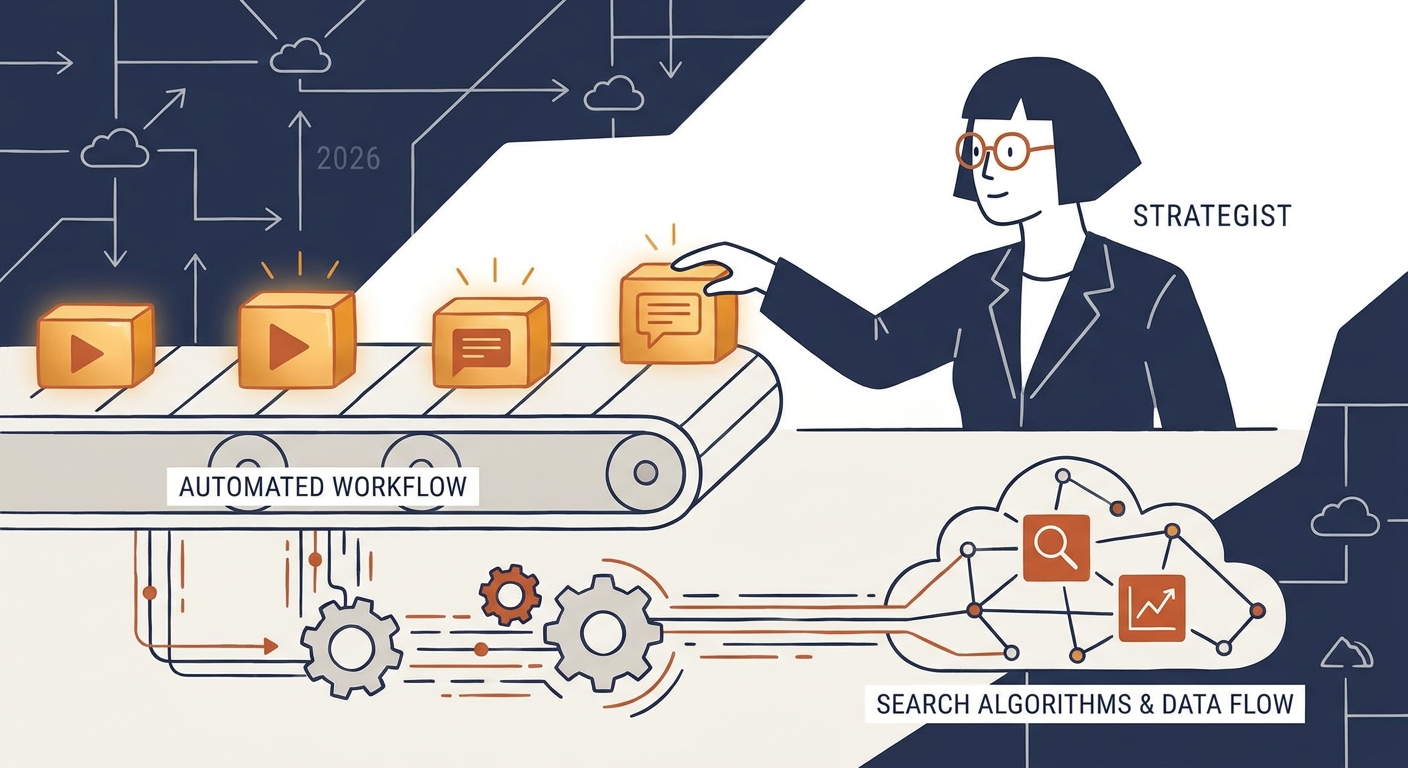
The mandate for marketing leaders has shifted overnight. It’s no longer about churning out a mountain of text; it’s about architecting high-value, human-centric narratives. Scaling in this era isn’t about swapping your creative staff for a cold, calculated algorithm. It’s about offloading the soul-crushing, mechanical burden of production to an engine. When you outsource the grunt work, your human experts finally get the breathing room to focus on the good stuff: strategy, nuance, and genuine connection.
Why the "Volume-First" Era is Officially Dead
We spent the early 2020s obsessed with output. If you could pump out ten articles a week, you were the king of the jungle. By 2026? That strategy is a liability.
The "saturation crisis" is real. Search engines now actively hunt down and penalize content that lacks a distinct point of view or original data. When every competitor can cough up a 1,000-word SEO article in six seconds, the value of the "article" itself has plummeted toward zero. It’s noise. And the audience is tired of it.
Success today is about predictive SEO and real-time response. It’s about knowing what your audience needs before they even type the query. ANALYSIS — an earlier version of this article introduced this argument with "as highlighted in" and linked a marketing agency's own promotional post, which does not contain the statement and is not research. The argument stands on its own merits; the false attribution has been removed. If your content doesn't offer a perspective that a machine couldn't have scraped from the top three Google results, you’re invisible.
How Automation Acts as an Engine for Modular Content
The best teams have killed the "static article" mindset. They operate on a "Modular Content Architecture." Think of it like building a house: stop trying to carve every brick from scratch. Use pre-fabricated, high-quality components.
You aren't just writing a white paper anymore. You are creating a core asset—the "mother ship"—that an automated pipeline then decomposes into a LinkedIn carousel, a three-part email nurture sequence, a series of short-form video scripts, and a set of infographics.
This "Content Factory" model ensures your brand’s expertise is amplified across every channel without forcing a dozen writers to manually rehash the same points.

By leveraging this workflow, you maintain consistency while scaling production. ANALYSIS — a specific multiplier previously stated here had no source and has been removed. The AI handles the heavy lifting of formatting and cross-platform adaptation. The human team acts as the architect, ensuring the "Raw Idea" is actually worth the effort in the first place.
The Modern 2026 "Content Tech Stack"
If your tech stack is just a CMS and a word processor, you’re already in the rearview mirror. The modern 2026 engine is a tightly integrated ecosystem. You need a central hub—usually an enterprise CMS—connected via middleware like Zapier or Make to your AI writing assistants and performance analytics.
This isn't about cobbling together a Frankenstein’s monster of tools. It’s about creating a seamless flow of data. When a piece of content performs well, the analytics should automatically trigger a workflow to create follow-up assets. For those looking to upgrade their capabilities, exploring AI Writing Tools is the logical first step toward centralizing your creative output. Furthermore, if you’re struggling with the integration of these disparate systems, Managing AI Marketing Workflows provides the necessary roadmap for connecting your creative team to your automation layer.
Protecting Your Brand Voice at Scale
The biggest fear among content directors? That automation will turn their brand voice into a muddy, robotic soup. It’s a valid concern, but it’s a failure of implementation, not the technology itself.
In 2026, "Brand Guardrails" are the standard. Use NLP-based governance tools that scan every draft against your specific tone-of-voice data—your lexicon, your sentence structure, and your "do not use" list.
This is where the "Human-in-the-Loop" (HITL) checkpoint becomes non-negotiable. Automation should never be the final gatekeeper. Your writers and editors should spend 80% of their time on the "Anti-Generic" phase: injecting personal anecdotes, challenging assumptions, and ensuring the content resonates with the specific cultural context of your audience. The AI provides the skeleton; the human provides the soul.
Can Automation Actually Improve Your ROI?
The math is simple. If your senior content strategist is spending six hours writing a blog post, they’re being massively underutilized. Automating drafting, tagging and formatting can cut that substantially. ANALYSIS — an earlier version of this article gave a specific before-and-after that amounted to an 8x reduction, presented as arithmetic. No benchmark supports it; measure it on your own workflow before planning against any figure.
When you scale this across an editorial calendar, the ROI is found in the "Time-Saved" vs. "Revenue-Generated" equation. Your team stops being a group of laborers and starts acting like a high-level content agency. For insights on how to shift your team toward high-value storytelling, Content Generation Solutions offers a look at how companies are successfully pivoting their human resources toward strategic growth rather than manual production.
The Pitfalls: Don't Trip Over Your Own Feet
Even with the best tools, it’s easy to mess up. The most common error is the "set-and-forget" mentality. Automation is a high-performance vehicle; it requires a pilot. If you ignore metadata, fail to audit for cultural nuance, or let AI-generated drafts go live without a human eye, you’ll eventually publish something that damages your brand equity.
Another danger is the failure to account for factual accuracy. AI is a fantastic synthesizer, but it is not a source of truth. Every automated workflow must include a verification step. Jasper's own guidance makes the same point from the vendor side: "always involve your team for final reviews to ensure content feels authentic, aligns with brand values, and resonates with your target audience" (Jasper, (retrieved 2026-09-02) SOURCED). ANALYSIS — an earlier version of this article cited a piece titled "The Future of Content Strategy" at that URL; no such title exists, and the page is a vendor best-practices post rather than research.
Future-Proofing: What Should You Automate First?
You can’t automate everything at once. Start by identifying where your team feels the most "friction." Usually, this is in the repetitive, low-creativity tasks that drain energy.
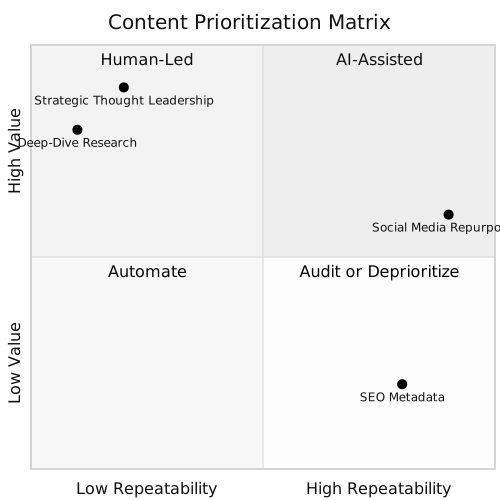
By prioritizing tasks like SEO metadata generation and social media repurposing, you clear the decks for your team to focus on the high-value, human-led thought leadership that drives real engagement.
Conclusion: Embracing the "AI-Assisted" Future
The shift toward an AI-assisted workflow isn't a choice—it’s an evolution. By moving away from volume-first tactics and toward a modular, HITL-focused architecture, you position your brand to lead in an increasingly crowded market. Automation is the secret, but only when it serves the master: a human strategy rooted in empathy and expertise. Review your current pipeline today. Identify one bottleneck. Automate it, refine it, and watch how your team’s output—and impact—transforms.
Frequently Asked Questions
Does using AI automation hurt my SEO rankings in 2026?
Not at all. Search engines are agnostic regarding the origin of content. They care about intent and value. If your automated process results in high-quality, verified, and helpful content that serves the user, your rankings will remain stable or improve. The penalty only applies to low-effort, low-value "filler" content.
How do I ensure my AI-generated content sounds like my brand?
You must train your AI models on your specific brand voice. This involves using custom fine-tuning, maintaining a living style guide that the AI can reference, and employing prompt engineering that enforces your specific tone, vocabulary, and formatting standards.
What is the biggest mistake companies make when scaling content?
The biggest mistake is prioritizing volume over value and omitting the human-in-the-loop checkpoint. Scaling is useless if the content being produced doesn't move the needle or provide genuine insight. Always prioritize the final human review.
Which parts of the content creation process should I automate first?
Start with the "low-hanging fruit": repetitive, data-heavy tasks. Content repurposing—turning a long-form article into social snippets or email newsletters—and SEO metadata generation are the ideal starting points for any automation pipeline.
How does "Modular Content" differ from traditional content creation?
Traditional content creation treats every piece as a standalone project. Modular content treats the "core asset" as the source of truth, breaking it down into atomic, reusable components that can be deployed across various formats and platforms, drastically increasing efficiency and consistency.
Related reading
- AI-Powered Content Generation: How to Maintain Quality at Scale
- AI Trends to Watch in 2025
- How AI Is Transforming Content Creation: Trends and Innovations
- AI for Content Creation: 6 Best AI Writing Tools in 2024
- How We Went Passwordless and Scaled LogicBalls from 4K to 250K MAU
How This Guide Was Sourced
Written and maintained by the LogicBalls editorial team (logicballs.com). Disclosure: LogicBalls builds AI writing tools.
Every figure retained above is linked to the source it came from and dated. Where a number could not be traced to a named source with a stated method, it has been removed rather than repeated — several were, including multipliers and case-study percentages for unnamed companies.
Two patterns worth knowing as a reader. Productivity and ROI figures in this field are usually averages across very different tasks, or vendor-commissioned surveys of small samples; treat them as directional, not as planning benchmarks. And a working link to a real research organisation does not mean the specific claim came from it — several citations here pointed at real publishers who had said something materially different.
No LogicBalls telemetry is used in this guide.
Related Articles
 content marketingThe 2026 Landscape: How Artificial Intelligence is Changing Content Marketing ForeverStop using AI for shortcuts. Learn why the 2026 content landscape demands a shift from volume to human-verified expertise to survive the era of AI saturation.Ankit Agarwal8 min read
 AI content creation softwareAre You Using the Right AI Content Creation Software? A 2026 ChecklistDrowning in AI subscriptions? Use our 2026 checklist to audit your content stack, eliminate workflow friction, and focus on high-impact AI integration.Ankit Agarwal8 min read
 automate content creationHow to Automate Content Creation: A Step-by-Step Guide for Marketing TeamsLearn how to automate content creation while maintaining brand authority. Build a high-velocity workflow that empowers your marketing team to focus on strategy.Ankit Agarwal6 min read
 AI content creationAI Content Creation vs. Manual Writing: Which Strategy Wins in 2026?Stop choosing between AI and manual writing. Discover why 2026 marketing success depends on a Human-Led AI strategy to master E-E-A-T and beat the volume trap.Ankit Agarwal7 min read