Are You Using the Right AI Content Creation Software? A 2026 Checklist

TL;DR
- ✓ Audit your current AI subscriptions to eliminate redundant and costly tool sprawl.
- ✓ Prioritize integrated AI workflows that connect directly with your CMS and CRM.
- ✓ Shift your focus from simple text generation to measurable content pipeline impact.
- ✓ Adopt a human in the loop approach to maintain brand tone and quality.
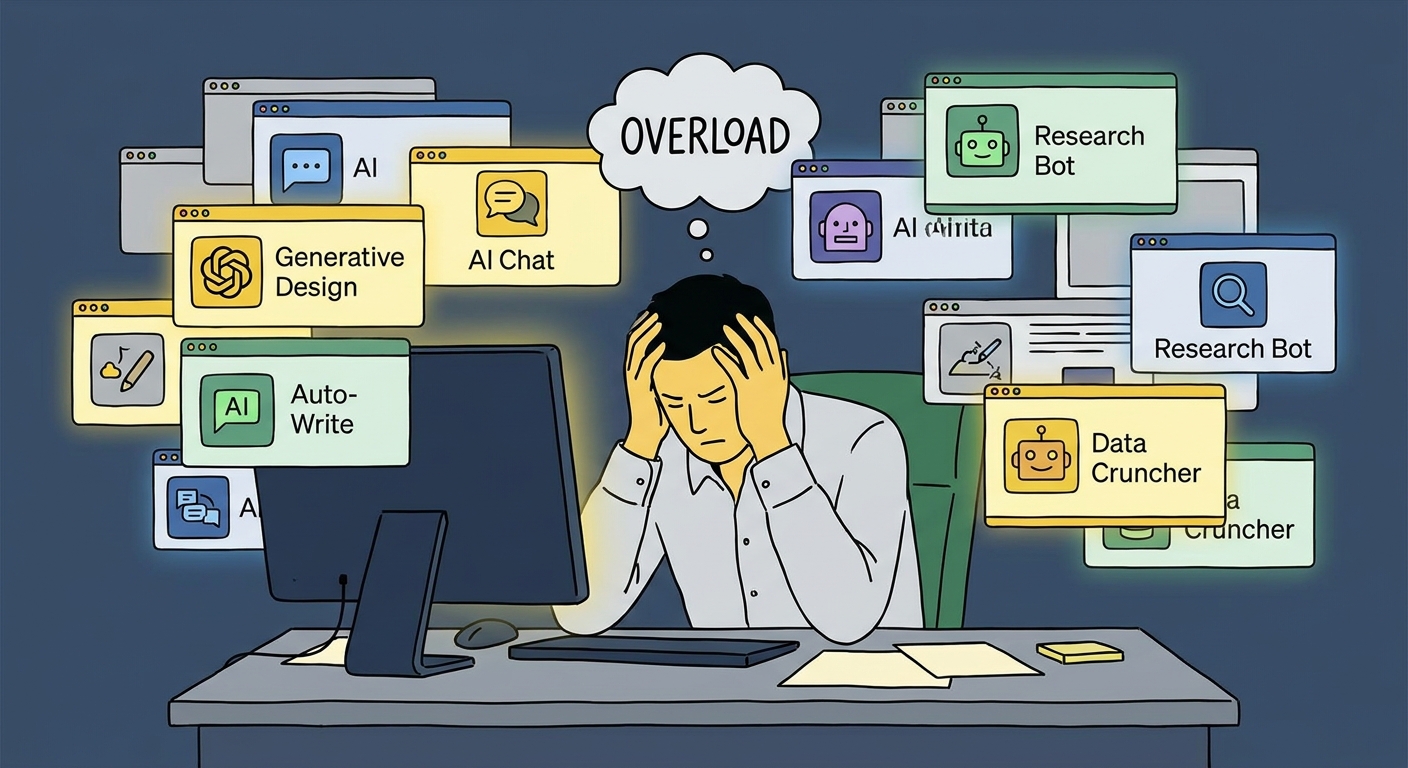
Let’s be honest about your 2026 AI stack: you’re likely drowning in subscriptions you barely use. You expected a productivity explosion, but instead, you got "wrapper fatigue"—that soul-crushing cycle of copy-pasting, re-formatting, and jumping between six different browser tabs just to get a single blog post out the door.
In a survey of 1,000 US small-business marketers and owners, "while 82% say they use AI for marketing, just 23% use it across all three pillars" — daily use is a smaller subgroup the report calls Power Users (ActiveCampaign / Talker Research, fielded May–June 2025, (retrieved 2026-09-02) SOURCED). ANALYSIS — an earlier version of this article opened by saying 82% use AI "every single day." The frequency was added to a general-adoption figure that never carried it. Yet, for many, the output isn't surging. It’s strangled by the friction of disjointed tools. The right AI software isn't the one with the most flashy buttons or the longest list of features. It’s the one that vanishes into your workflow. It should feel like an extension of your CMS, not an isolated island where text goes to be generated, formatted, and then manually fixed by a human who is losing their mind.
If your setup forces you to export, import, and re-polish brand tone every time you hit "publish," you aren't working with AI. You’re working for it.
The "Tool Sprawl" Audit: Are You Burning Cash?
Most marketing leads operate under a dangerous illusion: more subscriptions equal more power. We call this the "Subscription Sprawl" trap. You’ve got a tool for brainstorming, another for drafting, a third for grammar, and a fourth for SEO. You’re losing hours every week just navigating the gaps between these apps.
To fix this, start with a cold, hard tally. List every AI subscription hitting your corporate card. Categorize them. Where do they overlap? If you’re paying for three different tools that all do basic text generation, you’re paying for more than just the subscription fee. You’re paying for the cognitive load required to choose which one to open.
Moving from a fragmented mess to an integrated system is the only way your ROI stops being "experimental" and starts being "operational."
Defining Content ROI in 2026
We’re past the point of being impressed by a chatbot that can write a decent blog post. Everyone has that. Today, the only benchmark that matters is "pipeline impact." Does your tool actually move the needle, or is it just generating digital noise?
The "Human-in-the-Loop" standard is your most vital metric. The best software isn't a "set it and forget it" machine. It’s a co-pilot that makes human review faster, not harder. If your software hides the creative process or makes it impossible for an editor to step in, it’s a liability. Your AI should accelerate the journey from draft to final polish, not obscure the path.
The 2026 Evaluation Framework
Before you sign up for another annual plan, put every piece of software through this three-pillar test.
1. Quality and Consistency
Generic AI kills brands. You need tools that learn your specific lexicon. If the output sounds like a random server wrote it, it’s useless. Vendors now market brand consistency as a core capability — Jasper, for instance, describes storing "your brand voice, style guides, audience profiles, and product knowledge" and applying that context across a team (Jasper, (retrieved 2026-09-02) SOURCED). ANALYSIS — that is vendor marketing rather than evidence of an industry baseline, and an earlier version of this article named a "Brand Voice Engine" product that does not exist.
2. Workflow Integration
The future is native. We’re seeing a shift toward in-CMS editors that let you generate and optimize content without leaving your dashboard. Using a versatile AI Content Generator that plugs directly into your existing environment is the fastest way to kill the friction that chokes creativity.
3. Security and Data Privacy
If you’re an enterprise, you cannot afford to feed your proprietary data into public models. Your checklist must include explicit opt-outs for model training, SOC2 compliance, and clear data residency terms. If they can’t show you the security documentation, they don't belong in your stack. Period.
Categorizing Your Stack: The 2026 Checklist
Where Do You Start Your Ideation?
Most teams fail at the blinking cursor. They hope a chat window will save them. Don't do that. Use structured tools—like a dedicated Blog Post Ideas Generator—that force you to input your audience, pain points, and SEO keywords before the generation starts. This bridges the gap between a creative block and a functioning editorial calendar.
Which Writing Tools Actually Understand Your Brand?
There is a massive chasm between "chat wrappers" and specialized engines. A chat wrapper is just a thin, generic layer. A specialized engine is trained on your content library. If the tool doesn't ask for your style guide or your top-performing articles as reference, it’s a toy.
Is Your Visual Content Production Scalable?
Visuals are often the bottleneck. In 2026, the standard for professional, commercially safe imagery is set by platforms like Adobe Firefly. When selecting visual AI, ensure it provides indemnification and integrates with the design tools your team already uses. If you’re generating images that require manual cleanup to fix weird fingers or text, you aren't saving time; you’re just outsourcing the headache.
How Should You Handle Video Editing?
The era of frame-by-frame manual cutting is dying. The new standard is text-based editing, where you manipulate video by editing the transcript. Tools like Descript AI Video Editing have changed the economics of production entirely. If your video team is still spending hours on simple cuts, they’re using legacy workflows. Move on.
The "Agentic" Shift: Moving Beyond Text
We’ve entered the age of "Agentic AI." This is the shift from AI that writes to AI that acts.
An agent doesn't just draft an email; it triggers the sequence in your CRM, updates the deal status, and pings your sales team in Slack. It doesn't just write a blog post; it formats it, adds the meta-tags, and schedules the publication within your CMS. This is the holy grail of content ops. When your tools start talking to each other, the "wrapper" becomes irrelevant. You aren't managing tools anymore; you’re orchestrating a system.
Future-Proofing Your Workflow
The cost of AI compute is plummeting. The advantage isn't in the tech itself—it's in how you integrate it.
Avoid "shiny object syndrome." Every time a new "revolutionary" tool launches, pause. Ask yourself: Can it do what I’m already doing, but better and faster? If the answer is no, stay the course. The winners of the next few years will be the teams that built a resilient, integrated foundation, not the ones who chased every trend.
Frequently Asked Questions
How do I stop AI content from sounding generic?
Move beyond basic prompts. Train your AI on your specific brand voice, feed it your best-performing past content as a reference, and—this is non-negotiable—keep the "human-in-the-loop." Use AI to build the skeleton, but use human editors to inject the unique insights, anecdotes, and opinions that AI simply cannot fake.
Is it better to use one "all-in-one" AI tool or several specialized ones?
It’s a trade-off between convenience and depth. An "all-in-one" tool is great for speed and keeping your workflow under one roof. But if you have a niche requirement—like advanced technical video editing or complex data visualization—a specialized tool will always win. Aim for a "hub and spoke" model: one central platform for 80% of your work, and 1-2 specialized tools for high-impact, specific tasks.
What should I look for in an AI tool regarding data privacy?
Look for "Enterprise-grade" in the fine print. Does the provider let you opt-out of having your inputs used to train their global models? Are they SOC2 Type II compliant? Do they offer written guarantees that your content remains your intellectual property? If they can’t give you a security white paper, don't trust them with your data.
How can I tell if an AI tool will actually save me time?
Calculate your "Total Time to Value." This isn't just the time it takes to generate the output; it’s the time spent on prompt engineering, plus the time spent fixing the output, plus the time spent moving that output into your CMS. If the total time is higher than if you had just written it yourself, the tool is a net negative. The "right" tool is the one where the output is 80-90% ready to ship the moment it hits your CMS.
Related reading
- AI-Powered CMMC Level 1 Tools: Which Checklist Gets You Audit-Ready?
- How to Choose the Right AI Content Creation Software for Your Specific Niche
- 10 Best AI Tools for Content Creation in 2026: A Comprehensive Review
- AI Content Generation Software: How to Choose the Right Platform for Your Brand
How This Guide Was Sourced
Written and maintained by the LogicBalls editorial team (logicballs.com). Disclosure: LogicBalls builds AI writing tools.
Every figure retained above is linked to the source it came from and dated. Where a number could not be traced to a named source with a stated method, it has been removed rather than repeated — several were, including multipliers and case-study percentages for unnamed companies.
Two patterns worth knowing as a reader. Productivity and ROI figures in this field are usually averages across very different tasks, or vendor-commissioned surveys of small samples; treat them as directional, not as planning benchmarks. And a working link to a real research organisation does not mean the specific claim came from it — several citations here pointed at real publishers who had said something materially different.
No LogicBalls telemetry is used in this guide.