How to Automate Content Creation: A Step-by-Step Guide for Marketing Teams
automate content creationcontent marketing workflowmarketing team automationAI content strategyautonomous content agents
 Ankit AgarwalMarketing Head
Updated 6 min readHow we fact-check
On this page
- What Does a Modern Automated Content Workflow Look Like?
- How Do You Audit Your Current Content Operations?
- How to Build Your Autonomous Content Tech Stack?
- The "Blueprint" – How to Automate Your First Content Loop
- How Do You Maintain Brand Voice in an AI-First World?
- How Do You Manage Risks and Brand Dilution?
- How to Scale and Measure Success?
- Frequently Asked Questions
- Related reading
Stop thinking of automation as a shortcut to churn out mediocre blog posts. That’s a race to the bottom. Instead, think of it as building a high-velocity engine that frees your team to do the one thing AI can’t touch: strategic empathy.
When you move from manual, siloed work to autonomous content agents, you aren't just saving 10+ hours a week—you’re buying back the time needed for brand positioning and real human connection. According to HubSpot Marketing Statistics 2026, the winners aren't the ones spamming "copy-paste" prompts. They are the ones building "Human-in-the-Loop" (HITL) mandates into their infrastructure. Every asset, whether drafted by an agent or a person, needs that final polish of authority to survive in today’s crowded market.
What Does a Modern Automated Content Workflow Look Like?
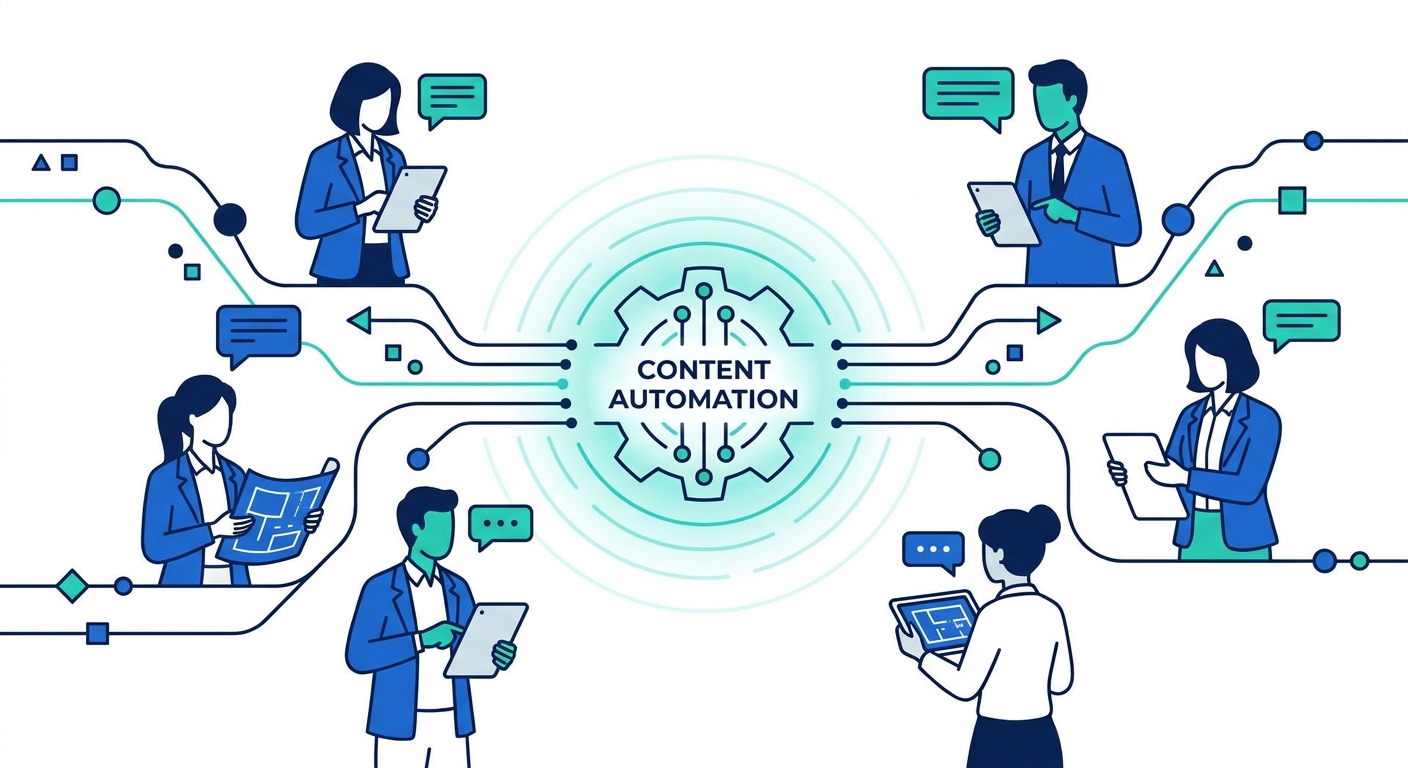
The days of treating SEO, CRM, and social media as separate islands are over. A mature strategy treats your entire marketing ecosystem as one synchronized organism. Think of it as four pillars: Ideation, Creation, Editing, and Distribution.
By connecting these via middleware, you ensure that a single kernel of data—a customer pain point or a trending industry topic—cascades into a dozen high-quality assets without you lifting a finger.

How Do You Audit Your Current Content Operations?
Before you buy a single tool, map your landscape. Most teams fail because they automate the wrong things. Start by splitting your tasks into two buckets: "Automation-Ready" and "Human-Core."
Automation-Ready tasks are repetitive, high-volume, and rule-based. Transcription, metadata tagging, social scheduling, and initial drafts for recurring digests? That’s low-hanging fruit. Let the machines handle the grunt work that kills your team’s focus.
Conversely, "Human-Core" tasks—developing unique points of view, interviewing experts, and crafting high-empathy narratives—must stay in human hands. If you’re struggling to define where the machine ends and the human begins, you might need to revisit your Content Strategy Services to make sure your brand architecture is actually solid enough to support scaling.
Also, look at your "Zero-Party Data." This is the stuff your audience tells you on purpose—survey responses, feedback forms, or interaction history. This is the gold standard. When your content is fueled by what your customers actually say, rather than generic trends, it carries real weight.
How to Build Your Autonomous Content Tech Stack?
You aren't just looking for a writing app. You’re looking for "connective tissue"—middleware like Zapier or Make that passes info between platforms. Prioritize tools with rock-solid API access.
Your stack needs three layers:
- The Intelligence Layer: AI writing assistants that let you engineer prompts to match your specific voice. Browse these AI Writing Assistant Tools to find one that talks nicely to your CMS.
- The Automation Middleware: The glue between your CRM, your AI, and your publishing channels. For a deep dive into the architecture, check out this Zapier Content Workflow Guide.
- The Data Hub: A central repository for your zero-party data. If your AI isn't pulling from a single source of truth, it’s just hallucinating.
The "Blueprint" – How to Automate Your First Content Loop
Stop treating content as a one-off task. Treat it as a loop. Here is how you turn one webinar into a multi-channel engine.

Transcribe the session. Feed it to an AI to summarize into a blog post. Then—and here is the secret—your human editor steps in to inject the soul: the anecdotes, the industry context, the punchy headers. Finally, the AI slices that up for social. This isn't just efficiency. It’s consistency.
How Do You Maintain Brand Voice in an AI-First World?
People hate "AI content" because it feels robotic. To stop this, treat your brand style guide like code. Don't hope your writers "get it." Document the tone, the forbidden phrases, the sentence structures you love, and the perspectives you hate.
The "Content Writer" role is dead. Long live the "Content Editor." Your team should spend less time staring at a blinking cursor and more time acting as curators and quality-control experts. According to Content Marketing Institute 2026 Trends, the brands that win will prioritize human insights while letting AI handle the heavy lifting of formatting.
How Do You Manage Risks and Brand Dilution?
Automation needs guardrails. The biggest danger in B2B is the "hallucination"—where an agent confidently invents a fake study or misrepresents a technical detail.
Establish a HITL checkpoint for everything. No content goes live without a human eye verifying the facts. If you’re in a regulated industry, build in automated compliance triggers that flag sensitive claims for legal review before the "Publish" button even appears.
How to Scale and Measure Success?
Stop measuring success by the number of posts. That’s a vanity metric. Measure "Predictable Content ROI." How does this loop affect your lead velocity? Does it drop your customer acquisition cost (CAC)? Does it build search authority?
Iterate based on real-time feedback. If your LinkedIn posts are flopping, don't blame the machine—tweak the prompt. Test a new angle. Automation isn't a "set it and forget it" system; it's a living cycle of constant improvement.
Frequently Asked Questions
Will automating content creation make my brand sound robotic?
It will only sound robotic if you treat AI as a replacement for human creativity rather than a tool for operational speed. By implementing a mandatory human-in-the-loop review process, you ensure that the AI provides the structure and data, while your team provides the tone, empathy, and strategic insight that humanizes the final output.
Which tasks should I automate, and which should always remain human-led?
Automate repetitive, high-volume, and data-heavy tasks like transcription, basic formatting, social media scheduling, and initial drafting. Keep human-led tasks focused on strategy, high-level storytelling, subject matter expert interviews, and final brand voice polishing.
How much does it cost to set up a fully automated content workflow in 2026?
The cost varies significantly based on your tech stack, but in 2026, the barrier to entry is lower than ever. Many teams find that the cost of middleware and AI API subscriptions is offset within the first two months by the reduction in manual labor hours. It is an investment in scalability rather than a sunk cost.
How do I ensure my AI-automated content still ranks for SEO?
Focus on E-E-A-T (Experience, Expertise, Authoritativeness, and Trustworthiness). AI can generate the text, but it cannot generate experience. Your team must add unique case studies, original data, and human-led insights to every piece of content to ensure it provides value that search engines—and humans—actually prioritize.
What is the biggest mistake marketing teams make when starting with automation?
The "set it and forget it" trap. Many teams build an automation, launch it, and never look at it again. Successful automation requires continuous monitoring, prompt refinement, and iterative testing to ensure the content remains relevant and aligned with your evolving brand voice.
Related reading
- How to Automate Content Creation: A Step-by-Step Workflow for Teams
- How to Automate Content Creation: The Ultimate Guide for Marketing Teams
- Automate Content Creation: 7 Ways to Save Time with AI Writing Assistance
- Building Smarter Marketing Engines: How AI Agents Can Automate SEO and Content Creation
Related Articles
 automate content creationHow to Automate Content Creation: The Ultimate Guide for Marketing TeamsStop manual busywork. Learn how to build an orchestrated content ecosystem that scales output while keeping human creativity at the center of your strategy.Ankit Agarwal3 min read
 automate content creationHow to Automate Content Creation: A Step-by-Step Workflow for TeamsStop manual drafting. Learn to build an agentic content workflow that scales production velocity while keeping your brand voice human and strategic.Ankit Agarwal7 min read
 AI content workflowThe Future of Business Automation: Integrating AI Tools into Your Content WorkflowStop manual prompting. Learn to build autonomous AI agentic workflows to scale your content strategy, optimize SEO, and drive enterprise productivity by 2026.Ankit Agarwal7 min read
 AI agents for marketingBuilding Smarter Marketing Engines: How AI Agents Can Automate SEO and Content CreationLearn how AI agents automate SEO and content creation to build smarter, scalable marketing engines that drive organic growth.Mohit Singh6 min read