Integrating AI-Powered Content Generation into Your Business Infrastructure

TL;DR
- ✓ Transition from basic generative prompting to advanced agentic AI workflows for scalability.
- ✓ Implement an LLMOps framework to manage prompts and data with software engineering rigor.
- ✓ Build automated content pipelines that integrate directly into your existing business infrastructure.
- ✓ Avoid pilot purgatory by treating AI as a permanent system rather than a prototype.
The days of treating AI like a parlor trick are over. If you’re still copy-pasting prompts into a browser window, you aren't just behind the times—you’re building your business on a foundation of sand.
We’ve moved past the "experimental" phase. The companies that will dominate the next decade aren't the ones playing with chatbots; they are the ones building agentic content infrastructures. According to the Gartner AI Predictions 2026, we are looking at a future where 40% of enterprise applications will run on task-specific AI agents. That is a massive, structural shift. It’s time to stop thinking of AI as a clever writer and start treating it like a programmable engine that owns your entire content lifecycle from start to finish.
From Generative to Agentic: Redefining the Architecture
Most businesses are stuck in a linear trap. A human prompts the model; the model spits out text. That’s it. It’s a bottleneck. You’re doing all the heavy lifting, and the AI is just acting as a glorified autocomplete.
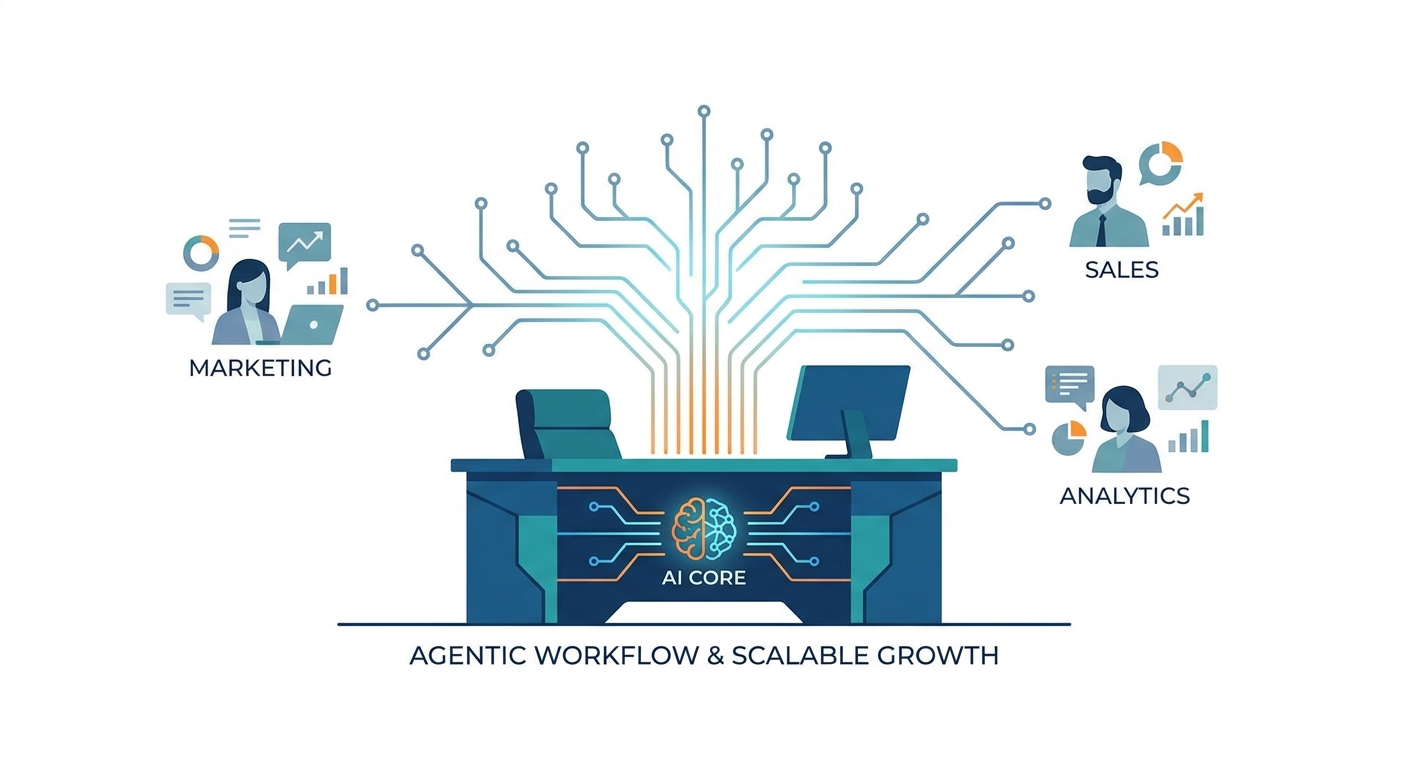
To scale, you need to pivot to "Agentic" workflows. Think of an agent not as a tool, but as a digital employee. It doesn't just wait for instructions; it takes a high-level goal, breaks it into bite-sized tasks, executes them, and iterates when things go sideways.
In this setup, your infrastructure is the conductor. The agent researches the topic, cross-references your AI Content Strategy to ensure it sounds like you, drafts the piece, flags compliance red flags, and drops it into your project management queue. That is the difference between a toy and a teammate.
The LLMOps Framework: Stop Flying Blind
If your team treats LLMs like a "black box," you’ve already lost control. You need an LLMOps strategy. This is just a fancy way of saying you need to manage your models, prompts, and data with the same rigor you apply to your software engineering.
You need version-controlled prompt registries. You need pipelines that feed your proprietary data into the models so they actually know your business. You need monitoring that catches performance drift before it ruins your reputation. When you start Integrating Automated Content Workflows, you aren't just "doing AI." You are building a system of record. Every prompt is tracked, every output is audited, and every data source is verified. Without this, you’re flying blind, waiting for the inevitable moment your AI hallucinates a product feature that doesn't exist.
Bridging the "POC-to-Production" Gap
Why do so many companies get stuck in "Pilot Purgatory"? It’s rarely a lack of ambition. It’s a failure to treat AI as infrastructure. You build a cool prototype, it works in a vacuum, and then it dies because it doesn't plug into the actual business fabric. As McKinsey on Operationalizing GenAI points out, the value isn't in the model—it’s in the integration.
Stop building "AI projects." Start building "AI-enabled processes." If your AI agent can't talk to your CMS, your CRM, or your database, it’s not an agent. It’s a distraction.
Governance: The Non-Negotiables
Governance isn't a post-deployment checklist. If you’re checking for bias after the content is live, you’ve already failed. You need to bake governance into the API layer itself.
Think of this as "Governance by Design." You need guardrails that intercept every single request. Mask sensitive data before it hits the model. Audit language patterns for bias. Force the model to cite its sources against your internal knowledge base, as set out in NIST's AI Risk Management Framework. By automating these checks, you stop compliance from being a bottleneck and turn it into a seamless, invisible part of the workflow.
Human-in-the-Loop: The Editor-in-Chief Model
The goal of enterprise AI isn't to fire your writers; it’s to promote them. Elevate your team from "content creators" to "editors-in-chief." We use a "Review-as-Code" methodology. Just like developers use pull requests to check code, your team should treat AI drafts as code blocks.
This ensures the AI handles the grunt work—the research, the formatting, the heavy lifting—while the human expert maintains final authority over the brand voice and strategic intent. It’s repeatable, it’s scalable, and it keeps the chaos of ad-hoc feedback to a minimum.
The Multimodal Frontier
We are moving past the text-only era. Your modern content infrastructure should be multimodal by default. Your pipeline should take a single data feed and churn out a blog post, a video script, and a series of social media captions, all perfectly aligned.
When your infrastructure handles video, audio, and text, your Time to Resolution (TTR) drops off a cliff. You stop having siloed teams managing different media. Your agents orchestrate the entire distribution. This is the future of the high-velocity enterprise: a single, intelligent engine that breathes life into every corner of your strategy.
The Future of the AI-Enabled Workforce
Infrastructure is your new competitive moat. In 2026, the winners won't be the ones with the flashiest chat UI; they’ll be the ones with the most resilient, secure, and integrated pipelines. The transition from "experimental" to "enterprise" is tough, but it’s the only way to stay relevant. Prepare your data, harden your governance, and build your agents. The foundation you lay today will define your market position for the next decade.
Frequently Asked Questions
How do I transition from AI experimentation to full production integration?
Focus on moving from "ad-hoc prompting" to "API-driven workflows." This requires building a centralized data pipeline that feeds your LLMs, ensuring that your AI is working with proprietary data rather than generic web-scraped information.
What are the biggest security risks when integrating AI into business infrastructure?
The primary risks involve data leakage during the training/inference process and the potential for "prompt injection" attacks. Integrating robust governance frameworks—like those outlined by NIST—is essential to secure your data pipelines.
How does "Agentic AI" differ from standard generative AI tools?
Standard generative AI waits for a prompt to produce a single output. Agentic AI is designed to understand a high-level goal, break that goal into sub-tasks, execute those tasks autonomously, and iterate based on feedback loops without human hand-holding.
How can I ensure my AI-generated content maintains a unique brand voice at scale?
Brand voice is maintained by embedding your brand guidelines into the system prompt architecture and utilizing RAG (Retrieval-Augmented Generation) to ground the AI in your specific, high-quality historical content rather than general training data.