The Future of Business Automation: Integrating AI Tools into Your Content Workflow

TL;DR
- ✓ Transition from reactive AI tool usage to proactive autonomous agentic workflows.
- ✓ Leverage AI agents for continuous SEO monitoring and automated content production pipelines.
- ✓ Integrate your tech stack using middleware to eliminate data silos and inefficiency.
- ✓ Focus human effort on high-level strategy rather than manual drafting and research.
The days of grinding out content manually are dead. By 2026, the competitive edge won’t go to the fastest writer in the room. It’ll go to the team that builds the smartest autonomous engines. We’ve moved past the "gee-whiz" phase of simple chat prompts and straight into the era of "Agentic Workflows."
These are systems that don't just sit there waiting for your command. They watch your business triggers, dig through data, draft assets, and optimize for search—all without you needing to click "generate" every five minutes. It’s a total shift from being a reactive tool-user to being a proactive system architect. According to the economic impact analysis by McKinsey, this isn't just a way to save a few hours; it’s the new baseline for enterprise productivity.
Why the Shift from "AI-Assisted" to "Agentic" is Inevitable
For years, we treated AI like a digital intern. We gave it a task, waited for the result, and then spent three times as long cleaning up the mess it made. That model is broken.
In 2026, an "Agentic" workflow means the AI actually has agency. It perceives its environment, understands constraints, and executes multi-step processes. Think about it: an agentic system doesn't just "write a blog post." It monitors your SEO dashboard. It sees a ranking dip. It identifies the competitor content that’s eating your lunch. It pulls your internal brand data so the new piece is actually relevant, drafts the content, and pushes it to your CMS.
You aren’t "prompting" anymore. You’re managing a fleet of specialists. This transition is inevitable because the sheer volume of content needed to stay relevant in today’s saturated feed makes manual, tool-by-tool production physically impossible for any team that wants to grow.
The Core Components of an AI-Driven Content Funnel
To build an automated pipeline, you have to stop thinking of content strategy as a series of isolated events. It’s a loop. A constant, breathing cycle of ideation, research, drafting, optimization, and distribution.
That "Human-in-the-loop" sign-off? That’s your only point of friction. And honestly, it should be. By automating the grunt work of research and formatting, you free up your team to actually do the work that matters: high-level strategy and editorial integrity.
Connecting Your Tech Stack to Create an "AI Brain"
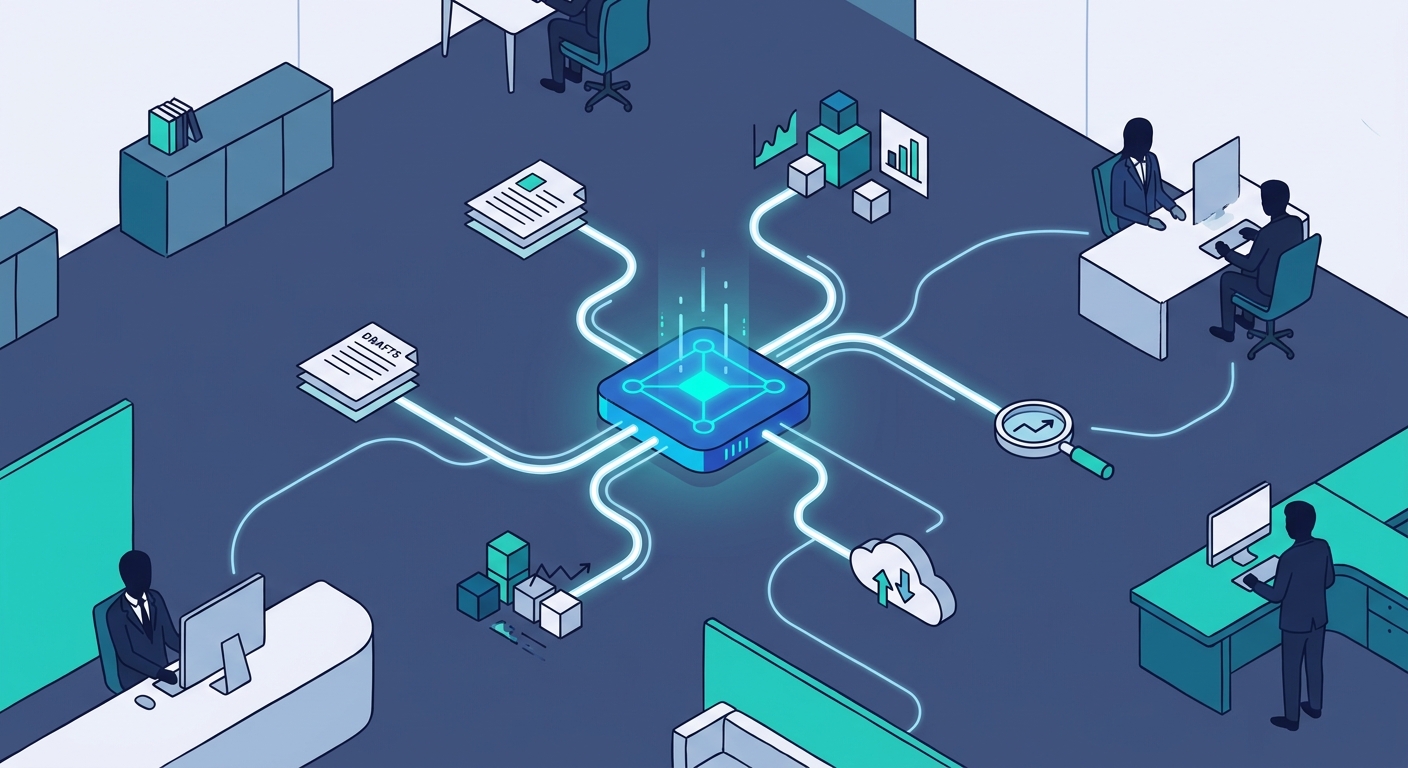
The biggest mistake teams make? Silos. If your SEO tool, your CRM, and your generative AI aren't talking to each other, you’re burning money. You need middleware like Zapier or Make to act as the connective tissue between your platforms.
But the real breakthrough is the Model Context Protocol (MCP). MCP lets your AI agents query your internal databases, customer logs, and technical docs in real-time. Instead of spitting out generic, hallucinated advice, your agents pull from your actual brand history. When you integrate these specialized Content Strategy Tools into your workflow, you create a "Brain" that gets smarter with every single piece of content you ship.
Building Your System: Keeping the Brand Voice Alive
Generic AI output is the kiss of death for brand authority. By 2026, the standard is "fine-tuned context." You can't just plug a vanilla model into your blog and expect to climb the rankings. You need a "Brand Brain"—a system built on your specific style guide, your past hits, and your internal tone-of-voice documentation.
Using tools like NotebookLM or custom RAG (Retrieval-Augmented Generation) pipelines, you can feed your agents a library of your best work. This forces the agent to mimic your cadence, your vocabulary, and your perspective. If you want to avoid the "robotic" trap, you’ve got to explore advanced AI Content Generators that allow for deep-system prompting.
The "Human-in-the-Loop" Role in 2026
The content creator’s job has changed. You’re not a "writer" anymore; you’re an Editor-in-Chief and an Orchestrator. You aren't responsible for the first draft—that’s a commodity now. You’re responsible for quality control and strategic direction.
This requires rigorous SOPs. You have to move away from ad-hoc task management and toward structured automation protocols. ANALYSIS — an earlier version of this article attributed a finding about ROI from standardising automated processes to the Global State of IT Automation report. That report is real, but contains no such finding; the attribution has been removed. A real link behind an unsupported claim is worse than no link, because it survives a spot-check and fails a read. You need to define the exact triggers for when an agent should draft, who approves it, and what data points actually define "success."
Scaling Volume Without Sacrificing SEO
Scaling without losing quality is the holy grail. The secret is Generative Engine Optimization (GEO). Forget old-school SEO, which was all about satisfying a static crawler. GEO is about ensuring your content provides the high-signal, human-verified depth that modern AI-driven search engines crave.
    title Traditional vs Agentic Workflow Comparison
    dateFormat  X
    axisFormat %s
    section Traditional
    Research & Writing : 0, 40
    Review & Edit      : 40, 60
    Publishing         : 60, 70
    section Agentic
    AI Research & Draft: 0, 5
    Human Review       : 5, 15
    AI Distribution    : 15, 20
When you let agents handle the research and initial synthesis, you save hours of labor. Reinvest that time into adding unique insights—the human touch that keeps readers on the page and search engines ranking you higher.
Real-World Case Study: Scaling Content Output by 5x
Take a mid-sized B2B firm that was hitting a wall with blog production. They were doing everything manually—research, writing, finding trends. It was impossible to keep up. They implemented an agentic workflow by connecting their internal CRM to an LLM via the Model Context Protocol.
The result? Their agents scanned industry news daily, spotted trends relevant to their customers, and drafted summaries that the team only had to polish. ANALYSIS — an earlier version of this article presented an anonymous "mid-sized B2B firm" case study with specific output and traffic figures. No company was named and no source given, so the numbers have been removed rather than left reading as first-party evidence. The team didn't get bigger; the workflow just got smarter.
Preparing Your Team for the Automation Wave
This isn't just a technical transition; it’s a cultural one. You have to move your team away from "prompt engineering"—which is basically just asking a chatbot questions—toward "workflow architecture."
Your people need to learn how to design systems, how to debug an automated pipeline, and how to master the "Human-in-the-loop" approval process. Stop viewing the agent as a threat to your job. View it as the most capable teammate you’ve ever had. If you treat the agent as a threat, you’ll fight the technology. If you treat it as an engine for your creativity, you’ll lead the industry.
Frequently Asked Questions
How do I ensure my AI-automated content doesn't sound generic?
Focus on the integration of proprietary data via MCP and strict style-guide fine-tuning within the agent's system prompt. By grounding the model in your own historical data and voice, you prevent the "generic" output that plagues unrefined automation.
What is the first step to automating a content workflow if I’m a small team?
Start by automating one high-friction, repetitive task—such as converting long-form blog posts into social media threads—before attempting end-to-end automation. Success in one small area builds the technical confidence needed for broader integration.
Will AI automation replace my content team?
No; it shifts roles from manual drafting to high-level strategy, creative direction, and quality oversight, allowing smaller teams to compete with large agencies by focusing on what AI cannot do: deep human empathy and strategic vision.
What are the biggest risks of fully automating a content workflow?
The primary risks include brand voice drift, potential hallucinations in factual data, and SEO penalties if content lacks a human-verified layer of expertise. This is why the "Human-in-the-loop" sign-off is the non-negotiable anchor of the process.
How does "Agentic AI" differ from the AI tools I used last year?
Last year's tools were reactive (you ask, it answers); 2026 Agentic AI is proactive (it monitors triggers, performs research, and executes workflows autonomously without constant manual input).