
AI-Powered Content Generation vs. Manual Writing: Which Is Better for SEO?

TL;DR
- ✓ The debate between AI and manual writing is an outdated strategic mistake.
- ✓ Success now requires a hybrid model known as Dual-Discovery SEO.
- ✓ Generative Engine Optimization requires becoming a trusted source for AI citations.
- ✓ AI provides the structural foundation while human expertise ensures high-value content.
- ✓ Generic content fails while proprietary insights earn visibility in search results.
Stop me if you’ve heard this one before: Is AI going to kill the SEO writer?
If you’re still losing sleep over that "AI vs. Manual" debate, you’ve already missed the boat. The binary choice between robots and humans isn’t just outdated—it’s a massive strategic blunder. In 2026, the question isn’t which one is better. The question is how fast you can bridge the gap.
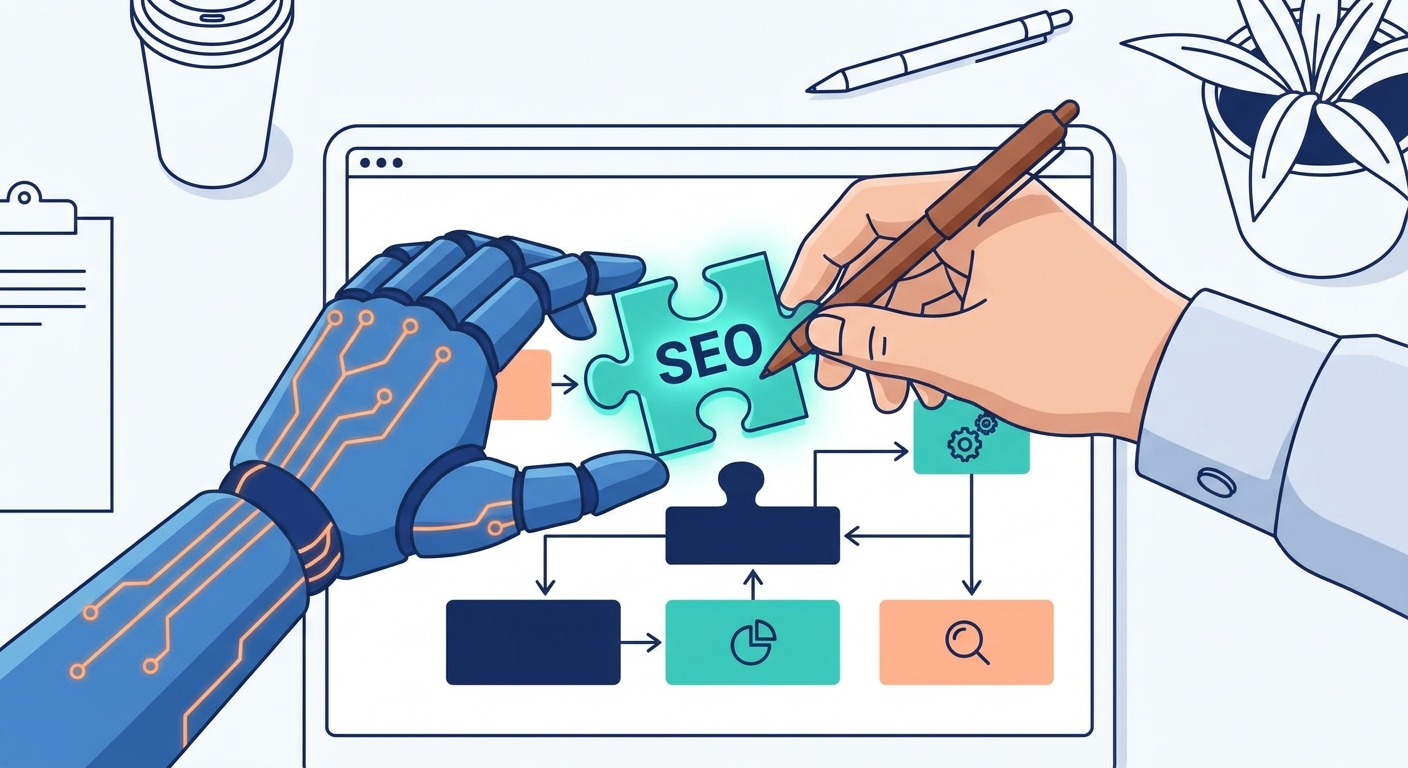
We’ve entered the age of Dual-Discovery SEO. You aren’t picking a side; you’re building a hybrid engine. AI is your research assistant, your grunt worker, and your structural architect. Human expertise? That’s your quality control, your soul, and your final, non-negotiable validator. If you aren't playing both sides, you’re essentially invisible.
The New Reality: Why "Dual-Discovery SEO" Has Replaced Traditional Search
For years, we lived for the blue link. We chased keywords like dopamine hits, stuffing headers and praying that a high click-through rate would pay the bills.
That world is dead. Welcome to the "Zero-Click" landscape.
When a user fires a query at a search engine today, they usually don't want a list of links. They want an answer, served hot, right on the results page. This shift toward Generative Engine Optimization (GEO) means that if you aren’t being cited as the primary source of truth, you don’t exist. According to recent industry analysis from Search Engine Journal on AI Trends, the game has pivoted. We’ve moved away from keyword density and toward "Entity Authority."
Search engines aren't looking for the most keywords anymore. They’re looking for the brand that consistently proves it knows its stuff. If your content is just a rehash of what’s already floating around the web, the AI will ignore you. To grab that citation, you have to be the signal in the noise.
Is the "AI vs. Manual" Debate Obsolete?
Can we stop calling AI a "competitor"? It’s a tool. It’s no different than a word processor, a spreadsheet, or a data scraper. The real tension isn't AI vs. Human—it’s "AI Noise" vs. "High-Value Citations."
AI Noise is the endless flood of generic, hallucination-prone fluff clogging up the pipes. It’s predictable. It’s bland. And frankly, it’s untrustworthy.
High-value citations, on the other hand, are earned. They come from proprietary data, sharp opinions, and insights that an LLM couldn't possibly scrape because they haven't been written yet. When you use AI to replace human thought, you get commodity content. When you use it as a utility to structure, research, and draft, you create a foundation that a human expert can actually build on.
Where Does AI Content Excel in Your SEO Strategy?
AI is a force multiplier. If your content velocity is dragging, AI is your best friend. It excels at the heavy lifting—the stuff that drains your team's energy without adding much creative value:
- Scaling Topical Depth: AI is a beast at mapping out content clusters and spinning up long-tail variations that cover the breadth of a topic.
- Structuring Data: Got a mountain of raw data or dry internal reports? An AI-Powered Content Generator can translate that technical jargon into readable, indexed summaries in seconds.
- Metadata and Formatting: AI can zip through thousands of pages to ensure meta-descriptions, title tags, and structured data schemas are consistent. That saves hundreds of hours of manual drudgery.
But here’s the catch: Most companies publish the raw output. Don't do that. Use AI to get to the 70% mark. That final 30%—the bit that actually builds trust and ranks—is where the human element is non-negotiable.
Where Is Manual Writing Irreplaceable for E-E-A-T?
If you want to know why humans still run the show, go read Google's Search Quality Rater Guidelines. The focus on Experience, Expertise, Authoritativeness, and Trustworthiness (E-E-A-T) isn't just corporate speak. It’s the rubric that decides whether your site sinks or swims.
AI has no experience. It hasn't "been there." It hasn't sweated through a high-stakes business meeting, learned from a botched marketing campaign, or conducted a proprietary survey of its customers.
The "Last Mile" of content needs:
- Proprietary Insights: Data that only you own.
- Real-World Failure Stories: AI is great at telling you how to do something; it’s terrible at explaining why things went wrong in the trenches.
- Expert Interviews: AI cannot sit across from a veteran of the industry and pull out a unique, untold anecdote.
This is the content machines are trained to prioritize, because it’s the only stuff that can’t be copied by a bot.
How Do You Build a High-Performance Hybrid Content Engine?
To survive in 2026, your workflow needs to match the complexity of modern search. You need speed, but you can’t sacrifice the authority that drives citations.
This cycle is iterative. You use AI to build the skeleton, but the "meat"—the anecdotes, the quotes, the synthesis of complex ideas—must come from a human. Finally, use SEO Content Optimization Tools to polish the structure so it’s primed for both traditional search and AI ingestion.
How to Optimize for Citations in AI Overviews (AIO)?
If you want to be the brand that pops up in a Perplexity answer or a Google AI Overview, you have to write for the machine's digestion. According to the Perplexity AI Blog, models favor content that is factual, punchy, and structured for easy extraction.
- Use Descriptive Headers: AI models look for clear, logical hierarchies to understand what a section is about.
- Provide Definitive Answers: Hit the point immediately. Start sections with a direct answer, then follow with the supporting data.
- Data-Backed Snippets: Tables, bulleted lists, and clear stats. AI loves structured data because it’s easy to parse and cite.
- Internal Linking: Link your authoritative pages together to reinforce your brand’s "Entity" status.
How Do You Measure Success Beyond Traditional Clicks?
The era of the "click" as the ultimate metric is over. In the age of AI search, you need to track "Citation Frequency" and "Brand Mention" metrics.
Are you showing up in the answer boxes? Are users mentioning your brand when they talk about a solution?
Track your organic visibility through the lens of Entity Authority. Use tools that monitor where your brand pops up in AI-generated answers. If your traffic is flat but your brand mentions in high-authority AI contexts are climbing, you’re winning the long game.
What Does the Future of Content Look Like in 2027?
By 2027, the web will be drowning in "good enough" AI content. Its value will be effectively zero.
What will skyrocket? Verified data. Original research, primary interviews, and deep-dive analysis that an AI can't hallucinate or steal. We’re moving toward a future of "Personalized AI Search," where the engines themselves filter out the noise and prioritize sources that have proven their credibility over time.
If you spend your time trying to out-produce AI on volume, you’ve already lost. If you spend your time building a brand that the AI must cite to be accurate, you’ll own the future of search.
Frequently Asked Questions
Does Google penalize AI-generated content in 2026?
Google doesn't care if a robot wrote it. They care if it's helpful, accurate, and trustworthy. They penalize spam, not tools. If your AI content is high-quality and adds real value, it’s treated exactly like human-written content. The problem is when you use AI to flood the web with derivative, low-effort garbage.
How can I make my brand appear in AI Overviews?
Focus on becoming an authority. Keep your site structure clean, use clear headings, answer specific queries directly, and earn citations from other reputable sources. AI models are looking for trust signals and structured, factual data.
Is manual writing still necessary for SEO?
Absolutely. Manual writing is the only way to ensure your content has a unique brand voice, proprietary data, and that human perspective search engines crave. AI can generate text, but it can't generate the "experience" required for top-tier E-E-A-T.
What is the difference between SEO and GEO (Generative Engine Optimization)?
SEO is about driving clicks to your website via traditional search. GEO is about being cited as the "source of truth" within an AI's generated response.
What is the "Hybrid Framework" for content creation?
The Hybrid Framework is a workflow that uses AI to handle the speed, research, and data-structuring parts of content, while human editors handle the authoritative, anecdotal, and trust-building parts. It’s the best of both worlds.