
How to Automate Content Creation: A Step-by-Step Workflow for Teams

TL;DR
- ✓ Transform content production from a manual burden into an efficient operational process.
- ✓ Use AI agents to handle research and ideation instead of staring at blank pages.
- ✓ Distinguish between general marketing automation and creative lifecycle manufacturing.
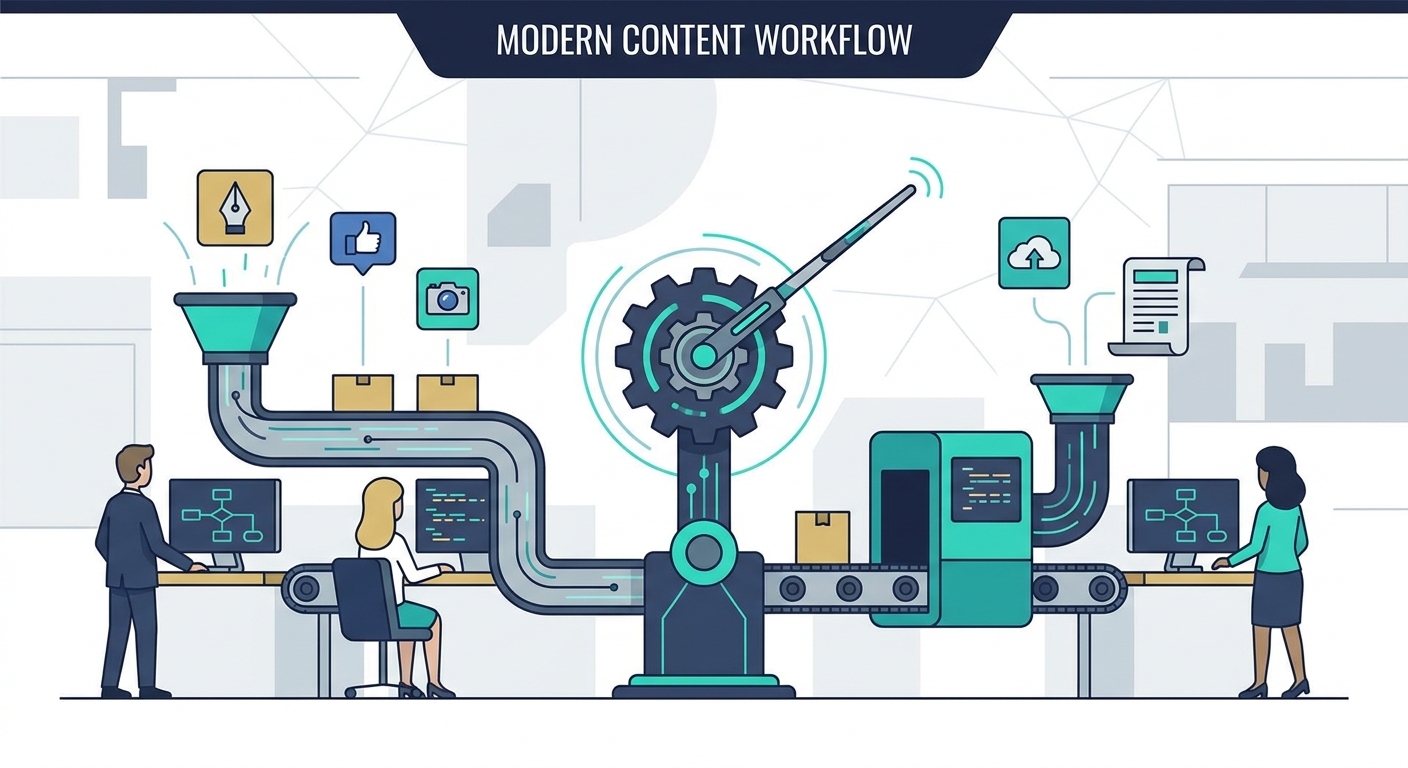
- ✓ Implement a four-phase framework to eliminate bottlenecks and increase production velocity.
- ✓ Empower your team to focus on high-level strategy rather than repetitive logistics.
Content production isn't a writing problem anymore. It’s an operations problem.
If your team is still drowning in email chains, scattered spreadsheets, and endless status pings, you aren’t suffering from a lack of creativity. You’re suffering from a broken process. By 2026, the teams that win won't be the ones with the biggest writing staff—they’ll be the ones who treat content like a product lifecycle.
It’s time to stop manually drafting everything. It’s time for "Agentic Workflow Orchestration." This is how you skyrocket your output while keeping your content human, verified, and sharp.
Why Your Content Bottleneck is an Operational Failure
The old way of doing things is linear, fragile, and painfully slow. You make a request. A writer stares at a blinking cursor for an hour. An editor spends three days chasing down feedback. The draft sits in a folder and gathers dust.
This isn't just annoying; it’s a direct hit to your "production velocity." That’s the only metric that matters: how fast can you move an idea from a rough concept to a high-performing asset?
True automation isn't about letting a bot churn out soulless, robotic drivel. It’s about killing the friction. When you automate the boring logistics—the research, the formatting, the scheduling, and the repurposing—you free your team to focus on the things that actually scale: strategy, unique perspective, and creative direction.
What is Content Automation vs. General Marketing Automation?
Don't confuse the two. General marketing automation is mostly about lead scoring, nurturing, and mapping out the customer journey. That’s the "sales" side of the house.
Creative lifecycle automation is the "manufacturing" side. It’s the plumbing connecting your brain to your audience. If your CRM is sending automated emails, that’s marketing automation. If your AI agent is taking a 2,000-word research deep-dive and turning it into ten tailored LinkedIn posts? That’s creative lifecycle automation.
The 4-Phase Content Automation Framework
To build a machine that actually works, you have to break it into modules. This helps you spot the "latency"—the moments where your team is just sitting around waiting for someone else to hit "approve."
Phase 1: Planning and AI-Driven Ideation
The biggest killer of productivity is the "empty page" syndrome. Stop guessing what your audience wants. Use AI agents to handle keyword clustering and trend analysis. You can go from a vague "we need a blog post" to a data-backed editorial calendar in minutes. Feed your market data into an agent, let it identify the high-intent topics, and get to work.
Once those clusters are set, plug them into your content calendar. Now, your team is always working on high-impact initiatives instead of throwing ideas at the wall to see what sticks.
Phase 2: Creation and the "Anti-Generic" Mandate
Here is the trap: scaling production often leads to a race to the bottom. Everything starts sounding like a textbook.
To avoid this, treat your AI like a hyper-efficient junior researcher—never a lead author. Integrate your AI-powered writing tools into your workflow, but enforce a hard "anti-generic" mandate. The AI builds the skeleton. It finds the data. It writes the first draft. But the human expert? They provide the voice, the war stories, and the strategic edge. Check out industry standards on AI-authored content to see how to keep that balance without losing your soul.
The 10-Minute Prompt Library
- The Research Agent: "Analyze the top 5 ranking articles for [Topic]. Summarize the key arguments, identify the missing data points, and suggest a unique angle that challenges the current consensus."
- The Structure Architect: "Create a detailed outline for a 1,500-word guide on [Topic]. Include H2/H3 headers, bulleted takeaways, and a 'human-in-the-loop' checkpoint suggestion for every 300 words."
- The Voice Aligner: "Rewrite this section to sound like a seasoned industry veteran: punchy, opinionated, and rhythmic. Avoid fluff, jargon, and generic introductory phrases."
Phase 3: The Review and Approval Loop
If your review process involves Slack messages like "Hey, can you look at this?" you’ve already lost. That’s not a process; that’s a conversation.
You need triggers. When an AI finishes a draft, it should automatically update a status in your project management software (think Asana or Monday.com) and ping the right editor. The "Human-in-the-Loop" isn't a suggestion—it’s the filter that ensures your brand authority stays intact. Algorithms can mimic structure, but they can't replicate human judgment.
Phase 4: Distribution and Micro-Content Repurposing
This is the ROI goldmine. Stop treating a blog post as a one-and-done deal. That article is your "source of truth." Use an AI repurposing agent to dismantle it. Turn that one technical piece into platform-specific gold.
How to Build Your Creative Ops Stack
You need three layers to make this stick:
- The Source of Truth: A project management tool that tracks exactly where every asset lives in its lifecycle.
- The AI Agent Layer: The muscle that handles drafting, researching, and slicing up content.
- The Distribution Hub: The delivery vehicle that pushes content to your social channels, CMS, and email lists.
ANALYSIS — an earlier version of this article cited research from the Content Marketing Institute on "the State of Content Operations" for a finding about team morale. No report by that name exists, the link pointed at CMI's homepage rather than any study, and the morale finding appears nowhere in CMI's published research. The attribution has been removed. Why? Because they aren't spending their day on grunt work.
Measuring Success: Beyond Volume to ROI
Stop counting blog posts. That’s a vanity metric. If you publish 50 posts and nobody cares, you haven't succeeded; you've just created a lot of noise.
Focus on production velocity. How many hours pass from the moment you identify a keyword cluster to the moment you hit "publish"? When you shorten that loop, you can jump on market trends before your competitors even know they exist. If your writers spend 80% of their time on strategy because the automation handled the heavy lifting, you’ve won.
How to Maintain Brand Voice in an Automated World
People are terrified that AI will make their brand sound like a robot. It will, if you let it.
The fix? Train your AI. Feed it your best, high-converting content. Tell it to study your cadence, your sentence length, and your vocabulary. But never, ever skip the final mile. The human editor is the ultimate filter. AI can mimic tone; it cannot mimic empathy or lived experience. That’s your competitive advantage. Keep it.
Frequently Asked Questions
Can AI automation replace our entire content team?
No. Automation replaces the repetitive, low-value tasks that burn out your creative talent. It elevates your team from "content creators" to "content architects," allowing them to focus on high-level strategy, creative direction, and critical human review, which are essential for true brand authority.
How do I ensure my automated content doesn't sound robotic?
The key is a rigorous "human-in-the-loop" phase. Use AI to build the framework, but mandate that a human editor adds the final polish, unique perspective, and nuanced language. By training your AI on your specific brand voice guidelines and tone, you can significantly reduce the "robotic" quality of the raw output.
What is the first step to automating a content workflow?
Audit your current process to identify the biggest bottleneck—usually, this is the handoff between drafting and editing. Automate only that single step first. Once you have a stable, automated approval trigger in your project management system, you can expand to the ideation and distribution phases.
Does content automation hurt SEO?
Not if executed correctly. Google’s algorithms prioritize helpful, high-quality, and authoritative content. Automation is simply a tool for production; if the strategy, value, and human expertise behind the content remain high, search engines will continue to value your assets. The risk only arises when you use automation to generate low-effort, low-value "filler" content.
Related reading
- How to Automate Content Creation: A Step-by-Step Guide for Marketing Teams
- How to Automate Content Creation: The Ultimate Guide for Marketing Teams
- Automate Content Creation: 7 Ways to Save Time with AI Writing Assistance
- AI-Powered Content Creation: LogicBalls' Guide to Supercharging Your Writing Workflow
- Why Remote Teams That Look Busy Still Struggle to Deliver Results