Filling the Gaps: How AI Image Editing Fits Into a Modern Content Workflow
AI image editingcontent workflowvisual content creationAI design toolscreative efficiency



Image by Hamza AI on Magnific
Anyone who produces content at scale has already internalized that AI writing tools change the speed of the text side of the pipeline. Drafts arrive faster, outlines appear on demand, rewrites that once took a morning happen in minutes. What is less often discussed is the parallel shift happening on the image side: the same wave of AI capability that redefined text production is now redefining what you can do with a photograph, a generated image, or a screenshot. Understanding where AI image editing fits, and specifically what it can accomplish that manual editing could not, rounds out the workflow picture and turns scattered AI tools into something that actually compounds.
The text side is running ahead
It is worth naming the asymmetry. AI writing tools have matured quickly: they handle ideation, drafting, rephrasing, summarizing, and formatting with enough reliability that content teams have restructured around them. The image side is catching up but still feels newer to most practitioners. Many teams that run an AI-assisted content pipeline still handle images through older editing workflows, manual adjustments, design software, or delegating to someone who knows their way around layers and masks. The opportunity is to close that gap and let the image side move at the same speed as the text side, not because efficiency is the goal for its own sake, but because the image and the text tell one story, and bottlenecks on either side slow both.
What generative fill actually unlocks
The specific AI image capability that most changes content production economics is generative fill: the ability to mark a region of an image and have AI generate plausible content for it, whether adding, removing, or replacing. Tools that fill image areas with AI make this available without design software or technical skill in a few steps: upload, mark the area, generate, download. The scope of what this enables is worth unpacking fully, because it is broader than most non-designers expect.
Aspect ratio adaptation is the most common use case. A hero image shot in landscape needs to become a vertical thumbnail, a story frame, and a square social post without cropping the subject out. Generative fill extends the canvas in the required directions, continuing the background plausibly, so the image fits every format with the subject still centered and whole. A blog post's lead image can become a YouTube thumbnail can become an email header in minutes rather than hours.
Background cleanup is the second major use case. The product photograph that arrived from a supplier with a messy backdrop, the screenshot that caught something distracting at the edge, the team photo with an unfortunate object in the corner: all of these can be fixed by selecting the problem area and letting the AI regenerate it with content that matches the surrounding scene. What used to require Photoshop skill and time now happens without either.
Third is scene extension for editorial and conceptual imagery. When a piece requires a specific mood or visual context that stock photography only partially delivers, generative fill can extend or adapt existing images rather than requiring a new asset. The atmospheric sky behind a product, the setting that establishes a concept, the context that makes an image land: these can be shaped after the fact rather than hunted through stock libraries.
Image formats in the AI content world
Running an AI-assisted content pipeline means encountering image format questions constantly. AI generation tools, stock platforms, and modern content management systems all tend to deliver images in next-generation formats like AVIF or WebP, because smaller files mean faster delivery and lower costs. MDN's comprehensive guide to image file types documents the landscape clearly: newer formats like WebP and AVIF offer substantially better compression than the classic JPG and PNG formats but carry less universal support across editing tools, CMSes, and distribution channels. The practical workflow implication is that format conversion becomes a regular task: AVIF files from AI generators need to become JPGs before they enter certain publishing pipelines; PNGs need to become WebPs before they hit certain CDNs; and occasionally the reverse, as tools downstream expect the older formats that everyone accepts.
Having a reliable browser-based conversion tool in the workflow removes this as a source of friction. The same Cloudinary toolset that handles generative fill also handles AVIF-to-JPG, AVIF-to-PNG, and other common conversions, meaning image format questions resolve in the same place as image editing questions rather than requiring a second tool. Reducing the number of tools a team must context-switch between is one of the quieter but more consequential forms of workflow efficiency.
What AI editing cannot do, honestly
A complete workflow picture requires honesty about limitations. Generative fill produces statistically plausible content, not magically correct content. It excels at extending continuous backgrounds, removing isolated distractions, and adapting geometry, and it struggles with faces, readable text, precise architectural details, and repeating structural patterns like grids or tiles. The rule that works in practice: let generated content be scenery, not subject. The product, the person, the meaningful detail that the image is actually communicating should stay inside the original pixels; AI-generated regions surround and support rather than constitute the core message.
The failure modes are worth knowing in detail, because they follow a consistent logic. Text rendered inside a generated region almost always degrades into plausible-looking gibberish, which is fine if no one needs to read it and a serious problem if a sign, label, or caption must stay legible. Faces generated from context rather than sourced from the original have a tendency to drift into the uncanny: proportions shift, expressions flatten, and the result triggers immediate distrust even in viewers who cannot say precisely why. Straight lines that must remain straight, window grids, tiled floors, architectural facades, are where the model's statistical nature shows most visibly, since it is sampling from distributions rather than following geometric rules. Knowing these weak spots in advance means routing them around: extend the sky, not the signage; remove the object in the background, not the person in the foreground; widen the studio backdrop, not the product shelf.
This is also where the honest-use principle applies most clearly. Generated content in an image must not change what a reader or customer reasonably believes they are seeing. For editorial illustration, extending a sky or widening a backdrop is purely presentation. For product photography, generating detail the actual product does not have is misrepresentation. That line is easy to respect in practice because the best use cases for generative fill are all on the presentation side anyway.
The practical companion to understanding that line is building a light review step into the workflow rather than relying on automation to self-police. Generated regions should be inspected at full resolution before the image publishes, not just at thumbnail scale, because artifacts cluster at seams and in fine detail that look fine in a small preview. A habit as simple as zooming to 100 percent on the edited area catches the vast majority of problems before they reach an audience. Automating fill at scale through an API is genuinely useful; automating the quality check out of existence is not. The speed gain from AI image editing is real enough that a thirty-second human review at the end still leaves the pipeline dramatically faster than it was before.
Making the whole pipeline move together
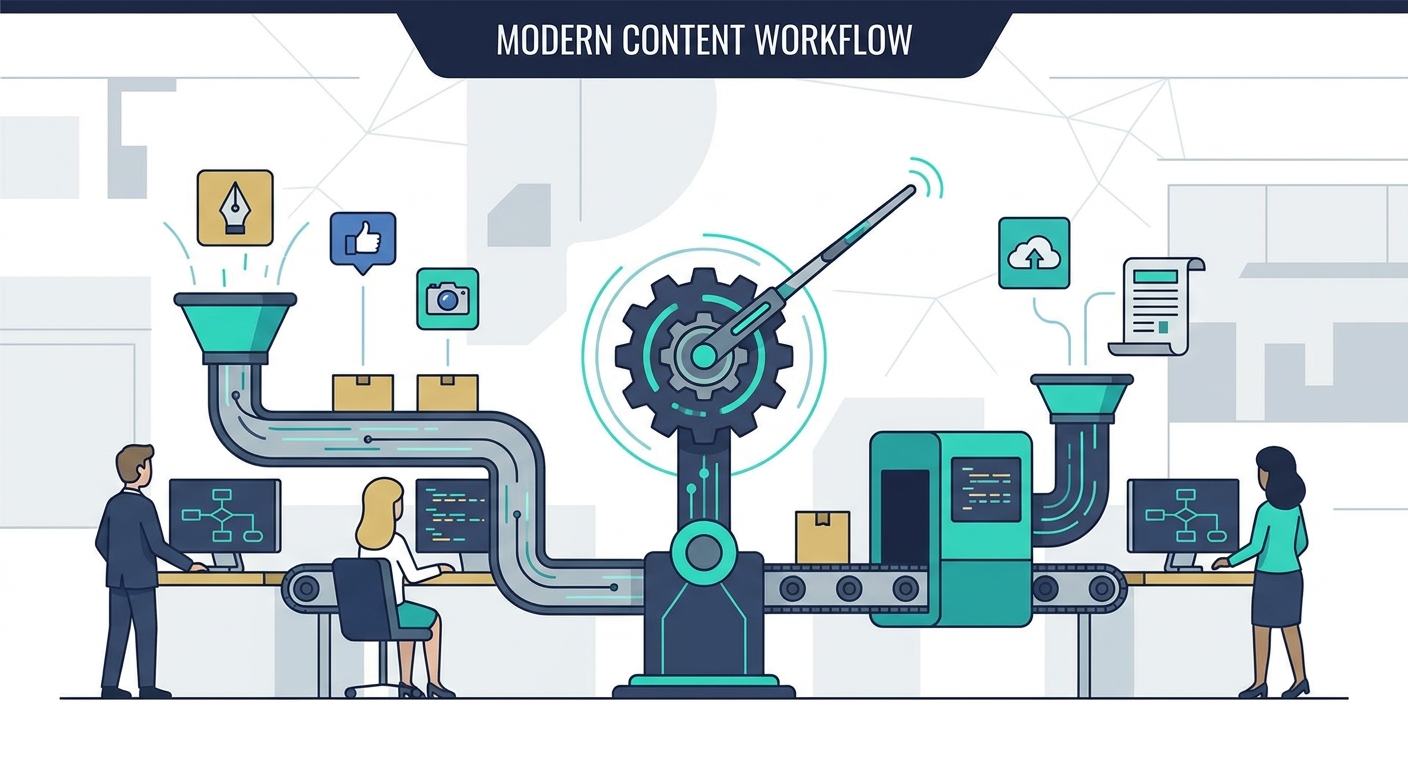
The content workflows that get most leverage from AI are the ones where text and image sides move in coordination. A draft arrives, an image gets sourced or generated, fill and format conversion happen in the same browser session, and the piece moves to publishing without waiting on design resources. This is achievable today with free browser tools for everything except the writing itself, which means the bottleneck has shifted entirely to quality judgment: choosing what to say, choosing what to show, and evaluating whether both do their job. Those are the decisions that require human attention. Everything else is increasingly a tool call.
Related Articles
 AI scriptwritingHow to Pair AI Scriptwriting With a Video Editing ServiceStruggling to scale your video production? Learn how to combine AI-generated scripts with professional editing services to create high-quality content faster.Hitesh Kumawat12 min read
 automate content creationHow to Automate Content Creation: A Step-by-Step Workflow for TeamsStop manual drafting. Learn to build an agentic content workflow that scales production velocity while keeping your brand voice human and strategic.Ankit Agarwal7 min read
 AI content creationAI-Powered Content Creation: LogicBalls' Guide to Supercharging Your Writing WorkflowDiscover how to use AI tools like LogicBalls to supercharge your content creation. Learn tips and strategies for brainstorming, writing, editing, and optimizing your content.Ankit Lohar9 min read
 AI image editing5 AI Image Editing Tasks That No Longer Require PhotoshopStop paying for expensive software. Discover 5 essential photo editing tasks that AI tools can now handle in seconds. Save time and elevate your workflow today.Hitesh Kumawat6 min read