
How to Automate Content Creation: The Ultimate Guide for Marketing Teams

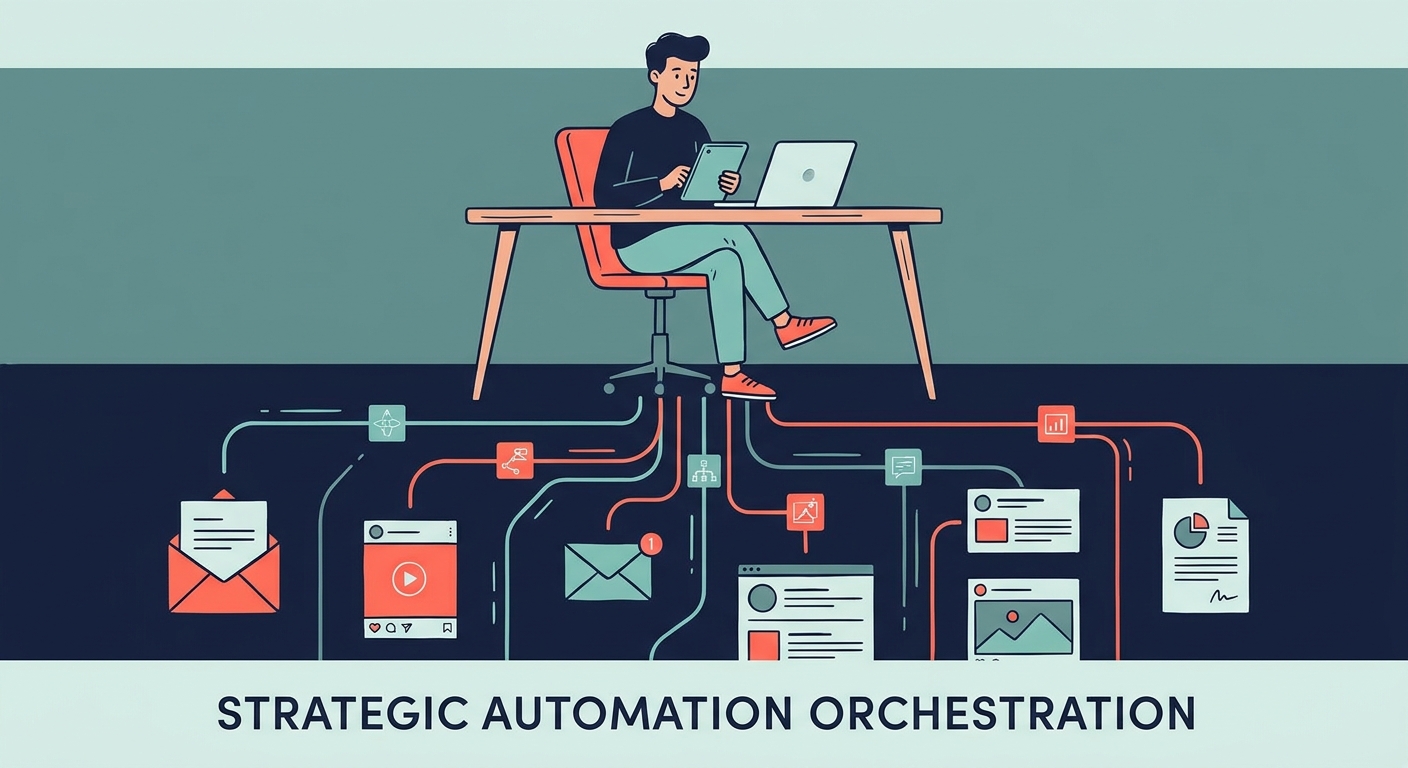
TL;DR
- ✓ Move beyond basic AI prompts to build an orchestrated content creation ecosystem.
- ✓ Reclaim 27 hours weekly by automating manual tasks like tagging and formatting.
- ✓ Use a centralized tech stack to maintain brand voice and prevent tool sprawl.
- ✓ Implement human-in-the-loop workflows to ensure quality and strategic oversight.
Stop thinking of automation as a "generate" button. If you’re just hitting spacebar on an AI prompt and praying for a viral blog post, you’re doing it wrong. Real automation isn't about letting a machine do your job; it’s about building an orchestration layer that turns your marketing team from manual laborers into high-level creative directors.
It’s 2026. AI adoption has reached a 96% penetration rate across the board. The competitive advantage no longer goes to the company with the most tools. It goes to the team that treats their tech stack as a force multiplier for human intent. Stop sweating the small stuff and start managing a high-performance content ecosystem. That’s how you reclaim your sanity and start moving the needle.
Why Your Team Needs to Embrace the Orchestration Mindset
Most marketing departments aren't hurting for ideas. They’re drowning in "execution tax." Research into marketing automation statistics for 2026 shows that teams integrating AI workflows reclaim an average of 27 hours per week.
That’s four full business days. Gone.
Usually, that time is hemorrhaged on mindless busywork: formatting social snippets, drafting basic email sequences, and manual SEO tagging. When you switch to an orchestrated model, you stop treating AI like a glorified writing tool and start treating it like a junior department. You want 5x ROI? It’s not about pumping out five times the content. It’s about producing content that pivots in real-time based on how your audience actually behaves. When the machine handles the heavy lifting, your team is finally free to focus on the "Strategy Bridge"—that critical space where nuance, empathy, and bold creative bets live.
The Architecture of a Modern AI-Driven Content Stack
"Tool sprawl" is a silent killer. You’ve got five apps, none of them talk to each other, and suddenly your brand voice is fragmented across a dozen different dashboards. That’s not a strategy; that’s tech debt.
A mature stack needs a core engine that balances three things: pattern recognition, language flow, and predictive targeting. If you’re juggling disconnected apps, stop. Consolidate. Use AI Writing Assistant Tools as your central hub. It creates a single source of truth for your brand voice. When your writing, SEO, and strategy tools share the same data pool, you stop wrestling with your tech and start directing it.
Building a "Human-in-the-Loop" Workflow
Here’s where most teams trip up: they think "automated" means "unsupervised."
Wrong. A fully autonomous pipeline is a fast track to brand dilution and robotic hallucinations. You need to map your intervention points. Think of it like a high-end manufacturing line: the AI provides the raw materials, but your team provides the craftsmanship.
At the Strategy Input stage, you define the "why." At the Human Review stage, you aren't just hunting for typos. You’re checking to see if the piece actually sounds like you. By embedding these checkpoints, you ensure that speed never comes at the cost of your brand’s soul.
Choosing the Right AI Strategy for Your Brand
Stop starting with a blank white document. It’s 2026—
Related reading
- How to Automate Content Creation: A Step-by-Step Guide for Marketing Teams
- How to Automate Content Creation: A Step-by-Step Workflow for Teams
- Automate Content Creation: 7 Ways to Save Time with AI Writing Assistance
- Building Smarter Marketing Engines: How AI Agents Can Automate SEO and Content Creation
- Why Remote Teams That Look Busy Still Struggle to Deliver Results