
Mastering AI Content Generation: Best Practices for Quality and Consistency

TL;DR
- ✓ Transition from simple prompting to building autonomous agentic content ecosystems.
- ✓ Use Retrieval-Augmented Generation to ground AI in your proprietary brand data.
- ✓ Prioritize unique, verifiable value over traditional metrics like keyword density.
- ✓ Implement rigorous human verification steps to maintain authentic brand voice and DNA.
If you’re still treating AI like a magic trick—typing a prompt, hitting enter, and copy-pasting the result—you’ve already lost.
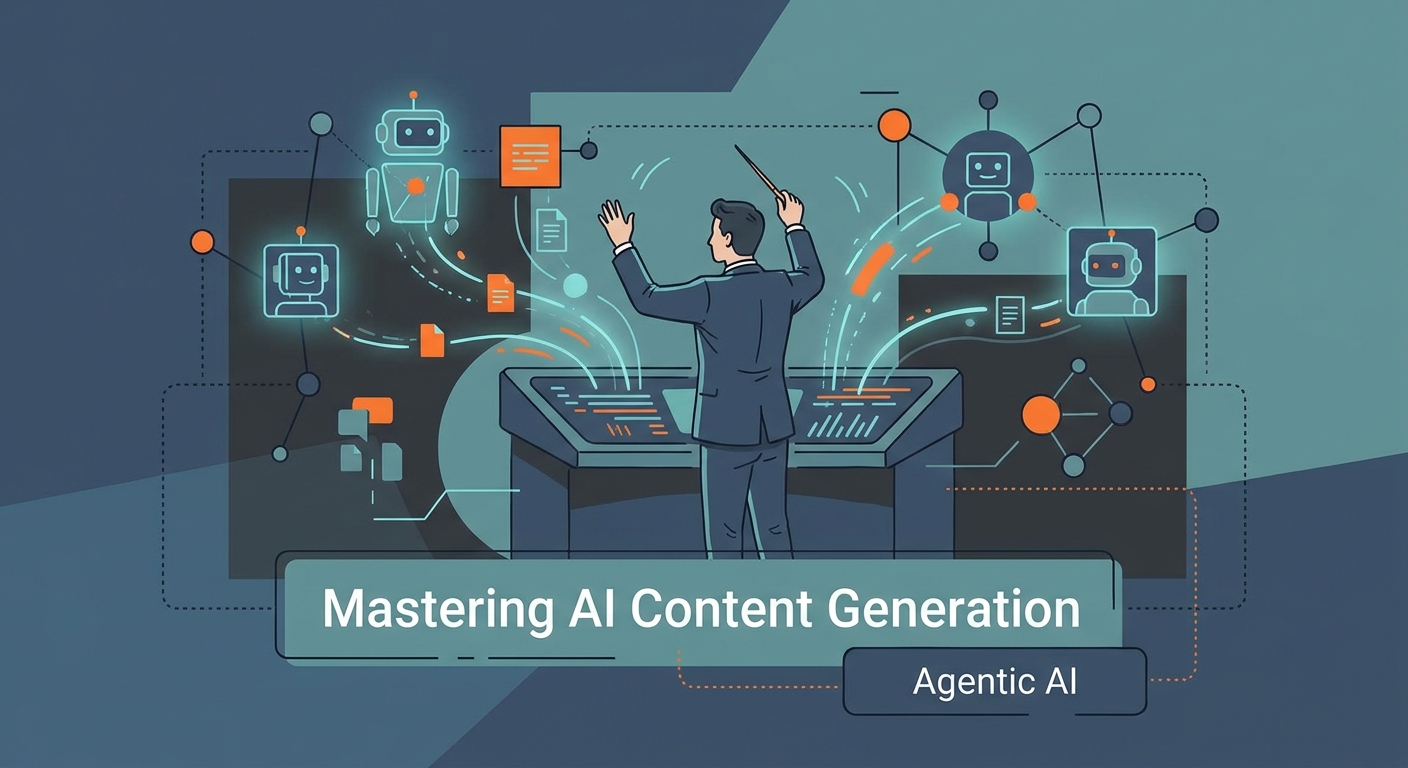
In 2026, the game isn't about better prompting. It’s about building an autonomous ecosystem. You aren't just writing; you’re managing a fleet. This is the era of Agentic AI, where machines handle the grunt work and your experts provide the soul. If you aren't building a pipeline that integrates proprietary data and rigorous human oversight, you’re just adding to the noise.
The Shift to Agentic Content Workflows
Stop thinking of AI as a one-and-done drafting tool. That’s amateur hour. We’re moving toward systems designed to research, draft, optimize, and verify content against high-level strategy.
When you shift to an agentic model, you replace the fragile "prompt-response" loop with a persistent, reliable pipeline. This isn't just about speed. It’s about not sounding like a robot. By baking your own data and guardrails into the process, you ensure that every piece of content actually sounds like you—not a generic LLM regurgitating internet averages.
What Does "High-Quality" Mean in 2026?
Forget keyword density. Forget sentence variety. Those are vanity metrics. Today, "helpful content" is simple: Does it solve the user's problem on the first try?
Google’s Search Essentials make it clear: the machines don't care who (or what) wrote the content. They care if it provides unique, verifiable value.
To hit this mark, you need Retrieval-Augmented Generation (RAG). Think of RAG as giving your AI a library card. Without it, the model is just a parrot, repeating the statistical average of the internet. With grounding—your whitepapers, your case studies, your internal documentation—it becomes a specialist. It starts speaking your language.
Building a Scalable AI Content Workflow
You need a system that captures input, processes it through your brand context, and routes it through human verification. No exceptions.
By formalizing this, you kill the chaos. Each stage of this pipeline acts as a filter. By the time a draft hits the "publish" button, it’s been vetted against your core messaging and factual requirements.
Maintaining Brand DNA Across AI-Generated Content
The biggest hurdle? The "homogenized" sound. You know the one—overly enthusiastic, bland, and dripping with corporate jargon.
To keep your brand DNA, treat your voice like a technical asset. Using a Brand Voice Generator is a start, but it’s not the finish line. You need to fine-tune models on your own historical content.
Set up persistent brand guidelines within your tech stack. Create a "brand bible" that the AI references for every single generation. If your brand is punchy and opinionated, the AI should be explicitly instructed to kill the passive voice and purge the fluff. If you don't define these boundaries, the model will always default to the lowest common denominator.
Mastering AI Search Optimization (AIO)
We aren't writing for the "blue link" anymore. We’re writing for the "Answer Engine." AIO is the art of structuring content so AI summaries and citation engines can actually digest it. According to the Content Marketing Institute (2026 Trends), the winners this year are the brands that provide clear, concise, verifiable answers to specific user questions.
Stop burying the lead. Use clear headings. Provide direct answers early. Think of your content as a series of modular answers rather than a long-form wall of text.
Integrating AI Tools into Operations
Don't buy every shiny tool you see. Map your tools to your strategy. Divide your operations into three pillars: Research, Drafting, and Analytics. For teams looking to scale, exploring professional AI Writing Tools can provide the infrastructure needed to support complex agentic workflows. If your internal team is struggling to bridge the gap between creative strategy and technical implementation, professional Content Strategy Services can help you design a custom architecture that actually fits your business.
Mitigating Hallucinations and Ensuring Accuracy
The AI will hallucinate. It’s a feature, not a bug. To stop it from ruining your reputation, you need a mandatory human-review phase. This is where your experts earn their keep. Never publish an AI draft without a structured verification checklist.
This workflow ensures every claim is tied to a source and every fact is verified against your internal databases. The "human touch"—the personality, the insight, the edge—is what you inject during that final polish.
Future-Proofing Your Strategy
Models will change. Six months from now, the current "state-of-the-art" will feel like a relic. If your strategy is tied to the quirks of one specific model, you’re doomed to constant rebuilding.
Build a "model-agnostic" strategy. Focus on the quality of your input—your data, your guidelines, your human expertise—rather than the specific LLM you’re using. Finally, be transparent. Adopt an "AI-Assisted" labeling policy. In a world drowning in synthetic content, audiences will reward brands that are honest about their process and prioritize quality over sheer volume.
Frequently Asked Questions
How do I stop AI content from sounding generic or robotic?
Focus on providing specific brand guidelines, proprietary data, and unique expert insights in your initial prompt. The "robot" sound comes from generic prompts; high-quality output requires context injection, specific tone instructions, and, most importantly, heavy human rewriting for nuance.
Is AI-generated content bad for SEO in 2026?
No. Search engines prioritize helpfulness and authority, not the origin of content. As long as the content provides unique value, answers user intent, and avoids mass-produced spam, it is viewed favorably by search algorithms.
How do I ensure factual accuracy when using AI?
Implement a mandatory human-review phase. Use AI tools that provide real-time, cited sources and cross-reference these against your own internal databases before publication. Never treat AI output as a finished product.
What is the biggest mistake businesses make with AI content?
The biggest mistake is treating AI as a "set and forget" tool. Successful businesses use AI as a force multiplier for human expertise, not a replacement for it. If you remove the human from the process, you remove the competitive advantage.