How AI Scribes Enhance Efficiency and Preserve Human Interaction

The modern doctor’s office has turned into a hostage situation. The hostage? The patient. The captor? A glowing, rectangular screen that demands constant attention. For years, clinicians have been trapped in the "pajama time" cycle—that soul-crushing ritual where you finish your real work of healing, only to spend three extra hours at night feeding data into the Electronic Health Record (EHR).
This isn't just a scheduling inconvenience. It’s a systemic rot. When a physician is forced to choose between eye contact with a patient and clicking boxes in a database, the patient-provider relationship dies a slow death.
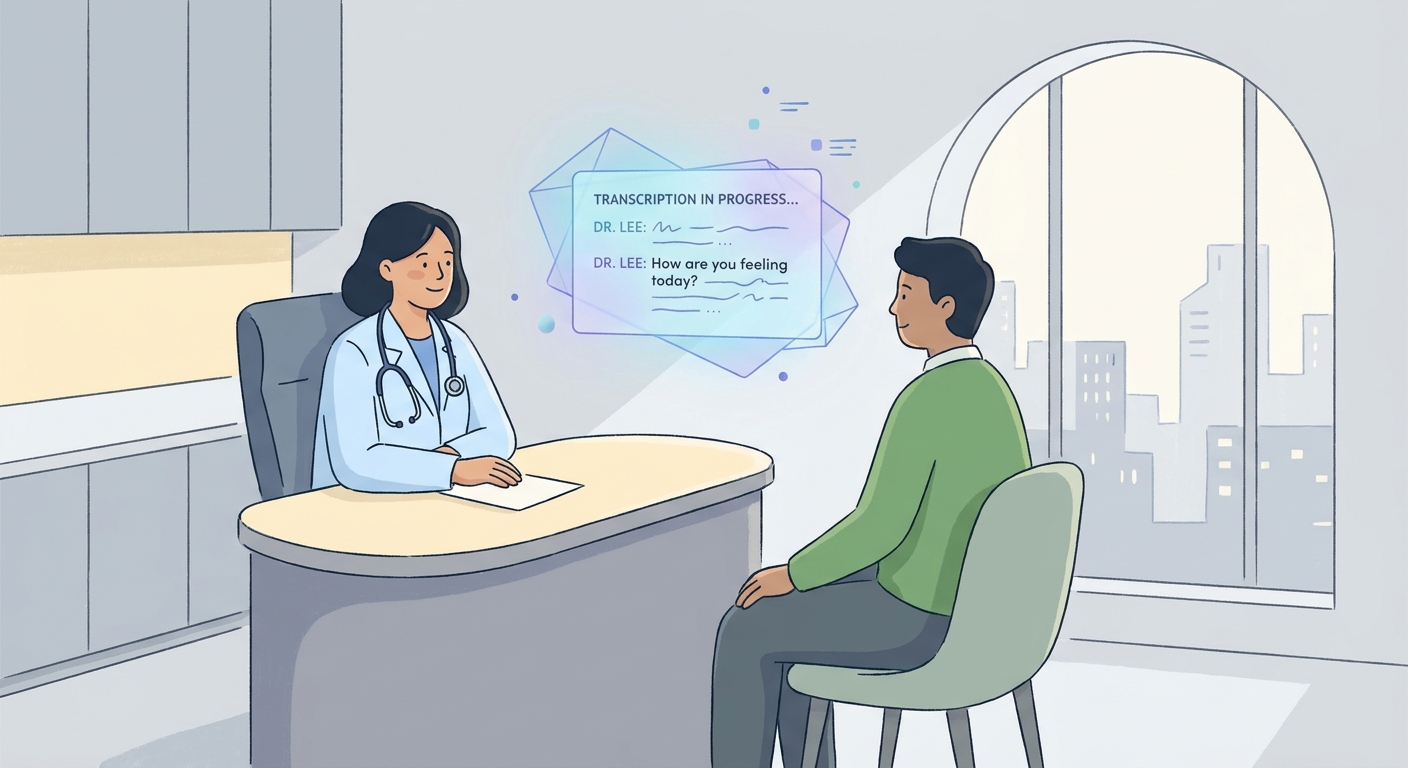
Ambient AI scribes are finally offering us a way out. They aren't just another layer of software; they are a bridge back to why we went to medical school in the first place. By shifting documentation to the background, these tools don't just shave minutes off a shift—they return a physician’s most precious resource: their undivided attention.
Beyond the Dictation Trap: Why Ambient AI is Different
To understand why this tech is a game-changer, we have to bury the ghost of old-school dictation. Remember those clunky voice-to-text tools? They were just mechanical typists. You had to stop your thought, pause your flow, and robotically bark "comma," "period," and "new line" at a microphone. It was a performance, and it destroyed the rhythm of the room.
Ambient AI doesn't ask you to perform. It just listens. It absorbs the messy, human, non-linear dialogue of a real appointment. It picks up the history of present illness, the social cues, and the clinical logic without you ever having to issue a command. It is the silent, efficient partner in the room.
This workflow flips the script. Instead of doing the heavy lifting after the patient leaves, the documentation happens in the background. By using AI-Powered Content Generation to organize the chaos of a real conversation, the technology lets the doctor stay the conductor, not the stenographer.
The Mathematics of Human Recovery
Let’s talk about the numbers, because they are staggering. We aren't just talking about saving a few seconds here and there. Research shows clinicians reclaim roughly 13 to 16 minutes per shift. That might sound modest, but when you scale that across a health system, it’s thousands of hours of life returned to the people who need it most. Check out this AMA research on AI scribes and the human side of medicine.
When you aggregate those minutes, you stop looking at a system that’s constantly on the brink of burnout and start seeing a system that can actually breathe. But the real win isn't just efficiency. It’s the "Human Connection Paradox." When you stop being a data-entry clerk, you can actually look at your patient. You notice the way they hesitate when they mention a symptom. You catch the things that aren't said. You become a doctor again.
The "Human Connection" Paradox
We’ve all been there: the doctor with their back turned, typing away while the patient pours their heart out. It feels cold. It feels transactional. It’s a check-box exercise masquerading as care. Patients feel that distance immediately—they feel like a file, not a person.
When the tech becomes invisible, the dynamic shifts. A Yale Medicine study found that ditching the screen-time burden leads to a 74% drop in burnout. That’s not just a win for the hospital’s bottom line; it’s a massive win for safety. A refreshed, focused clinician is a better clinician. When you remove the barrier of the keyboard, you build rapport. And when you build rapport, patients are far more likely to share the "hidden" info that actually leads to a correct diagnosis. By utilizing efficiency tools for professionals, we stop managing interfaces and start managing people.
The "Human-in-the-Loop" Model: A Non-Negotiable
Here is the trap: thinking you can "set it and forget it." In medicine, that’s a dangerous mistake. You cannot automate human judgment.
We use a "Human-in-the-Loop" model for a reason. AI is incredibly smart, but it’s not infallible. It might catch 95% of a conversation, but it might miss the subtle nuance of a patient’s tone that changes the entire diagnosis. The clinician is the final arbiter of truth. Always.
Think of the AI note as a high-quality draft—a starting point, never the finished product. How you use it depends on your specialty. In a trauma center, the AI might prioritize speed and brevity. In psychiatry, where every emotional shift matters, your oversight needs to be much more granular. The AI builds the frame; you paint the picture.
Ethics, Privacy, and Stewardship
We need to stop asking "Does it work?" and start asking "Is it safe?" The biggest hurdle is data integrity. We are handing over documentation to an "epistemic agent"—a tool that shapes how we document, and by extension, how we make decisions. According to a JAMA Network study on ambient AI efficiency, clinical validation is the only thing that matters.
Demand non-training environments. If a vendor wants to use your patient data to "improve their model," say no. HIPAA compliance is the basement, not the penthouse. Be transparent with your patients. Tell them, "I’m using this tool so I don't have to look at the screen while we talk." Nine times out of ten, they’ll be thrilled you’re actually paying attention to them.
A 5-Step Checklist for Secure AI Scribe Adoption
- Assess Vendor Privacy: If they train their models on your patient data, walk away. Period.
- Pilot with Purpose: Pick one unit. Measure the baseline. See the difference for yourself before going system-wide.
- Establish Verification: Treat every AI note like it was written by a medical student. Review it, verify it, sign it.
- Radical Transparency: Tell your patients what you’re doing. It builds trust, it doesn't break it.
- Continuous Auditing: AI drifts. Check the notes regularly to make sure the quality stays high and no biases are creeping into your charts.
The Future: Invisible Tech, Visible Care
We are finally moving away from the era where being a "good doctor" meant being a "good typist." We are entering an era where the computer should be invisible. Ambient AI isn't just a trend; it is the natural evolution of the clinical space.
The future of medicine won't be defined by how fast you can click through an EHR dropdown menu. It will be defined by how you use the time you've reclaimed. Technology is just the vehicle. The destination is still the same as it has always been: a human connection that fosters healing. By automating the rote work, we finally give ourselves the space to be human again.
Frequently Asked Questions
Will AI scribes replace the need for human medical scribes?
No, they are evolving into a "collaborative pair." The AI handles the rote documentation, while the human adds context, nuance, and final verification. In highly complex cases, the human element remains the final checkpoint for clinical accuracy.
How does ambient AI impact patient privacy?
It depends on the vendor. It is critical to choose systems that offer HIPAA-compliant, encrypted processing. The most secure vendors operate in "non-training" environments, meaning your patient data is never used to teach the model or shared with third parties.
What is the biggest risk of using AI for clinical notes?
The biggest risk is the "omission error," where the AI misses a subtle but critical patient symptom. This is why the "human-in-the-loop" model is non-negotiable; the clinician must always review and verify the AI’s output before it becomes part of the permanent medical record.
Does using an AI scribe make the patient feel uncomfortable?
Generally, no. Studies show that patients actually prefer the increased eye contact and improved engagement that occurs when the doctor isn't focused on a screen. Provided the patient is informed about the tool’s purpose, it typically enhances, rather than inhibits, the therapeutic alliance.