Leading AI Medical Scribes Trusted by Healthcare Professionals

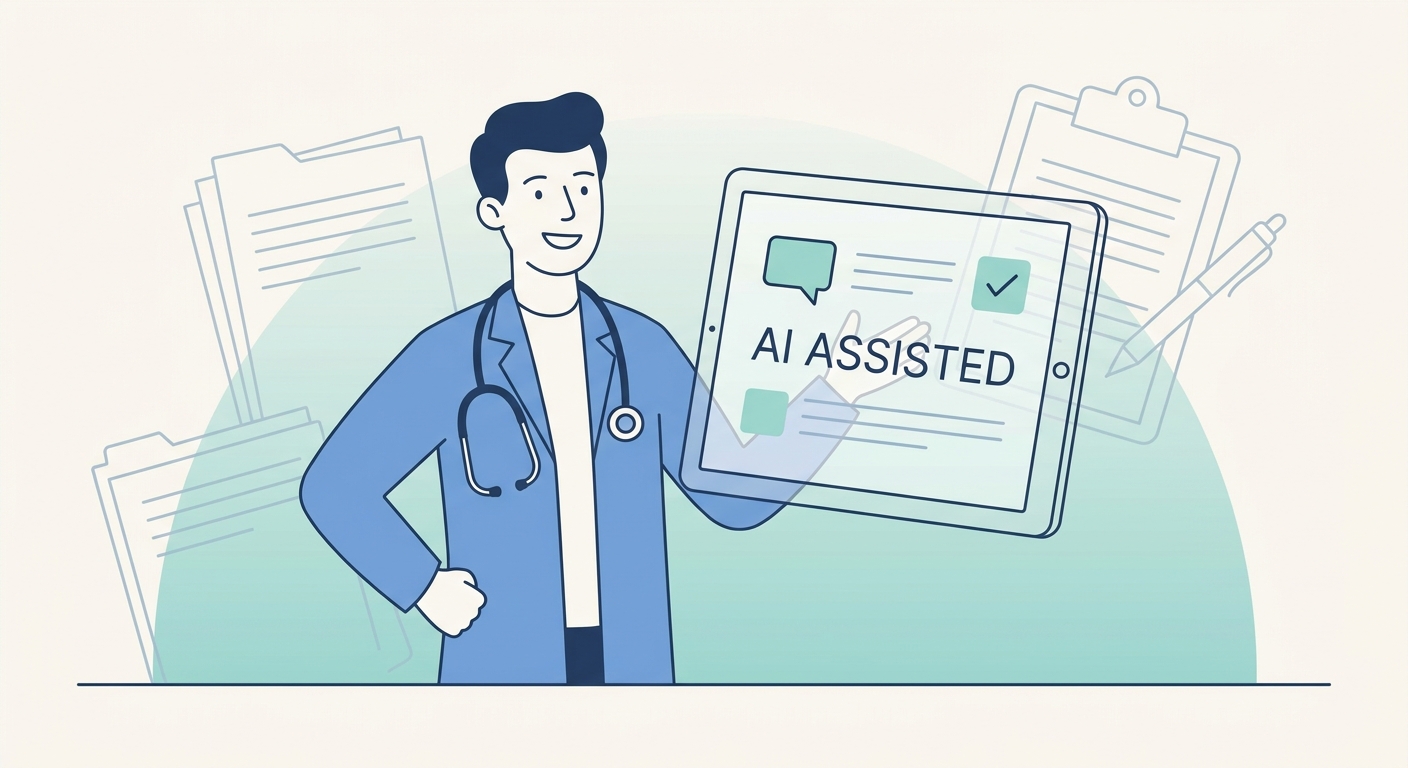
The era of the digital clipboard is dying, and honestly? Good riddance.
For decades, the "after-hours documentation grind" has been the silent killer of physician morale. We’ve forced our best healers to trade dinner with their families for quality time with blinking cursors and soul-crushing EHR fields. The AMA's national physician comparison report describes burnout as "driven by differences in workload, administrative burden, clinical environment, staffing support, and the day-to-day realities of practice," with 41.9% of physicians reporting at least one symptom in 2025, down from 48.2% in 2023 (AMA, Physician burnout rates are falling, specialty gaps remain, retrieved 2026-09-02). SOURCED Administrative burden is one driver among several — an earlier version of this article named it the primary driver and attributed that to a "Physician Burnout Report" the AMA does not publish.
The solution isn't a human scribe hovering in the corner of the room. That model was always a stopgap. The real answer is Ambient Clinical Intelligence (ACI). We’re moving past simple transcription into a world where the software acts as a sophisticated, context-aware partner. If you’re judging an AI tool by its typing speed, you’re missing the point. Trust today is measured by EHR integration, ironclad governance, and the system’s ability to actually reason like a clinician.
What is Ambient Clinical Intelligence (ACI) and Why Does It Matter?
Let’s be real: traditional speech-to-text was just a fancy stenographer. It heard words, typed them, and usually missed the entire point of the patient’s history. It was brittle, annoying, and often wrong.
Ambient Clinical Intelligence is different. It’s a silent, invisible partner. It listens to the natural flow of a consultation—filtering out the coughing, the shuffling papers, and the background noise—and translates that messy human dialogue into clean, structured, and clinically relevant notes.
This isn't just "keyword capture." It’s contextual understanding. When a patient mentions "chest pain," the software doesn't just put those words on a page. It understands the diagnostic weight, connects it to the patient’s history, and suggests the right documentation pathways.
By offloading the cognitive load of note-taking, we finally get to reclaim the "human" part of medicine. When the screen stops being the third person in the room, eye contact returns. The physician stops being an IT worker and starts being a doctor again.
The Methodology: How Do We Define "Trusted" AI Scribes?
Not all AI tools are created equal. In a high-stakes clinical environment, "good enough" is a massive liability. To cut through the marketing fluff, we use a simple "Trust Matrix."
First, Governance is the non-negotiable floor. We demand full HIPAA and SOC 2 compliance, backed by transparent Business Associate Agreements (BAAs). If a vendor gets twitchy when you ask about data residency or encryption, show them the door.
Second, Integration is the divide between enterprise-grade solutions and hobbyist toys. The best scribes offer native, bidirectional connectivity with the big players: Epic, Oracle/Cerner, and athenahealth. If a tool relies on "copy-paste" workarounds or browser extensions that break every time the EHR updates, it’s not saving you time—it’s adding more friction to your day.
Finally, Clinical Efficacy is the gold standard. A trusted AI scribe shouldn't just summarize; it should offer reasoning. It should help with differential diagnosis and suggest billing codes based on what was actually said. It turns the documentation chore into a clinical asset.
Which AI Medical Scribes Lead the Market in 2026?
The market is crowded, but a few tools have separated themselves by building actual infrastructure rather than just slick front-ends.
1. The Enterprise Standard (Deep EHR Integration) These are built for the heavy hitters—large-scale health systems. They prioritize security above all else. They’re designed to handle high-volume, multi-specialty environments where the AI needs to respect complex, pre-existing workflows without causing a system-wide meltdown.
2. The Specialty-Focused Powerhouse A cardiologist doesn't talk like a dermatologist. These platforms get that. By using pre-trained, specialty-specific templates, they offer a "plug-and-play" experience that requires zero tinkering. They capture the shorthand and the diagnostic criteria specific to your field, every single time.
3. The Solo Practice Accelerator If you’re an independent practitioner, you don't have an IT department. You need speed, low cost, and zero headaches. These tools focus on rapid onboarding—getting you up and running in under an hour—with mobile-first interfaces that let you close your charts before you even leave the office.
| Tool Name | EHR Integration | Best For | Compliance Rating |
|---|---|---|---|
| Enterprise-tier (illustrative) | Native EHR integration | Large health systems | Ask for the SOC 2 Type II report |
| Specialist-focused (illustrative) | API-based | Procedural specialties | Ask for the executed BAA |
| Solo-practice (illustrative) | Web-based / EHR sync | Private practice | Ask for the executed BAA |
Why "98% Accuracy" is a Metric of the Past
There is a dangerous obsession in the tech world with "raw transcription accuracy." Vendors advertise word-level transcription accuracy, but that is the wrong metric — and the real error rates are not reassuringly small. A validated evaluation of an LLM ambient scribe found that "hallucinations were detected in 20% of gold notes and 31% of ambient notes" (Frontiers in Artificial Intelligence, 2025, retrieved 2026-09-02). SOURCED ANALYSIS — an earlier version of this article framed the risk as "the missing 2%," which implies a defect rate an order of magnitude below what note-level evaluation actually finds. Review every note as clinical work.
If an AI confuses "patient denies chest pain" with "patient reports mild discomfort," the transcription is technically "accurate" by word count—but clinically, it’s a disaster.
We’re looking for contextual accuracy. We need systems that understand the difference between a patient’s subjective rambling and an objective clinical finding. And the "Human-in-the-Loop" model? That’s not a failure of the AI; it’s a necessary safety net. Modern tools make this easy by highlighting exactly what needs a quick sanity check. As we explore in our guide on how AI is transforming healthcare workflows, the goal is to augment your judgment, not replace it.
The "Total Cost of Ownership" (TCO) vs. "Time Saved"
Most administrators stop looking once they see the monthly subscription price. Big mistake.
The true cost of an AI scribe includes the time your staff spends troubleshooting, the friction of a tool that doesn't integrate, and the sheer frustration of a steep learning curve. A $300 tool that requires constant manual editing may cost more in clinician time than a $600 tool that reliably produces usable drafts.
If you do the math on a physician’s hourly value, those 10 hours aren't just an efficiency gain—they're a massive ROI. By streamlining administrative tasks with AI, you aren't just saving money; you’re preventing burnout and keeping your best people from walking out the door.
Governance, Safety, and the Future of Clinical Trust
The foundation of any AI implementation is the BAA. A Business Associate Agreement isn't just a legal document; it’s a promise of accountability. We only advocate for systems that prioritize local-inference models or strictly regulated, encrypted cloud processing that adheres to the highest HIPAA compliance guidelines for AI.
As the future of ambient clinical intelligence unfolds, we expect to see even tighter integration between scribes and clinical decision support systems. The future isn't just about recording what happened; it’s about using that data to provide better care in real-time. Trust is the currency here. The folks who prioritize safety and clinical rigor today are the ones who will be left standing tomorrow.
Frequently Asked Questions
How do AI medical scribes ensure patient data privacy (HIPAA)?
Ask each vendor for three things in writing: their encryption approach for audio and text at rest and in transit, an executed Business Associate Agreement covering storage, processing and deletion, and their current SOC 2 Type II report. ANALYSIS — note that HIPAA compliance is an obligation of your practice, not a badge a vendor carries; a BAA allocates responsibility, it does not transfer it. This is not legal advice. Many modern systems also employ "local-inference" options, where processing occurs on secure, dedicated servers rather than shared public clouds.
Does an AI scribe replace the need for a human medical scribe?
No. Think of the AI as an "Augmentation" rather than a "Replacement." The AI handles the heavy lifting of drafting and structuring the note, while the "Human-in-the-loop" model ensures the clinician retains final authority. This partnership allows for the speed of automation with the critical oversight of a medical professional.
What happens if the AI makes a clinical error in the note?
Modern ACI tools are designed with "Evidence-Linked Reasoning," which allows the AI to cite the specific part of the transcript that generated a particular note entry. If an error occurs, the clinician can quickly trace the source, correct it, and sign off. The AI is a draft engine; the physician remains the final editor.
How long does it take to train an AI scribe to my specific clinical workflow?
Modern ACI tools are increasingly "plug-and-play." Because they are pre-trained on vast datasets of medical terminology and specialty-specific encounters, the onboarding burden is minimal. Most clinicians find they can achieve full proficiency and seamless workflow integration within a few days of use.
Related reading
- 9 Best Artificial Intelligence Scribes for 2025
- The Future of AI in Medical Scribing
- Top 7 Healthcare Compliance Platforms That Streamline HIPAA Reporting
- How AI Scribes Enhance Efficiency and Preserve Human Interaction
How This Guide Was Sourced
Written and maintained by the LogicBalls editorial team (logicballs.com). This is not clinical, legal or compliance advice.
Sources, retrieved 2026-09-02:
- AMA, Physician burnout rates are falling, specialty gaps remain — burnout prevalence and drivers.
- Frontiers in Artificial Intelligence (2025), Assessing the quality of AI-generated clinical notes — note-level hallucination rates.
- JAMA Network Open, Ambient Artificial Intelligence Use and Clinician Documentation Burden, Productivity, and Efficiency — documentation burden, productivity and efficiency across 1,547 clinicians.
An important clarification about this article. The comparison table describes illustrative categories of product, not named vendors. An earlier version presented three invented product names alongside compliance ratings, in an article titled as a market ranking — including a "Tier 1 (SOC 2 Type II)" label, which is not a real rating. SOC 2 Type II is an audit report, and it has no tiers. If you need a vendor shortlist, ask each candidate for their SOC 2 Type II report and BAA directly rather than relying on any published table, including this one.
Other corrections. This article attributed a causal ranking to an "AMA Physician Burnout Report" that the AMA does not publish, and quoted a ten-hours-per-week time saving that no primary study supports — measured effects are fractions of a minute per note.
No LogicBalls telemetry is used in this guide.