Best 7 AI Tools to Сonvert an AI-Generated College Essay into Natural Writing

If you already tried AI-to-human text converters and still faced AI warnings or awkward essay output, the problem often lies with the tool itself. Not every converter works well for school or college writing.
We reviewed 25 AI humanizers and narrowed the list down to the 7 best options to help you choose the best AI to human text converter. You’ll see how each one handles academic essays and AI detection.
Why Students Look for AI Humanizers Today
Students did not start using AI humanizers by accident. The demand grew because the rules around academic writing changed much faster than students expected. AI became commonly used to write essay drafts, generate ideas, edit, or correct language issues.
At the same time, schools and universities introduced stricter AI policies:
Many institutions actively scan assignments with AI detectors such as GPTZero-style tools or built-in LMS checks. As a result, student work is no longer evaluated only by teachers. It is also judged by automated systems that look for patterns. Even a well-written essay can raise concerns when it follows structures that resemble AI output.
Another major issue is false positives. Students regularly report cases where genuinely written essays receive AI warnings. For example, according to ABC, a major Australian university reportedly accused thousands of students of AI misuse using detection software, and many students claimed the tools were unreliable. Strong grammar and neutral academic tone, things students are taught to aim for, can now work against them
Students also face growing pressure around academic penalties. In some institutions, a flagged essay can lead to extra reviews or formal academic integrity checks. This risk exists even when AI is used only as a drafting aid. Because the rules are often unclear, many students try to reduce any detectable AI patterns before submission rather than risk misunderstandings. Also, surveys of teachers reveal that many schools sanction the use of AI detection tools but admit they lack training to interpret results fairly. In some cases, teachers refer students to formal misconduct proceedings based on detection flags alone.
There is also clear AI content fatigue. AI-generated drafts tend to sound similar across topics. The same transitions, the same sentence flow, and the same balanced paragraphs appear again and again. Teachers notice this quickly. Essays may be correct, but they feel flat and predictable. Students sense this too, especially when comparing their own writing to AI drafts, and seek ways to make AI content more engaging.
AI humanizers respond to this need. When used to rewrite AI essay carefully, they help reduce artificial patterns and restore a more natural voice.
7 Best AI Humanizers for Academic Writing
We checked 25 AI humanizers, both well-known tools and more niche options that students often mention online. The search started on Google and continued through Reddit posts and social media comments, where people talk about real essay writing.
Each shortlisted tool was tested on several essay types: a short coursework essay, a full college essay, a college motivational essay, and a high school literary essay tied to a specific problem topic, to cover different academic levels and assignment restrictions.
For each AI humanizer for academic writing, we looked at:
How stable the results stayed across AI detectors
Grammar quality and readability
Sentence flow and structural changes
How well the text still fit academic writing
Only tools that worked reliably across all essay levels made it into the final list.
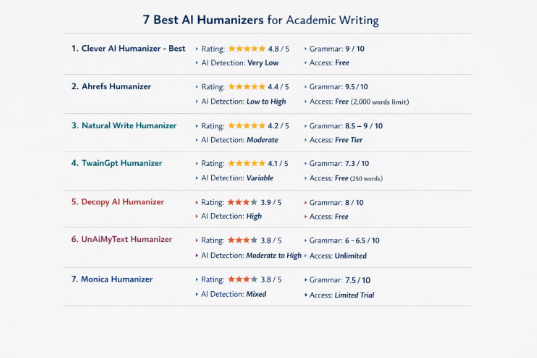
1. Clever AI Humanizer
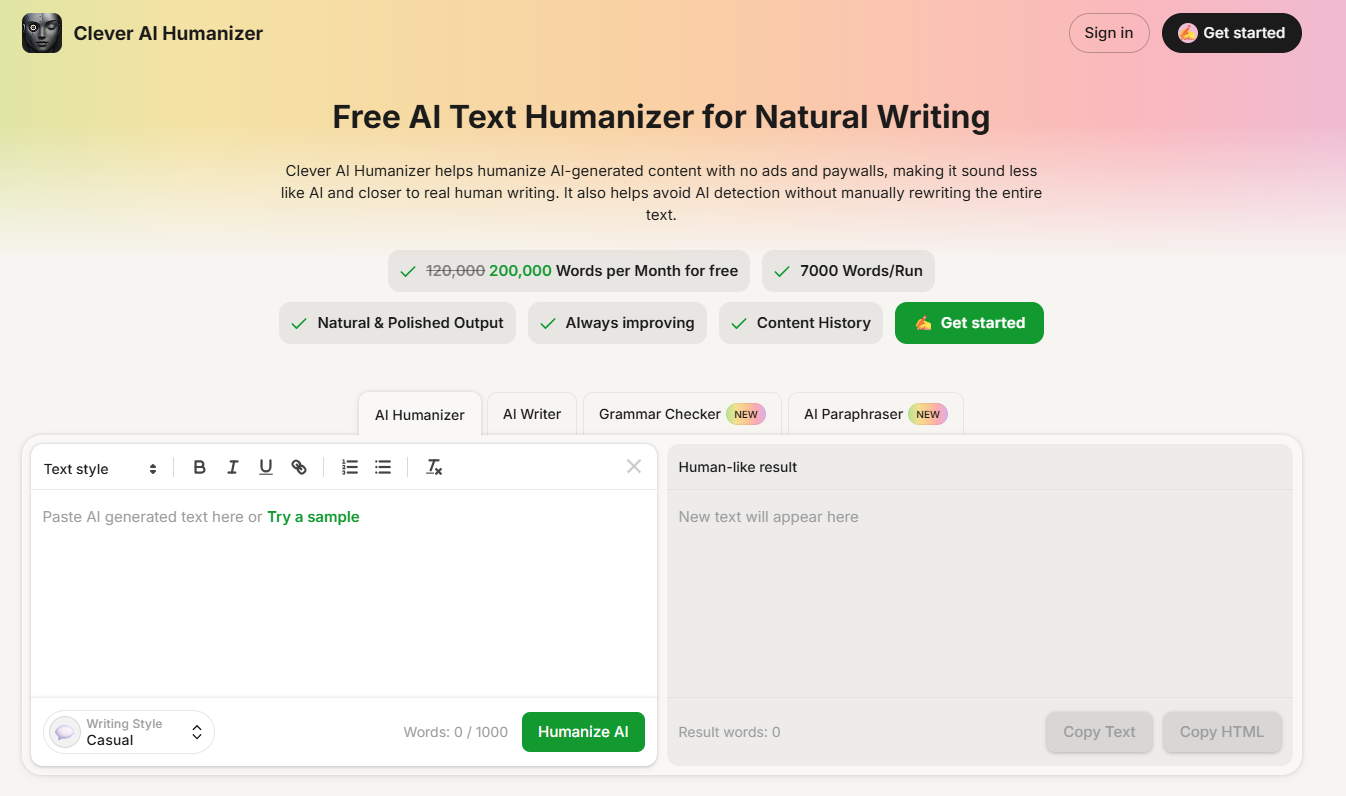
We found Clever AI Humanizer to be the best AI humanizer for improving writing style. At first look, the tool felt simple. The editor opens instantly, without ads or sign-up, and supports up to 3,000 words per request, with no fixed monthly allowance (Clever AI Humanizer, (retrieved 2026-09-02) SOURCED). It also offers writing and humanization in one place through the built-in AI writer, so drafts and rewrites stay in the same interface.
There’s also a built-in content history that saves previous rewrites, which helps compare versions or reuse text.
What stood out during testing was consistency. After tests with GPTZero, ZeroGPT, Writer, and QuillBot, AI scores dropped below 10% on stricter detectors and stayed around 0-4% on simpler ones. This reduction did not come at the cost of grammar. Sentence flow improved, structure looked more natural, and the text kept a consistent academic tone.
Overall rating: ⭐⭐⭐⭐⭐ (4.8 / 5)
Grammar score: 9 / 10
AI detection: Very low and stable on GPTZero and ZeroGPT
Access: Free
2. Ahrefs Humanizer
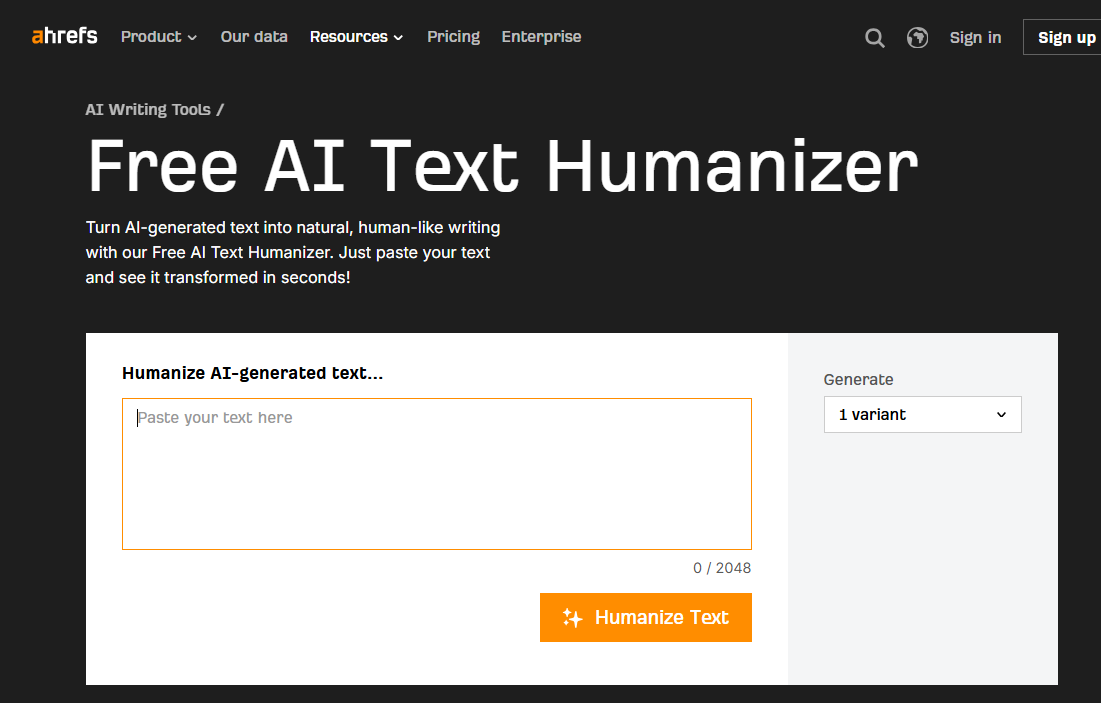
Ahrefs AI Humanizer delivers a very clean and controlled rewrite. The text feels stable across paragraphs, with clear sentence structure and careful wording that stays consistent from start to finish. Longer essays hold together well, without sudden shifts in tone or noticeable drops in quality.
In testing, the tool reduced surface-level AI patterns and improved overall clarity, but detection results varied by system. On simpler detectors such as Writer and similar checkers, AI scores often fell into a lower or mixed range. On stricter tools like GPTZero, ZeroGPT, and Netus.ai, the rewritten text still showed very high AI probability. The rewrite improves style and flow, but it does not fully alter deeper structural signals that advanced detectors look for.
Overall rating: ⭐⭐⭐⭐☆ (4.4 / 5)
Grammar score: 9.5 / 10
AI detection: Low to moderate on simpler detectors; high on strict detectors
Access: free, limited to 2,048 characters per run — roughly 300–350 words, not 2,000 (Ahrefs AI Humanizer, (retrieved 2026-09-02) SOURCED)
3. Natural Write Humanizer
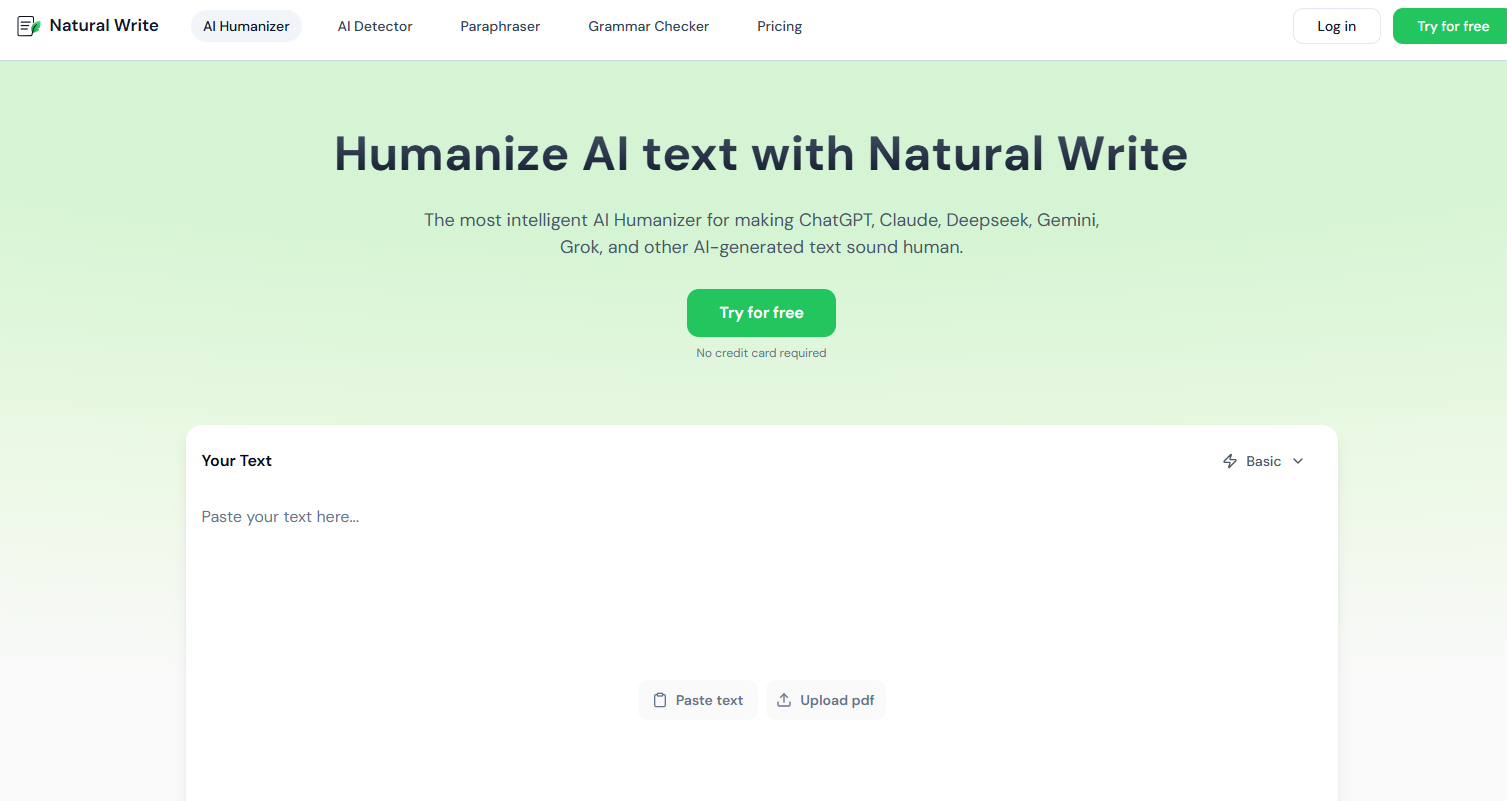
Natural Write AI Humanizer presents itself as a broad, user-friendly option aimed at students and academic writers who want fast results with minimal setup. It offers 300 free words without a card (Natural Write, (retrieved 2026-09-02) SOURCED); the 3,000-word figure an earlier version quoted refers to PDF extraction rather than a per-run limit. The vendor's own wording is "bypass" for detectors including GPTZero, ZeroGPT, Turnitin, Copyleaks, QuillBot, and claims weekly updates based on academic writing samples. The workflow is fast and simple, which explains why it attracts a large student audience.
Natural Write delivers noticeable surface-level changes: essays become smoother, sentence repetition decreases, and overly rigid phrasing softens. Short and mid-length essays benefit the most. However, deeper structure often stays almost unchanged. On longer academic essays, parts of the text still follow an even, template-like rhythm that advanced detectors tend to notice.
Detection results reflect this. Across multiple tests, AI scores dropped to 8-20% on mainstream and simpler detectors, while stricter systems still reported moderate AI probability. The tool improves safety but does not fully reset detection signals in all cases.
Overall rating: ⭐⭐⭐⭐☆ 4.2 / 5
Grammar score: ~8.5–9 / 10
AI detection: GPTZero ~10–20%, ZeroGPT ~8–18%
Access: free tier available, higher limits on paid plans
4. TwainGpt Humanizer
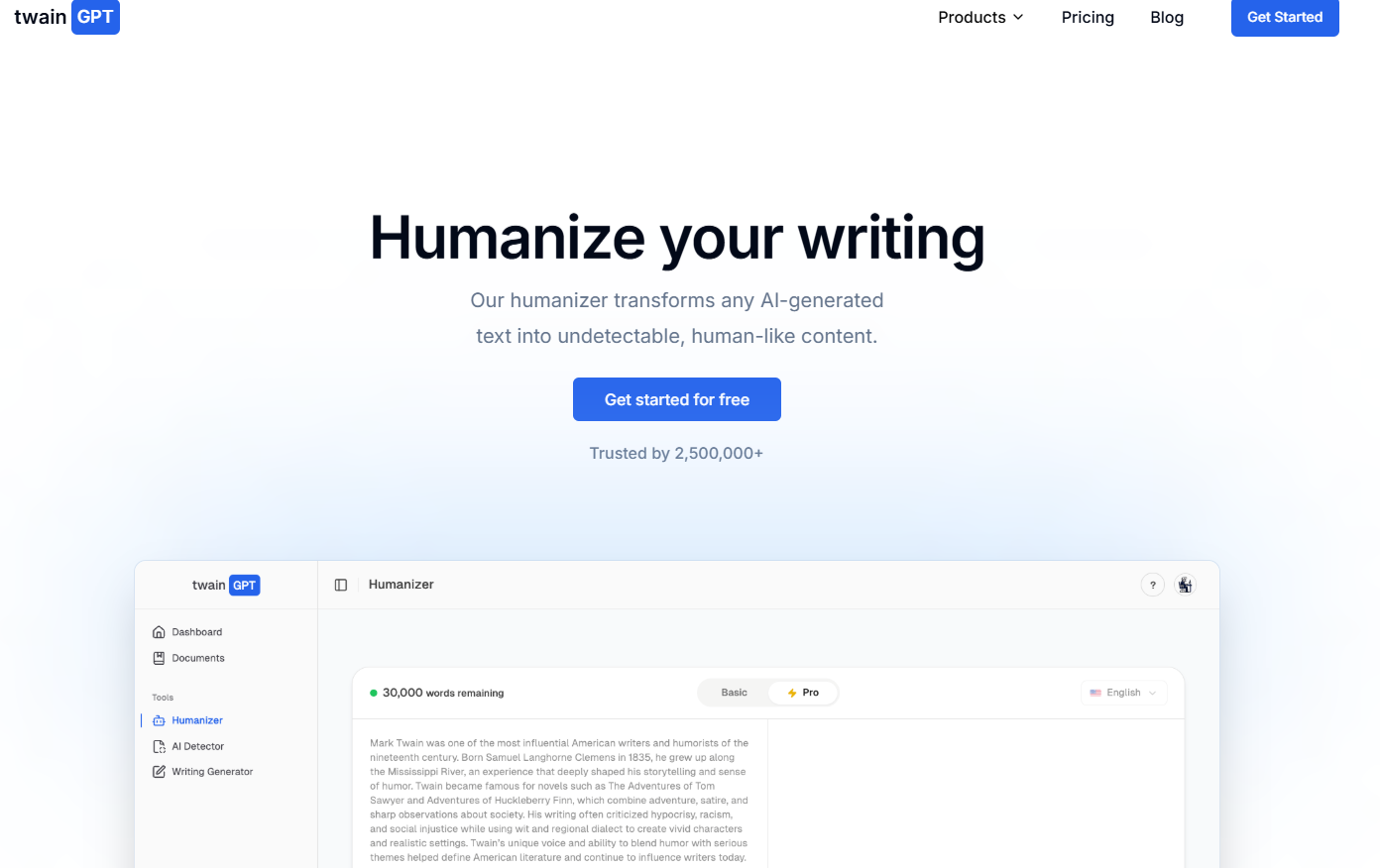
TwainGPT is a combined AI text humanizer + AI detector, which is appealing to students who want quick feedback without switching tools. It offers several rewrite modes and shows AI-likelihood scores before and after rewriting, so users can see how the text changes across detectors.
TwainGPT delivers noticeable but uneven improvements. On essays, sentence structure becomes less repetitive, and some obvious AI patterns disappear. At the same time, longer texts sometimes show small clarity issues or repeated phrasing, which means a short manual pass still helps.
Detection results show partial success rather than a full reset. On ZeroGPT, AI scores often dropped to the 0–18% range, while GPTZero usually reported 4–26% AI depending on the essay type. This is a clear improvement over raw AI drafts, but stricter systems still flagged parts of the content. TwainGPT works best for short to medium essays and lighter academic checks.
Overall rating: ⭐⭐⭐⭐☆ 4.1 / 5
Grammar score: ~7.3 / 10 (varies by text length)
AI detection: depends on the detector, 0 - 26% AI
Access: now sold as Verva (TwainGPT was renamed), with Basic at $8/month, Premium $20 and Ultimate $40, billed annually (Verva, (retrieved 2026-09-02) SOURCED)
5. Decopy AI Humanizer
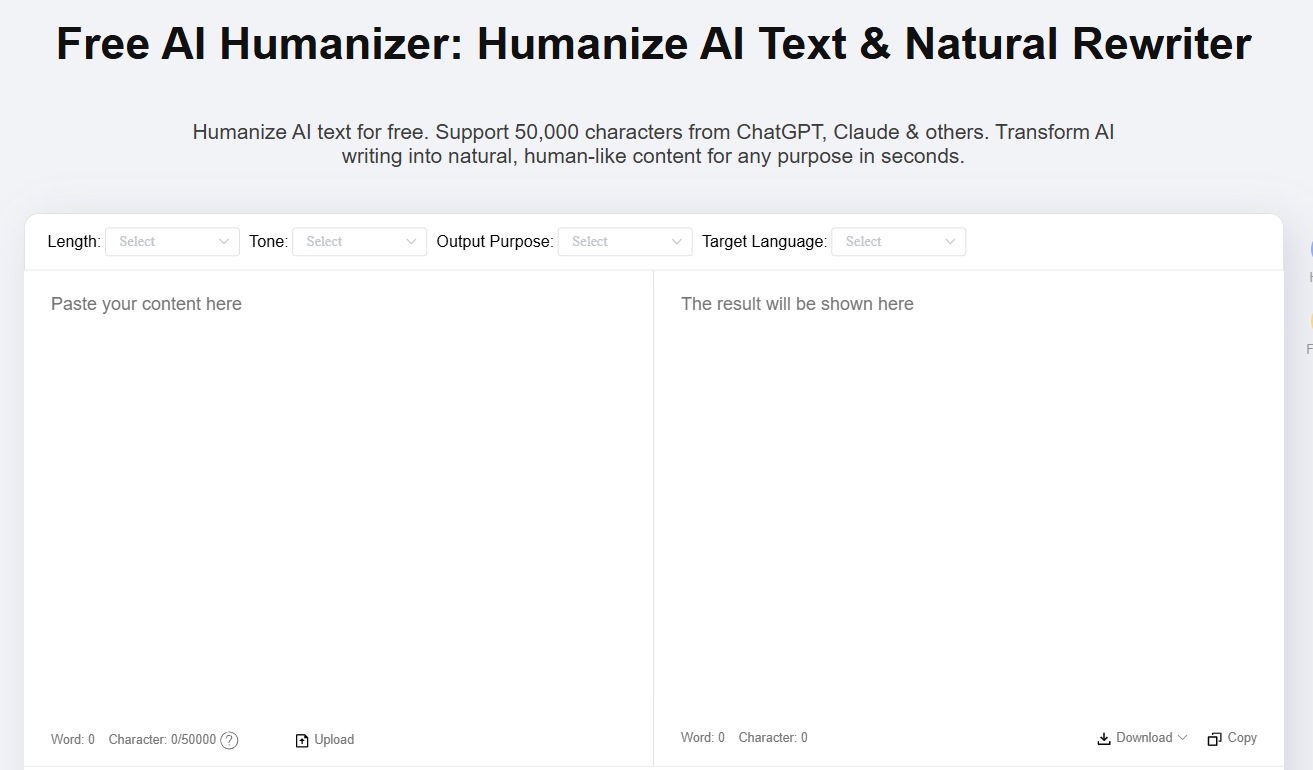
Decopy AI Humanizer often appears in discussions about free AI humanizers for students, especially when someone looks for a tool with no registration or limits. Its main appeal lies in instant access: paste an essay, adjust basic settings, and get a rewritten version right away.
When applied to academic essays, the results proved inconsistent. Checks with GPTZero and Undetectable AI still showed high AI probabilities, often in the 70–90% range. Adjustments to tone or length had little effect on detection outcomes. Grammar generally stayed acceptable, but sentence structure followed repetitive patterns, which made the text easy for detectors to flag. Some outputs also shifted toward a casual tone that did not suit formal school or college assignments.
Overall rating: ⭐⭐⭐☆ (3.9 / 5)
Grammar score: ~8 / 10
Detection: High AI scores on strict and simple detectors
Access: free credits with a 50,000-character per-input cap — not unlimited (Decopy, (retrieved 2026-09-02) SOURCED)
6. UnAiMyText Humanizer
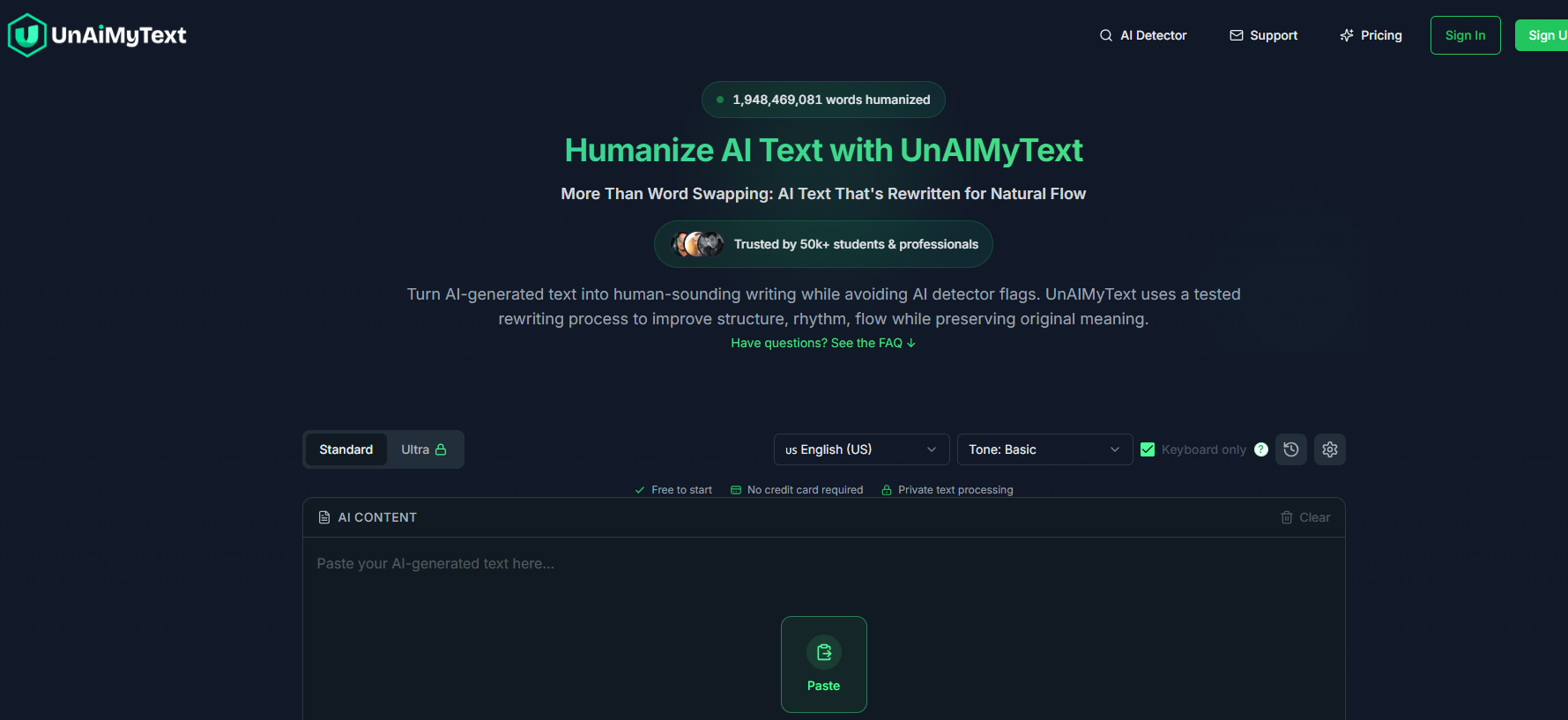
UnAiMyText Humanizer came up in a Reddit post where a user asked for a tool to humanize an AI-generated essay before submission. Many recommended UnAiMyText as an option that could change structure enough to reduce AI patterns. We decided to check how good it really is.
The results felt mixed but workable. The rewritten text usually stayed clear and readable, though longer essays often needed light polishing to smooth sentence flow and word choice. GPTZero and ZeroGPT showed a noticeable drop compared to raw AI drafts, though detection levels remained higher than with the strongest tools in this list.
Still, the output moved far enough away from obvious AI patterns to help in many everyday academic cases.
Overall rating: ⭐⭐⭐☆ (3.8 / 5)
Grammar score: ~6–6.5 / 10
AI detection: ~15–30% (GPTZero), ~10–25% (ZeroGPT)
Access: Unlimited, no registration
7. Monica Humanizer
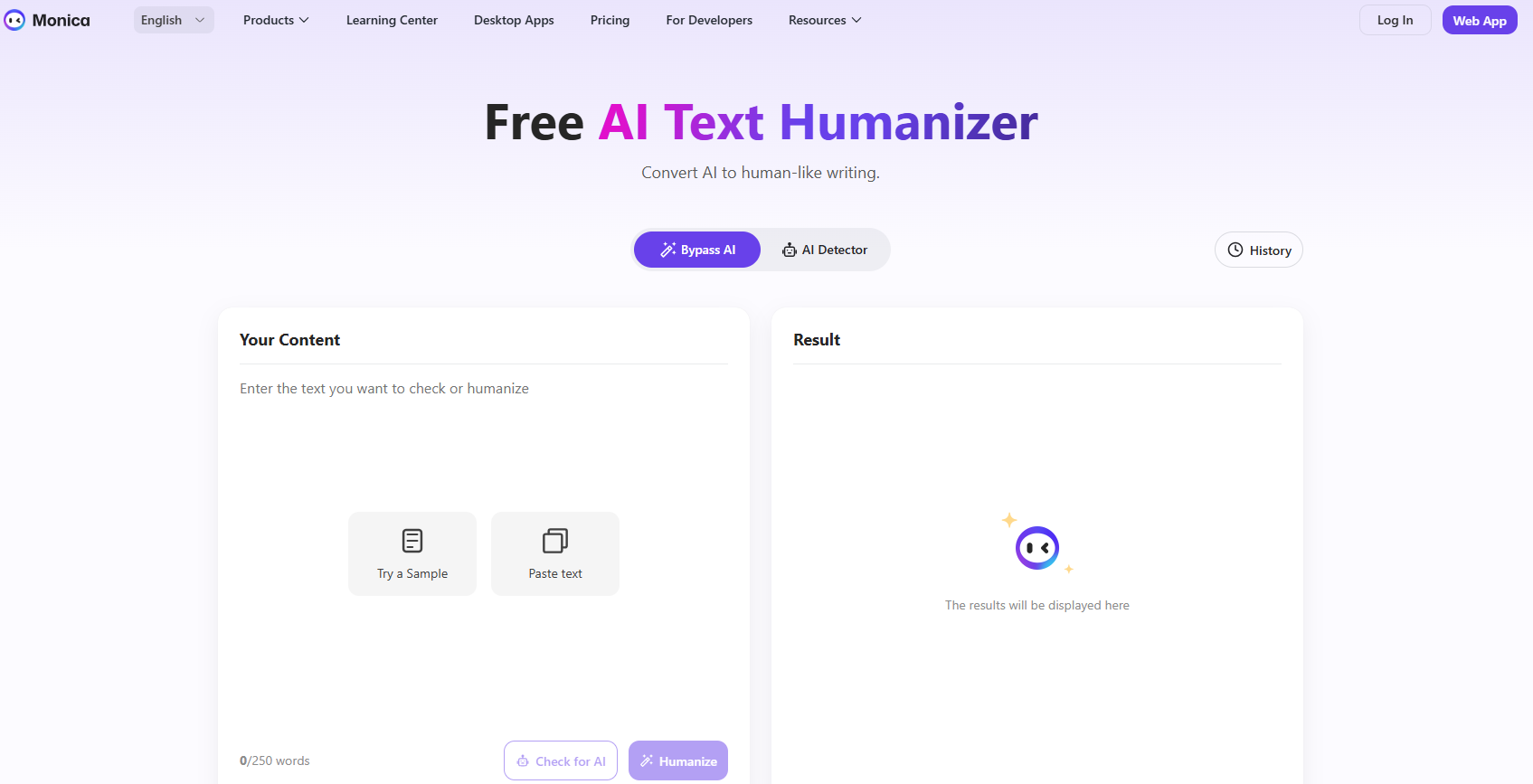
Monica Humanizer is usually one of the first tools that appears in Google search when you look for an AI text humanizer. It is part of the larger Monica AI suite, so the humanizer works as a small feature inside a multifunction platform rather than as a standalone tool. The interface looks modern and convenient, but access comes with clear limits.
The output quality feels somewhat inconsistent. Some rewrites look clean and readable, while others introduce unusual sentence breaks or phrasing choices, especially after repeated use. For short passages, the results can be great, but longer academic texts tend to require extra review.
Detection behavior reflects this variability. On ZeroGPT, scores sometimes drop noticeably. On stricter detectors such , AI signals often remain high. Grammar quality stays at an average level, with occasional formatting quirks, uneven sentence flow, and shifts in tone between paragraphs.
Overall rating: ⭐⭐⭐☆ (3.8 / 5)
Grammar score: 7.5 / 10
AI detection: High on GPTZero, mixed on simpler detectors
Access: Limited trial (about 250 words), account required
Common Student Mistakes When Humanizing Essays
To wrap things up, we want to point out something we noticed while reviewing essays and humanized drafts. Many problems appear not because students use AI humanizers, but because they trust them too much without a final review. In school and college work, the same mistakes repeat again and again, especially when tools are applied automatically rather than thoughtfully:
Single-pass rewriting leaves visible AI traces. One rewrite rarely removes all artificial patterns, so repetition, rigid transitions, or flat conclusions often remain easy to notice.
Over-humanized structure breaks academic logic. Too much sentence variation can disrupt argument flow, which makes the essay feel inconsistent and less academic.
Tone shifts between paragraphs raise questions. After rewriting, some sections may sound formal while others feel simplified, and this contrast becomes obvious in longer texts.
Unnatural word choices weaken credibility. Certain tools replace standard academic terms with expressive or uncommon vocabulary, which keeps grammar correct but makes the writing feel off.
Low detector scores give false confidence. A reduced AI percentage does not hide shallow arguments or vague explanations, and instructors often spot these problems without any software.
AI humanizers work best as a finishing step that supports clear structure and solid reasoning after using AI as essay writer.
Closing Note
After testing all tools, Clever AI Humanizer produced the most stable results across detectors. ANALYSIS — an earlier version of this article described it as "a world leader in bypassing" detectors. The vendor makes no such claim; its own Responsible Use Statement says "what you do with the tool is your responsibility, and the rules that apply to you still apply," naming institutional integrity policies specifically. It has strong grammar, and minimal need for edits. Across all our evaluation criteria, it ranked number one overall.
That said, the other tools still make sense in specific situations: Ahrefs Humanizer works well for clean grammar, Natural Write AI Humanizer and TwainGPT suit shorter essays with lighter checks, while UnAiMyText, Decopy, and Monica Humanizer fit quick rewrites but need extra review. The right choice depends on your essay type, detector risk, and how much editing you plan to do before submission.
Before You Use Any Tool In This Guide
Unauthorised use of AI in assessed work is academic misconduct at most institutions, and editing or rewriting the output does not change that. The University of Oxford's policy for MSc dissertations states that unauthorised AI use "is the presentation of work produced wholly, or in part, by AI as your own," and that it "is still academic misconduct, even if the student amends the AI output" (University of Oxford, retrieved 2026-09-02). SOURCED Sanctions range from mark deductions to expulsion, and the same policy requires that permitted AI use "has to be declared."
Read your institution's policy, use AI only where it permits, and declare it. A lower detector score does not make undeclared AI use permissible — it makes it harder to detect, which is a different thing.
On detector reliability, in both directions. Detectors do produce false positives, and research has found they "consistently misclassify non-native English writing samples as AI-generated, whereas native writing samples are accurately identified" (Liang et al., Patterns, retrieved 2026-09-02). SOURCED That is a real injustice — and the remedy for it is your institution's appeals process and its policy on evidence, not a rewriting tool. Note that in the Australian case cited in this article, "any case where Turnitin's AI detection tool was the sole evidence was dismissed immediately."
Related reading
- Crack the Code to the Best Essay Writing Service Today
- Unleashing AI Essay Writer: 16 Best AI Essay Generators in 2025
- What Are the Components of an Essay? A Simple Breakdown for Students by EssayHub
- Can AI Humanizers Help to Humanize AI Content? A Detailed Guide
How This Guide Was Sourced
Written and maintained by the LogicBalls editorial team (logicballs.com). Disclosure: LogicBalls builds AI writing tools.
Corrections. Every vendor specification in an earlier version of this article was wrong when checked against the vendor's own live page — word limits overstated by up to tenfold, a character limit reported as a word limit, a credit-capped tool described as unlimited, and one product reviewed under a name it no longer trades as. All are corrected above with links.
The detector scores quoted throughout this article are not reproducible. No methodology, sample or date was recorded for them, and detector outputs shift with every model update. Treat them as impressions from one session, not measurements.
No LogicBalls telemetry is used in this guide.