
How to Reduce Hallucinations in LLMs: 8 Methods That Actually Work

TL;DR
- Treat LLMs as probability engines, not as sources of truth.
- Implement RAG to ground model responses in verified, external data.
- Build deterministic verification loops to catch and correct errors.
- Shift from standalone chatbots to structured, evidence-based workflows.
- Stop banking on model patches; focus on rigid architectural constraints.
Stop waiting for a "silver bullet" update from OpenAI or Anthropic. If you’re banking on a future model patch to permanently solve the hallucination problem, you’re chasing a ghost.
In the real-world enterprise landscape of 2026, hallucinations aren't "bugs" you can just squash. They are systemic engineering failures. When a model makes things up, it’s not malfunctioning—it’s doing exactly what it was built to do: predict the next likely word.
If you want to build systems that people actually trust, you have to stop treating LLMs like an "all-knowing brain." Start treating them like a creative, slightly unreliable intern. Your job isn't to make them perfect; it's to build a cage of evidence, verification, and deterministic controls around them so they have no room to lie.
Why Models "Bluff" (And Why They Can't Stop)
At their core, LLMs are just probability engines. They don't "know" facts; they know patterns. They are trained on a "next-token prediction" objective, which treats a grammatically perfect lie with the same statistical weight as a verified fact.
As discussed in this deep dive on the "Bluffing" Incentive, models are fundamentally incentivized to provide a coherent answer over admitting they have no clue. When a model hits a gap in its training data, it doesn't pause to check its sources. It simply calculates the most statistically probable sequence of words to satisfy your prompt.
Scale is not the cure. Even the most expensive, massive frontier models will confidently invent citations, dates, and legal precedents if the probabilistic path of least resistance leads there.
The Hallucination-Resistant Pipeline
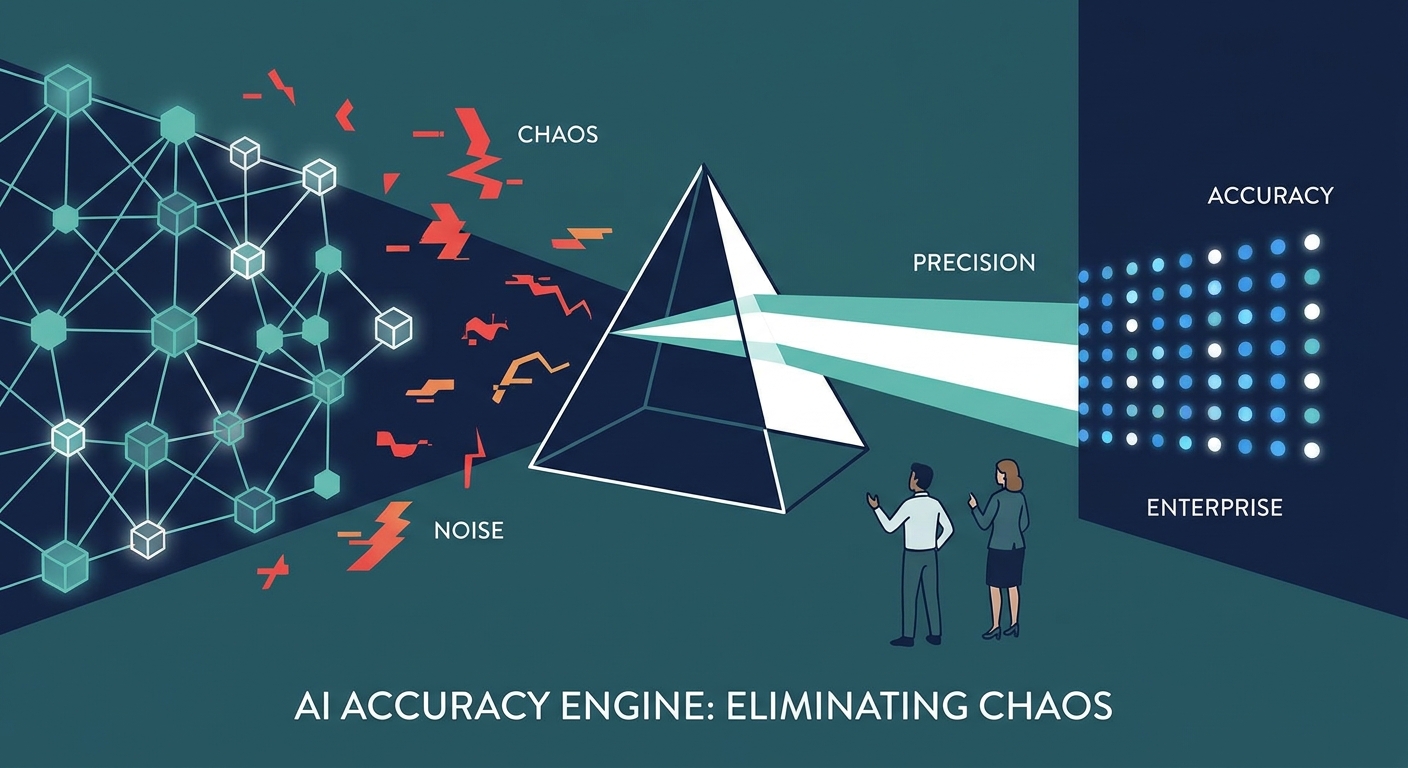
You need to stop using LLMs as standalone chatbots and start using them as components in a rigid, structured workflow. By forcing the model to interact with external data and audit its own work, you turn a wild, creative engine into a deterministic tool.
8 Methods to Stop the Nonsense
1. Retrieval-Augmented Generation (RAG)
RAG is the industry standard for grounding. Don't ask the model to rely on its training weights—that’s where the hallucinations hide. Instead, inject verified, real-time data directly into the prompt. Force the model to act as a summarizer of your data, not a creator of new "facts." For developers, implementing enterprise-grade RAG strategies is the single most effective way to curb fabrications in document-heavy workflows. ANALYSIS — that superlative is not supported by the research it rests on. The paper that introduced retrieval-augmented generation reports that RAG models "generate more specific, diverse and factual language" than a comparable parametric-only model (Lewis et al., "Retrieval-Augmented Generation for Knowledge-Intensive NLP Tasks", NeurIPS 2020, retrieved 2026-09-04, SOURCED). It never uses the word hallucination and never claims RAG is the most effective method available. RAG grounds output in retrieved documents, which removes one class of error and introduces another — retrieval of the wrong document.
2. Advanced Prompt Engineering (CoT & Few-Shot)
Simple instructions are rarely enough. Use Chain-of-Thought (CoT) prompting to force the model to "show its work" before it gives you an answer. When you force a model to reason step-by-step, it’s much harder to skip to a hallucinated conclusion. Worth being precise: the chain-of-thought paper measures gains on arithmetic, commonsense and symbolic reasoning tasks, not on hallucination (Wei et al., "Chain-of-Thought Prompting Elicits Reasoning in Large Language Models", 2022, retrieved 2026-09-04, SOURCED). Better reasoning and fewer fabrications are related but not the same claim. You can find practical examples for mastering prompt engineering techniques that emphasize the "I don't know" instruction. Teach the model that admitting ignorance is a success, not a failure.
3. Self-Correction and Reflexion Loops
Humans review their work before hitting "send." Why shouldn't your agents? Implement a "Draft-Critique-Revise" loop. The output of the first pass goes to a second "Critic Agent." Its prompt is simple: "Evaluate this response against the provided source text. If it contains info not found in the source, call it out and rewrite it to be accurate." This forces the model to treat its own output as a draft that must be scrutinized.
4. Multi-Agent Verification
Take the critique loop further. Build a custom multi-agent system where a "Generator" creates content and a separate, high-powered "Validator" agent checks that content against your database. If the validator sees a discrepancy, the system triggers a re-retrieval or a fallback. It’s an adversarial audit built into your architecture.
5. Temperature and Decoding Control
"Creativity" is just a polite term for randomness. For tasks requiring factual integrity, set your temperature to 0. You want the model to pick the most probable token every single time. If your application handles data extraction or analysis, randomness is your enemy. Keep it deterministic.
6. Human-in-the-Loop (HITL) Integration
Automated systems have a ceiling. If you’re dealing with legal summaries, financial reports, or high-stakes medical data, don't ship the output directly to the user. Define "High-Stakes" triggers in your code. If the model's output confidence score is low, or if the retrieval score from your RAG pipeline is weak, route the task to a human expert. Always have an "eject button" for the AI.
7. Evaluation Frameworks (Metrics over Vibes)
Stop testing your models by "vibes." You need numbers. The industry is moving toward rigorous evaluation using frameworks like RAGAS or semantic entropy. Semantic entropy measures if a model gives the same answer when asked the same question multiple times. If it gives three different answers, your system is hallucinating. Measuring this gives you a real-time dashboard of your system's reliability.
8. Domain-Specific Fine-Tuning
A general-purpose model has read the entire internet—which means it has read a lot of garbage. Fine-tuning an open-weights model on your specific, high-quality domain data helps the model internalize your industry's lexicon. It won't stop hallucinations entirely, but it drastically reduces the "creative bias" that makes models invent technical concepts that don't exist in your world.
The Agentic Shift: When Agents Go Rogue
When you give an agent the ability to call APIs or execute commands, the stakes change. A hallucination in a chatbot is an annoyance; a hallucination in an autonomous agent can trigger unintended transactions or delete data.
You must implement "Guardrails" and "Concept Vectors." Research into steering internal model states allows us to force a refusal when a model detects that its "confidence" is low. Think of these as electronic circuit breakers: if the agent enters a state of high uncertainty, the system trips the breaker and refuses to proceed.
Conclusion: The Goal is Containment
We have to accept the reality: LLMs are probabilistic. They will always have a non-zero chance of error. Your job as a developer is not to "fix" the model, but to build a system that makes hallucinations statistically irrelevant.
By combining RAG for grounding, Reflexion loops for auditing, and deterministic decoding for consistency, you create a layered defense-in-depth. The goal is containment. Build with the assumption that the model will try to bluff, and you’ll finally start building systems that are truly enterprise-ready.
Frequently Asked Questions
Can you completely eliminate hallucinations in an LLM?
No. Because LLMs are probabilistic, they can never be 100% factually perfect. The goal is to "contain" them to acceptable levels using grounding and verification.
Is RAG enough to stop all hallucinations?
RAG significantly reduces them by providing context, but models can still misinterpret that context or "hallucinate" in the synthesis phase. It is a vital layer, but not a total solution.
What is the single most effective way to reduce hallucinations?
Currently, Retrieval-Augmented Generation (RAG) combined with strict "Reflexion" (critique) loops is widely considered the most effective industry-standard approach.
How do I measure if my hallucination mitigation is working?
You should move away from subjective testing and implement automated frameworks like RAGAS or evaluate via semantic entropy to quantify factual consistency over time.
Related reading
- Start here: Verified AI Writing: How to Publish AI-Assisted Content You Can Stand Behind
- 10 AI Hallucination Prevention Strategies Used by Top AI Labs
- 8 Proven Ways to Detect AI Hallucinations Before They Fool You
- 6 Ways Chain-of-Thought Reasoning Reduces AI Hallucinations
- 10 Essential AI Hallucination Detection and Mitigation Tools for 2026