
The traditional contract negotiation process is a relic. It’s a dinosaur from an era that valued "administrative stamina"—the ability to suffer through endless email chains—over actual business velocity.
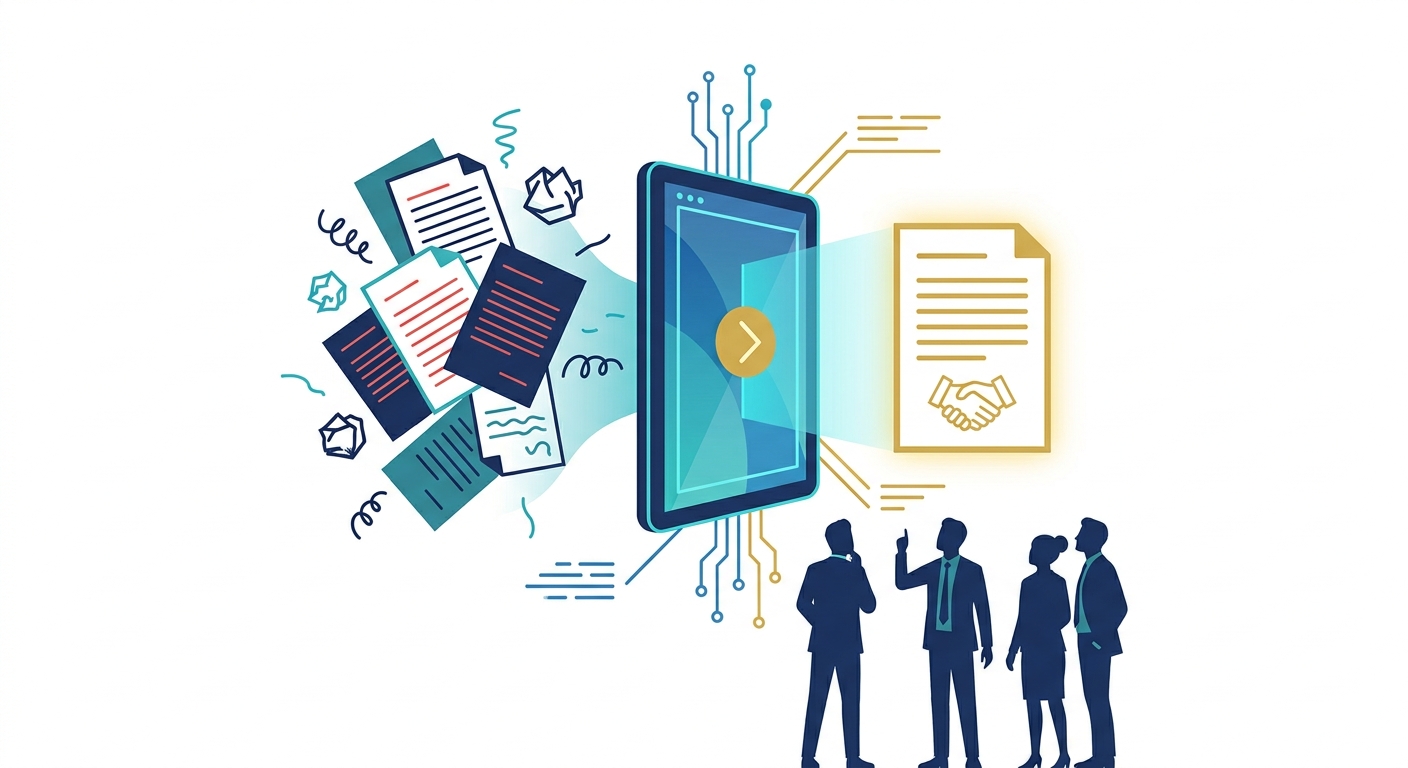
Right now, your legal team is likely trapped. They’re stuck in a "3-to-5 round" redlining purgatory, burning their most expensive hours manually comparing clauses against dusty, outdated spreadsheets. According to World Commerce & Contracting Benchmarks, this back-and-forth isn't just annoying; it’s the primary bottleneck strangling modern revenue operations.
Here is the reality for 2026: The shift toward AI-powered negotiation isn't about firing your legal team. It’s about liberating them. By letting AI handle the mind-numbing pattern-matching of clause alignment, in-house counsel can stop being document gatekeepers and start acting like high-level strategic architects.
Why the Traditional Redlining Process is Broken
The status quo is a hidden tax on your entire organization. Think about it: when a contract hits the redlining phase, "lawyer-to-lawyer" variance becomes a massive liability. One attorney marks up an indemnity clause with a specific preference; another ignores it entirely. Suddenly, you have a fragmented, inconsistent risk profile across your entire portfolio.
This isn't just a delay—it’s a "black box" of risk. When legal teams are drowning in volume, they lose the ability to spot the nuances that actually matter.
Manual effort is a dead end. When your team is buried in email attachments and version control chaos, the business grinds to a halt. Every extra round of negotiation adds days to the Sales cycle. Without a centralized source of truth, you aren't negotiating for the best outcome; you’re compromising speed for a false sense of security.
How Do AI-Powered Negotiation Tools Actually Work?
The secret sauce is "Playbook-First Architecture."
Stop thinking of a contract as a static Word document. Start thinking of it as a data structure. Modern AI maps every incoming clause against your company’s pre-defined fallback positions. If a counterparty tries to sneak in a limitation of liability that falls outside your risk threshold, the AI flags it instantly and suggests your pre-approved, "company-friendly" language.
This is augmentation, not replacement. The AI is your high-speed filter. It does the heavy lifting—identifying non-compliant language and suggesting alternatives—so your human lawyers only step in when the stakes are high enough to require real judgment.
Manual vs. AI-Assisted Negotiation: The Breakdown
| Feature | Manual Negotiation | AI-Assisted Negotiation |
|---|---|---|
| Turnaround Time | 3-5 Rounds (Days/Weeks) | 1-2 Rounds (Hours) |
| Risk Exposure | High (Human Error/Variance) | Low (Standardized Guardrails) |
| Consistency | Low (Varies by Attorney) | High (Playbook-Driven) |
| Human Effort | High (Repetitive Review) | Low (Strategic Oversight) |
As noted in The Future of Legal Tech 2026, the transition from simple automation (doing the same task faster) to augmentation (changing the nature of the task itself) is where the real competitive edge lies.
Standardize Before You Automate
AI is a force multiplier, but it cannot fix broken foundations. If your contract templates are messy, inconsistent, or non-existent, feeding them into an AI engine is just automating your own chaos. You need to clean house first.
Standardizing Your Contract Templates is the non-negotiable first step. When your templates are modular and clean, the AI can map your clauses with surgical precision. If you’re still struggling with the document creation phase, look into Automating Document Workflows to ensure every contract starts from a high-quality, pre-approved baseline. Remember: if the input is flawed, the output will be too.
Where Human Judgment Still Rules
Even the smartest AI needs a "Human-in-the-Loop" (HITL) mandate. There are critical junctures—complex M&A, aggressive litigation risks, high-stakes partnerships—where human intuition is irreplaceable.
The AI can flag a clause as "high risk," but only a lawyer can decide if that risk is worth taking to close the deal. As discussed in AI for Lawyers: A Practitioner's Guide, the goal is to reserve human brainpower for "walk-away" triggers and strategic maneuvering. You are the architect; the AI is just the drafting tool.
Vetting Your AI Negotiation Tool
Don't buy into the flashy demos. Most vendors will show you a "best-case scenario" that doesn't exist in the real world. Ask these five questions instead:
- How does this integrate with our specific playbook? (Avoid tools that force generic, one-size-fits-all terms.)
- How do you handle data privacy for sensitive clauses? (Prioritize enterprise-grade security and local hosting.)
- Can the AI learn from our internal historical redlines? (Look for tools that actually adapt to your firm's specific style.)
- How does the system handle "complex" vs. "standard" clauses? (Make sure it doesn't try to over-simplify high-risk legal language.)
- What is the workflow for human overrides? (The process must be seamless, not a friction-heavy barrier.)
Industry Nuances: SaaS vs. Procurement vs. M&A
The "one-size-fits-all" trap is where most AI implementations go to die.
- SaaS Agreements: These are high-volume. Speed is everything. Set your AI to "semi-autonomous" mode to handle routine deals without legal intervention.
- M&A or Procurement: These are high-risk. The AI should be in "alert-only" mode, acting as a research assistant that highlights discrepancies rather than suggesting automatic changes.
Tailoring your settings to the specific risk profile of the contract type is the hallmark of a mature Legal Ops leader.
Implementation Checklist for Legal Ops Leaders
- Phase 1: Standardization. Strip away the legacy templates. Get your core language consistent.
- Phase 2: Playbook Digitization. Define your "fallback" positions for every major clause. If it isn't documented, it can't be automated.
- Phase 3: Pilot Testing. Start small. Pick one low-risk, high-volume type (like NDAs) and test the AI’s performance.
- Phase 4: Scaling. Measure your success against the "3-5 round" benchmark. Once you see the cycle time drop, roll it out to more complex agreements.
Frequently Asked Questions
Does AI replace the need for a lawyer in contract negotiations?
No. AI handles the repetitive comparison and language alignment, allowing lawyers to focus on high-stakes decision-making and negotiation strategy.
What is a "Contract Playbook" and why does AI need it?
It is the digital rulebook for your company’s acceptable terms. AI requires this to automatically flag risky clauses and suggest approved fallback language that aligns with your company's risk appetite.
How does AI handle redlining differently than standard track changes?
Unlike passive track changes, AI provides immediate context, risk-level scores, and intelligent suggestions based on your company's established precedents, rather than just showing raw text edits.
Is AI-powered negotiation safe for sensitive legal data?
Yes, provided you select enterprise-grade tools that prioritize data privacy, robust encryption, and secure, localized data hosting, ensuring your proprietary information remains protected.