
How to Leverage AI Automation for Profit Generation

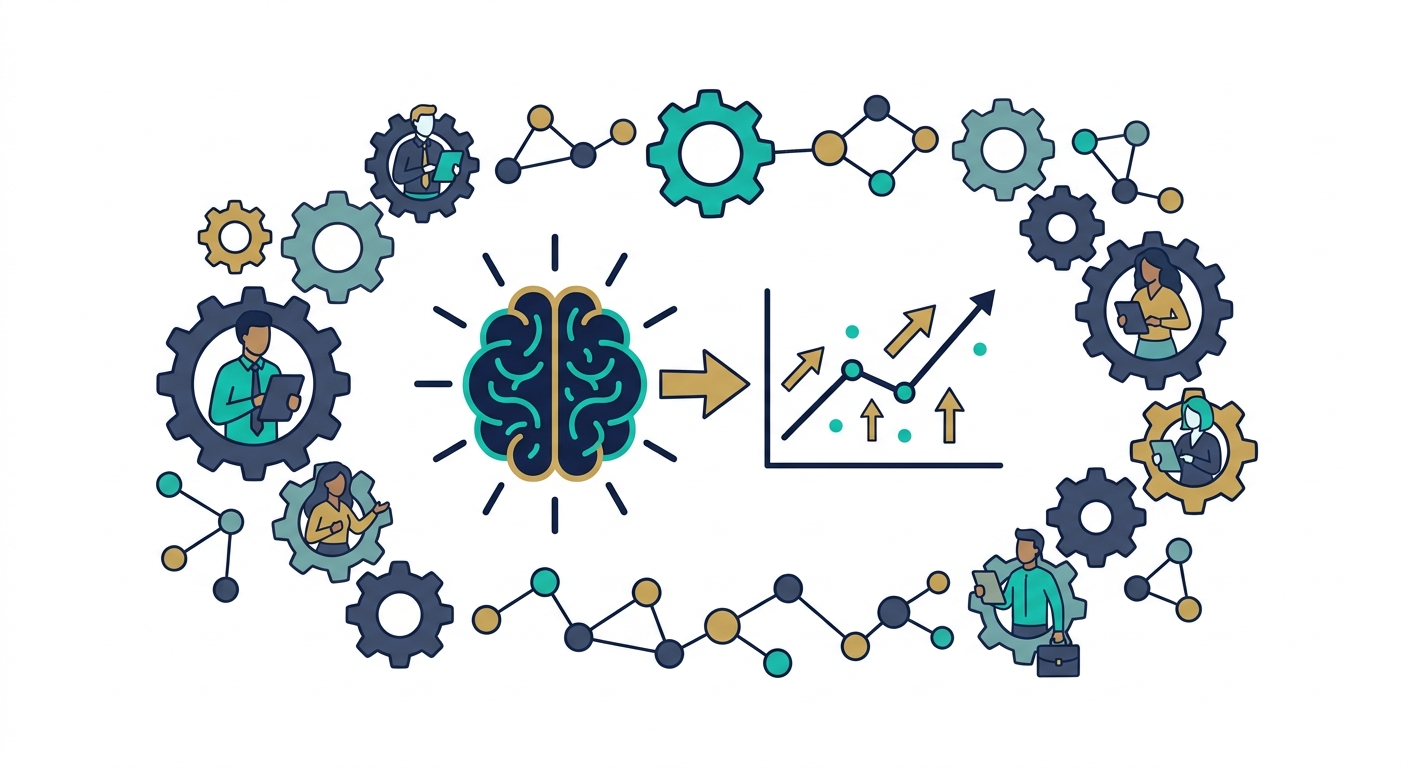
Profitability in 2026 isn't about how many hours your team logs. It’s a math problem. It’s a calculation of your Automation Ratio—the percentage of your revenue generated while you’re doing literally anything else.
The novelty phase? It’s dead. We’re done playing with chatbots for fun. The smartest companies today aren’t using AI as a "creative assistant." They’re using it as an operational backbone. If your business model still relies on hiring more people just to scale your revenue, you’re already losing. You’re playing an old game with a broken playbook. Real profit now comes from building agentic systems that execute, iterate, and optimize while you sleep.
What is the State of AI Profitability in 2026?
The market has finally moved past the "AI Hype" bubble. We’re in the cold, hard reality of unit economics now. Nobody cares if your tool can write a polite email anymore. We care about systems that can process a refund, update a CRM, and reconcile a ledger without a human ever touching a mouse.
We’re seeing a rise in something I call Negative Labor Churn. The most profitable companies are scaling revenue into the millions while keeping their headcount flat—or even shrinking it. As noted in the PwC 2026 AI Business Predictions, the competitive advantage has shifted. It’s no longer about who has the biggest team; it’s about who has the most efficient architecture. If you’re still hiring admin staff for manual data entry or basic customer routing, you’re leaking margin. Your competitors are busy capturing that profit through automated agents.
How Do You Optimize Your "Automation Ratio"?
The core of your profit strategy is the cost of intelligence. Too many founders make the rookie mistake of using a sledgehammer to crack a nut. They deploy massive, expensive frontier models for tasks that require nothing more than simple categorization or basic data extraction.
To maximize margins, you have to adopt Model Orchestration. You need to route tasks based on complexity. If it’s a simple sentiment analysis, use a small, specialized language model (SLM) that costs a fraction of a cent. Save your heavy-duty, expensive models for complex, multi-step reasoning.
By segmenting your workload, you stop the "intelligence waste." You ensure that every single dollar spent on API tokens translates directly into a higher net margin.
Are You Building "Agentic Workflows" or Just Chatbots?
There is a massive chasm between a reactive chatbot and a proactive agentic workflow. A chatbot sits there and waits for you to talk to it. An agentic system? It initiates action. If you want to Automate Your Workflow, you have to stop obsessing over interfaces and start obsessing over outcomes.
Agentic systems are the engine of 2026. These are autonomous clusters that monitor your CRM, trigger marketing sequences based on real-time behavior, and manage financial reconciliation. As discussed in Forbes’ 10 Predictions on Automation, the future of work isn't about human-AI collaboration in a little chat box. It’s about human-defined objectives executed by autonomous agents. If your AI isn't pulling data from your database and pushing it to your execution layer without your supervision, you haven't built an agent. You've built a toy.
Why Is the "Data-Network Effect" Your Only True Defensibility?
If you’re just building a "wrapper" around an existing API, you are one update away from obsolescence. Seriously. Your defensibility has to come from your data. You want to build a flywheel where every customer interaction feeds back into your system. This fine-tunes your internal models to be slightly more accurate, more personalized, and more efficient than the generic version you started with.
This creates a barrier to entry that capital alone cannot overcome. When your system learns the specific nuances of your customers' pain points better than a generic model ever could, you stop competing on price. You start competing on proprietary value. That is how you win.
Should You Build Your Own Model or Integrate APIs?
There is this recurring, dangerous myth that "owning your own model" is the path to power. In reality? For 99% of businesses, it’s a path to bankruptcy. Maintaining infrastructure, managing compute costs, and keeping pace with the research cycle is a full-time, expensive distraction.
The "Integrator Advantage" is real. By leveraging robust, off-the-shelf APIs, you keep your margins high and your technical debt low. You get access to the best intelligence in the world for pennies. This lets you focus your resources on the orchestration layer—the "glue" that connects these models to your unique business logic. If you need to refine your approach, consider an AI-Powered Content Strategy as an example of leveraging external intelligence to drive internal growth without the burden of building the underlying infrastructure.
What Are the High-Margin Business Models for 2026?
The most profitable models today leverage AI to solve high-friction, high-value problems with minimal overhead. Here are a few that are winning:
- AI-Native Consulting: Firms that use agents to perform audit, discovery, and compliance work in minutes rather than weeks.
- Automated E-commerce: Operations that utilize dynamic pricing and supply chain orchestration agents to manage inventory levels without a single human supply chain manager.
- Specialized B2B Agents: Micro-SaaS solutions that solve one complex, "boring" workflow—like automated legal document review or tax categorization—at 99% automation.
As explored in WeArePresta’s AI Business Strategies, the winners are those who target the most tedious, time-consuming tasks and replace them with a seamless, automated loop.
The "Silent Profit" Execution Checklist
Stop reading and start doing. Follow this four-step plan to move from theory to execution:
- Audit your labor-to-revenue ratio: Find the exact tasks that consume the most time but have the lowest strategic value.
- Identify "repetitive reasoning" tasks: Anything that requires a human to look at data, make a judgment, and then perform an action is a candidate for an agent.
- Implement an API-first integration layer: Stop building front-ends for a moment and focus on the plumbing. Connect your data sources to your model layer.
- Measure CAC/LTV improvements: Once your agents are live, track how your Customer Acquisition Cost drops as the agents take over lead qualification and onboarding.
Frequently Asked Questions
If I’m not a developer, can I still leverage AI automation for profit?
Yes. The surge in low-code and no-code automation platforms means you can now connect APIs and build agentic workflows using visual builders. You don't need to write code to define the logic; you need to understand your business processes well enough to map them out.
What is the difference between an AI chatbot and an "Agentic Workflow"?
A chatbot is a reactive interface designed for conversation. An agentic workflow is a proactive system designed for task completion. An agent has access to your software tools, can make decisions based on rules you define, and creates a finished result without needing a human to prompt it for every step.
How do I ensure my AI-automated business doesn't get copied by competitors?
Focus on proprietary data. While competitors can copy your UI or your prompt structure, they cannot easily replicate the specific, high-quality data loops you build through your unique customer interactions. Your "Data-Network Effect" is your moat.
Is it better to build my own AI tool or integrate existing APIs?
Integrate. Building, training, and maintaining proprietary models is a massive capital drain that rarely yields a return on investment for standard business operations. Using existing APIs allows you to remain agile, keep your margins healthy, and switch to newer, better models as they are released without re-engineering your entire infrastructure.