
Content Rewriting Best Practices: When and How to Use AI

TL;DR
- ✓ Use AI to refine tone for different audiences without losing proprietary data value.
- ✓ Leverage AI tools to renovate stale legacy content and discover fresh structural angles.
- ✓ Prioritize human perspective to ensure content avoids generic machine-generated sludge.
- ✓ Optimize existing content specifically for AI Overviews rather than traditional keyword stuffing.
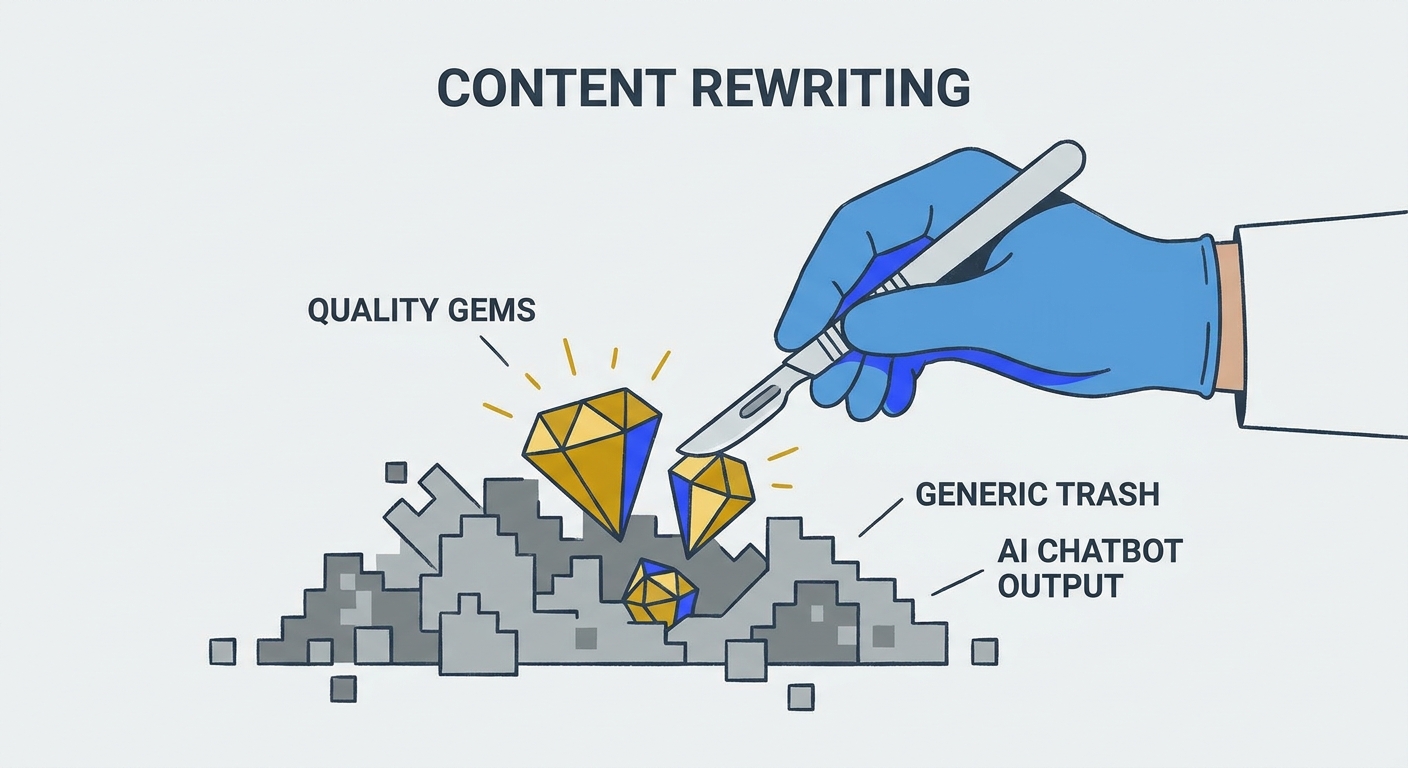
Rewriting in 2026 isn't about hitting a "rephrase" button to shave an hour off your workday. If that’s your strategy, you’ve already lost. In an internet currently choking on machine-generated sludge, "content production" is a dead end. We’ve entered the Quality Era, where search engines are finally getting smart enough to treat generic filler like the digital trash it is.
If you want to survive, stop churning out variations. Start practicing surgical precision. True mastery today isn't about letting the AI write for you; it’s about conducting an orchestra. The AI provides the structural engine, but you—the human—provide the soul, the proprietary data, and the brand nuance that makes a reader actually care.
The Death of "Average"
For the last few years, we’ve been drowning in an AI flood. It’s all the same: perfectly grammatical, perfectly boring, and completely devoid of a human pulse. These pieces check the SEO boxes, sure, but they fail to resonate with a single living soul.
Search algorithms are now hyper-focused on "stale assets"—content that technically answers a query but offers zero unique value. You can spot AI-assisted expertise from a mile away because it feels intentional. It doesn't just restate facts; it strips away the clutter, refines the argument, and hits you with a perspective that feels, well, human. Rewriting isn't a shortcut to save time. It’s a deliberate act of elevating intent. It’s the difference between a flat, robotic report and a piece of high-value thought leadership.
When to Bring in the Machines
Not everything needs a rewrite. And frankly, not everything needs AI. Don't use a sledgehammer to crack a walnut. Use it only where the friction is high.
The "Tone Shift"
You’ve got a dense, dry whitepaper. It’s a goldmine of proprietary data, but it reads like a tax code manual. Your core audience loves it, but your social media followers? They’d rather watch paint dry. This is where you use a specialized AI rewriter. You keep the factual backbone of your research, but you force the AI to pivot the tone—make it punchy, make it conversational, make it something a human would actually want to read on a Tuesday morning.
Breaking the "Blank Page" Curse
We all have those legacy posts—the ones that used to rank, used to bring in traffic, and now just sit there gathering dust. Fixing a stale article is often harder than starting from scratch because you’re stuck in the old way of thinking. AI is brilliant at acting as a sounding board here. It can look at the bones of your legacy content and suggest new structures, condensed versions, or fresh angles that align with how people are searching today. It’s not writing for you; it’s helping you see the renovation potential.
AEO (AI Overview) Optimization
The way we search has changed. If you’re still writing long, narrative-heavy paragraphs to catch a keyword, you’re playing a game that ended two years ago. AI Overviews want answers, not fluff. They want to know the what and the how immediately. Use AI to distill a 500-word explanation into a three-bullet-point summary that hits the user’s query dead-center. That’s how you capture visibility now.
The "Human-in-the-Loop" Workflow
Stop the "one-click" madness. If you aren't doing the work, the machine won't do it for you. Here is the only cycle that actually produces results worth reading.
Step 1: The Audit
Look at your content. Be brutal. Is it factually accurate? Does it say anything that hasn't been said a thousand times before? If the answer is no, delete it. Only keep the stuff that has a solid foundation but just happens to be a bit tired or dusty.
Step 2: The Prompting Strategy
"Rewrite this" is a garbage prompt for a garbage result. Stop being lazy. Act like a senior editor. Give the AI a persona: "You are a veteran tech journalist. Rewrite this paragraph to be punchy, authoritative, and focused on the ROI for a small business owner. Cut the corporate jargon." See the difference?
Step 3: The Human Polish
This is where the magic lives. The AI does the heavy lifting on structure; you do the surgery. Add the personal anecdotes that only you know. Toss in a controversial opinion. Fix the rhythm of the sentences so they don't sound like a monotone robot. If you don't add your own "fingerprints" to the piece, you’ve failed.
Rewriting for the "Answer" Economy (AEO)
If you want to rank in an AI-driven search world, you need to get comfortable with the "inverted pyramid." As discussed in Google's AI Optimization Guide, clarity is king.
Give the user the answer first. Then, give them the context. Keep your sentences short and your lists scannable. Semantic SEO isn't about stuffing keywords into a paragraph anymore; it’s about answering the question so well that the search engine has no choice but to pick you. Every time you rewrite, ask yourself: Is this the fastest, most painless way for the user to get what they need? If not, cut more.
Ethics: The Trust Currency
Trust is the only thing that matters. If your readers feel like they’re being duped by a bot, they’ll leave and never come back.
Transparency isn't hard. If AI did the bulk of the heavy lifting, own it. You don't need a "Robot Wrote This" sticker, but you should be clear about your process. And for the love of everything, watch your attribution. AI models are trained on the entire internet; they have a nasty habit of "borrowing" phrases that aren't theirs. As noted by the Authors Guild AI Best Practices, the risk of accidental plagiarism is real. Always verify your sources, and never take an AI's word for a fact.
The "Rewrite-to-Rank" Framework
"Good enough" is the new "fail." We are at a stage where the internet is so crowded that only the most helpful, human-verified content has a chance of surviving. As noted in recent analysis on SEO in 2026, the bar for search visibility is climbing.
To win, start by looking at your own historical data. Find the pages that used to be stars but have fallen off the cliff. These are your "stale assets." Use Content Optimization Services to systematically audit and refresh these pages. When you apply a human touch to your best legacy content, you aren't just protecting your traffic; you're reclaiming it.
Your Master Prompt Library
- The Simplifier: "Rewrite this for someone who has never heard of this topic. Use an analogy. Cut the jargon. Keep it conversational."
- The Professionalizer: "Take this draft and turn it into a high-level thought leadership piece. Focus on industry trends, make the tone confident and data-backed, and increase the vocabulary."
- The Storyteller: "Rewrite this report. Use the statistics to build a narrative about the user's biggest pain points and how our solution fixes them. Focus on the emotional impact."
Frequently Asked Questions
Will Google penalize content rewritten by AI?
Google doesn't punish AI. They punish garbage. If your content is helpful, original, and fact-checked, nobody cares how it was produced. If it’s spammy, keyword-stuffed drivel, they’ll bury it—regardless of whether a human or a robot wrote it.
How do I keep my brand voice when using AI to rewrite?
Create a "Style Guide" prompt. Tell the AI exactly who you are. Give it examples of your best work. If you sound "witty and direct," tell the AI to prioritize those traits. If you never use exclamation points, tell it that, too.
Is it plagiarism to have AI rewrite my own work?
Not technically, but it’s risky. AI can hallucinate information from other sources into your text. Always double-check that the AI hasn't accidentally lifted someone else's intellectual property while "paraphrasing" your own.
What is the biggest mistake people make when using AI for rewriting?
Skipping the human fact-check. AI is a world-class liar when it’s wrong. It will cite fake statistics with 100% confidence. If you don't verify every single claim against a real-world source, you are setting yourself up for a PR disaster.
The Future is Hybrid
We’re not being replaced; we’re being upgraded. The most successful creators are the ones who treat AI like a high-performance engine for their own intellect. You’re the driver. You pick the destination. You decide the route. If you’re ready to stop churning out noise and start producing high-value work, use our AI Rewriter to start your first real rewrite. The tools are here—it’s time to actually use them.