Do AI Detectors Actually Work? What the Research Shows
AI detectionacademic integrityAI content

On this page
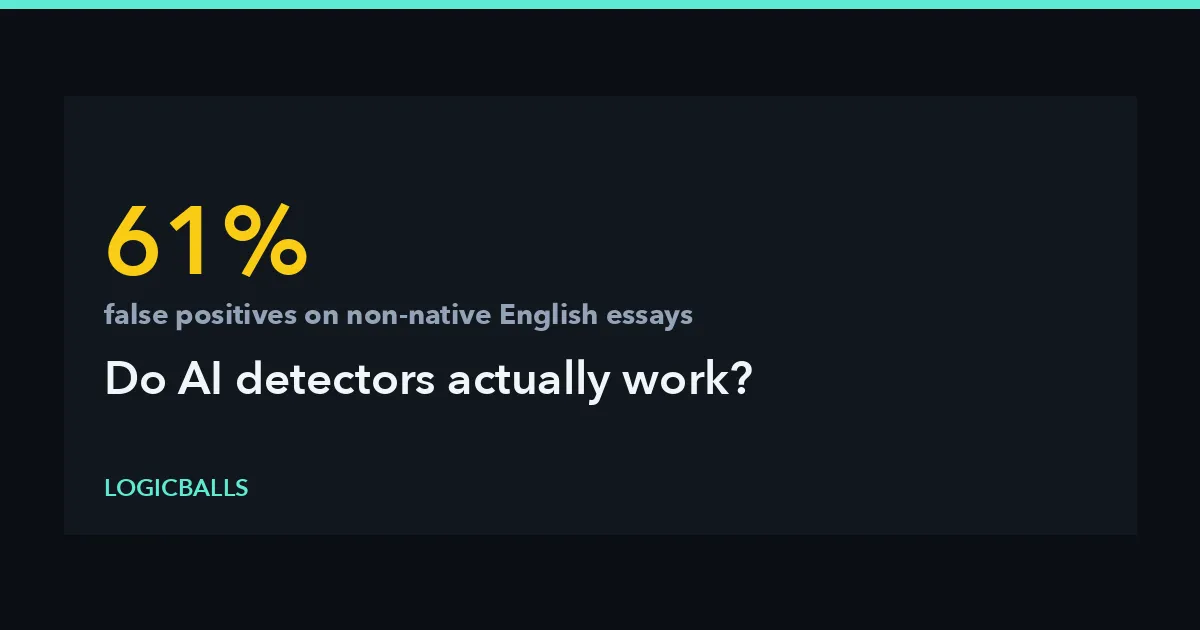
No. Not reliably enough to base a consequential decision on. A peer-reviewed study of seven detectors found they flagged 61.22% of essays written by non-native English speakers as AI-generated, against roughly 5% for native writers — and 97.80% of those essays were flagged by at least one detector (Liang et al., Patterns, 2023, retrieved 2026-09-04, SOURCED). OpenAI withdrew its own detector in July 2023 after it correctly identified only about a quarter of AI text. Two universities have published policies against using detector output as the sole basis for a misconduct finding.
We sell AI writing tools, so we have an obvious interest here. That is exactly why every number below is linked to a study you can read yourself rather than asserted by us.
Key Takeaways
- Detectors are biased against non-native English writers. Seven detectors averaged a 61.22% false-positive rate on TOEFL essays versus 5.19% on native-speaker essays; 19.8% of the TOEFL essays were flagged by all seven (Liang et al., Patterns, 2023, retrieved 2026-09-04, SOURCED).
- Light paraphrasing collapses accuracy. A paraphrasing model dropped one detector's accuracy from 70.3% to 4.6% at a fixed 1% false-positive rate, "without appreciably modifying the input semantics" (Krishna et al., NeurIPS 2023, retrieved 2026-09-04, SOURCED).
- OpenAI withdrew its own detector. It identified about 26% of AI-written text while mislabelling 9% of human text as AI.
- Vendors claim 98–99% accuracy. Those figures are self-reported from internal testing and are not replicated in the independent literature.
- Universities are already restricting use. Washington State: "not allowing the use of any AI detector as the sole source of support for a case against a student" (WSU Provost, retrieved 2026-09-04, SOURCED).
The false-positive problem, and who it lands on
The most important finding in this literature is not that detectors are inaccurate in general. It is who they are inaccurate about.
Liang and colleagues tested seven detectors — including several of the best known — against essays from non-native English speakers and essays from US school students. The results diverged sharply: an average false-positive rate of 61.22% on the non-native essays against about 5.19% on native-speaker writing.
Nearly every non-native essay in the sample, 97.80%, was flagged by at least one of the seven. 19.8% were flagged by all seven simultaneously.
The mechanism is not mysterious. Detectors largely key on textual predictability — lower lexical variety and simpler sentence construction read as machine-like. Those are also characteristics of competent writing by someone working in a second language. A tool built on that signal will systematically mistake one for the other.
This is the part that should decide the question. A tool with a 5% error rate distributed randomly is a tool with a known limitation. A tool whose errors concentrate on international students is something else, and no accuracy headline captures it.
Light editing defeats them
Krishna and colleagues built a paraphrasing model and ran detector output through it. At a fixed 1% false-positive rate, DetectGPT's accuracy fell from 70.3% to 4.6%. The paraphraser also evaded watermarking, GPTZero and OpenAI's classifier, and the paper notes it did so "without appreciably modifying the input semantics."
A separate theoretical analysis argues the ceiling is structural: as machine and human text distributions converge, the achievable accuracy of any detector approaches chance (Sadasivan et al., retrieved 2026-09-04, preprint, not peer-reviewed).
The practical consequence is uncomfortable. Anyone deliberately evading detection can do so with a paraphrasing pass. The people who get caught are disproportionately those who did nothing and wrote in a second language.
OpenAI withdrew its own
In January 2023 OpenAI released a classifier for AI-written text. It withdrew it that July, citing low accuracy. The published performance was roughly 26% of AI text correctly identified as likely AI-written, with about 9% of human text incorrectly flagged.
A sourcing note: OpenAI's announcement page returned HTTP 403 to our automated requests, so those figures come from contemporaneous reporting quoting it rather than from a page we read directly. Treat them as well-attested rather than primary-verified.
That a leading lab could not build a reliable detector for its own model's output, and said so publicly, is the most direct evidence available.
What the vendors claim
Detector companies publish very different numbers.
GPTZero states on its own site: "GPTZero has an accuracy rate of 99%… we correctly classify AI writing 99 out of 100 times", with a false-positive rate of "no more than 1%" (retrieved 2026-09-04, SOURCED — this is the vendor's own claim, not an independent finding).
Turnitin and Copyleaks publish comparable figures in the 98–99% range. Both companies' sites returned HTTP 403 to our requests, so those numbers are from secondary reporting and are not primary-verified here. Turnitin's claim reportedly carries a qualifier worth noticing: it applies to documents where more than 20% of the text is already flagged.
None of these figures has been independently replicated in the peer-reviewed sources above, and they conflict directly with them. Vendor accuracy claims are internal test results. That does not make them dishonest; it makes them not evidence.
Institutions are already drawing lines
Washington State University publishes: "We will continue our policy of not allowing the use of any AI detector as the sole source of support for a case against a student for academic misconduct" (retrieved 2026-09-04, SOURCED).
The University of North Florida publishes that it "does not recommend using AI detection tools for academic assignments until they become significantly more reliable and transparent", noting the tools give only "probabilistic assessments" that do not meet the institution's burden of proof (retrieved 2026-09-04, SOURCED).
These are not activist positions. They are administrators recognising that a probabilistic score cannot support a finding with real consequences for a student.
What to do instead
If you are an educator or an editor, treat a detector score as a prompt to ask a question, never as a finding. Ask about process — drafts, notes, sources, the reasoning behind a choice. Someone who wrote the work can discuss it; that conversation is evidence in a way a percentage is not.
If you have been wrongly flagged, the research above is your argument, particularly if you write in a second language. Ask what evidence exists besides the score, and ask whether the institution has a policy on sole reliance — many now do.
If you are commissioning writing, specify what you actually want: sources you can check, claims you can verify, disclosure of AI assistance. Those are verifiable. "Passes a detector" is not, and optimising for it rewards paraphrasing rather than quality.
If you are writing with AI assistance, the useful discipline is not evading a classifier. It is being able to show where each claim came from.
How This Guide Was Sourced
Written and maintained by the LogicBalls editorial team (logicballs.com). Disclosure: LogicBalls builds AI writing tools. A finding that AI detectors are unreliable is commercially convenient for us, and you should weigh this article accordingly. That is precisely why the argument rests on peer-reviewed studies and published institutional policies you can read yourself, rather than on our testing or our opinion.
Sources, labelled by type. Peer-reviewed: Liang et al. in Patterns (Cell Press, 2023) on detector bias against non-native writers; Krishna et al. at NeurIPS 2023 on paraphrase evasion. Preprint, not peer-reviewed: Sadasivan et al. on theoretical detection limits. Primary institutional sources: Washington State University's provost office and the University of North Florida, both fetched directly. Vendor claim, fetched from the vendor: GPTZero's stated accuracy.
What is not primary-verified here, stated plainly. The Patterns publisher page returned HTTP 403, so the Liang figures were read from the arXiv version of the same paper. OpenAI's announcement page returned 403, so its classifier figures come from contemporaneous reporting quoting it. Turnitin's and Copyleaks' sites returned 403, so their accuracy claims are from secondary reporting. A fourth study, Weber-Wulff et al. in the International Journal for Educational Integrity, could not be fetched from any mirror and its figures are therefore not quoted in this article at all.
What we did not do. We ran no detector tests of our own and publish no experiment. Every figure above comes from work by others, linked and dated.
Detection research moves quickly. Every figure carries its retrieval date. If a detector is independently validated at high accuracy on non-native writing in future, that would change this analysis, and we would rather update it than defend it.
No LogicBalls telemetry is used in this guide.
Frequently Asked Questions
Are AI detectors ever useful?
As a triage signal in a low-stakes setting, possibly — a reason to look more closely at something. As the basis for an accusation, an assessment grade or a rejection, the peer-reviewed evidence says no.
Why do they flag non-native English writers so often?
Because they largely key on textual predictability, and writing in a second language tends to use a smaller vocabulary and simpler sentence structure. The detector cannot distinguish "predictable because it was generated" from "predictable because the writer is working in a second language".
Vendors claim 99% accuracy. Why the gap?
Vendor figures come from internal testing on their own datasets. The independent studies tested against adversarial conditions — paraphrasing, non-native writing — and found much worse performance. Both can be technically true and only one describes real-world use.
Can I prove I wrote something myself?
Process evidence is the strongest thing available: drafts, version history, notes, sources, and the ability to discuss your reasoning. Version history from a document editor is more persuasive than any counter-score.
Does this mean AI-written work is undetectable and rules are pointless?
No. It means automated detection is unreliable, so policies that depend on it are unreliable. Rules about disclosure, about being able to explain your work, and about verifying claims do not depend on a classifier and are enforceable.
Conclusion
The peer-reviewed evidence points one way. Detectors flag most non-native English writing as AI, a paraphrasing pass collapses their accuracy, and the lab best placed to build one withdrew its own at 26% accuracy. Vendor claims of 98–99% are internal, unreplicated, and contradicted by the independent work.
That makes them unsuitable for any decision with a consequence attached. The questions that survive are the old ones: where did this claim come from, can you show your working, and does the source say what it is said to say.
Related reading
Related Articles
 avoid AI detection10 Proven Tricks to Avoid AI Detection in Content WritingStruggling with AI detection tools flagging your content? Learn 10 expert-backed strategies to infuse human warmth, personality, and authenticity into your writing.James Smith6 min read
 paraphrasing academic sourcesHow to Paraphrase Academic Sources Without Losing Meaning (Or Integrity)Learn how to paraphrase academic sources for your blog or marketing content without losing meaning or risking plagiarism using best practices and AI tools.Mohit Singh5 min read
 AI accuracyWhat One Wrong Fact Actually Costs: 8 Real ConsequencesEight documented cases where a wrong fact reached a court, a regulator or a customer, what each one cost, and why the fine was never the expensive part.Ankit Agarwal11 min read
 YouTubeWhat Actually Happens When You Buy YouTube ViewsYouTube's own policy bans artificial view inflation and the services that sell it. Here is what the platform says, what it does about it, and what to do instead.Ankit Agarwal8 min read