What Actually Happens When You Buy YouTube Views
YouTubeplatform policycontent marketing

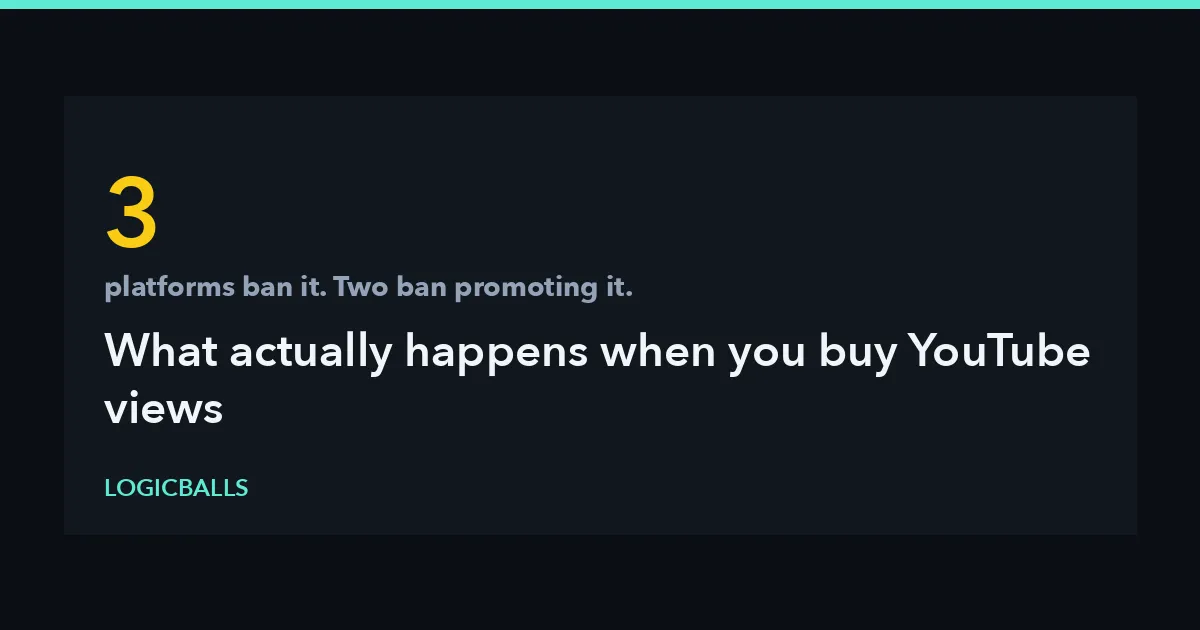
Buying YouTube views breaks YouTube's rules. The platform's own fake-engagement policy states that "YouTube doesn't allow anything that artificially increases the number of views, likes, comments, or other metrics" (YouTube Help, retrieved 2026-09-04, SOURCED). Purchased views can be removed, the video can be taken down, and the channel can be penalised or terminated. The same policy separately prohibits promoting the services that sell them, which is why you will not find a list of vendors in this article.
This post covers what YouTube's policy actually says, what the platform does when it detects inflated metrics, why the numbers rarely survive anyway, and what a small channel can do instead. It is written against YouTube's published policy as of 4 September 2026.
Key Takeaways
- The policy is explicit. YouTube prohibits "anything that artificially increases the number of views, likes, comments, or other metrics either by using automatic systems or serving up videos to unsuspecting viewers" (YouTube Help, retrieved 2026-09-04, SOURCED).
- Promoting these services is separately banned. The same policy prohibits content that "Links to or promotes third-party services that artificially inflate metrics like views, likes, and subscribers" (same source, SOURCED).
- Purchased views are routinely removed. YouTube states that it regularly validates views and removes those it determines to be artificial, so a count can fall after it rises.
- The metric you are buying is the one that matters least. Watch time and viewer retention drive recommendation; a view that stops after a few seconds contributes nothing to either.
- This applies across platforms. Meta prohibits "selling, buying, or exchanging for engagement" (Meta, retrieved 2026-09-04, SOURCED).
What YouTube's policy actually says
Two separate rules are worth reading, because most articles on this subject only mention the first.
Artificial inflation is prohibited. The fake-engagement policy covers metrics obtained "either by using automatic systems or serving up videos to unsuspecting viewers." That second clause matters: it covers not only bots but also the incentivised traffic and pop-under placements many services actually use, where a real human technically loads the video without ever choosing to watch it.
Promoting the services is also prohibited. Content that "links to or promotes third-party services that artificially inflate metrics like views, likes, and subscribers" is against the policy in its own right. A channel can breach this rule without ever buying anything, simply by recommending a vendor.
That second rule is why this article names no services. We are not being coy — publishing a list would itself be the violation.
What the platform does about it
YouTube states that it regularly validates views and removes those it determines to be artificial. In practice this means a view count can go up and then come back down, sometimes days later.
The published consequences escalate. Metrics judged artificial are removed. Videos can be taken down. Channels can receive strikes, lose monetisation, or be terminated. YouTube does not publish a threshold or a schedule, and the absence of an immediate consequence is not evidence that a purchase went unnoticed — validation is not instant.
There is also a practical asymmetry worth understanding: the channel is responsible for the metrics on it, regardless of who bought them. Services do not carry the risk. The account does.
Why bought views usually do not do what people hope
Set the policy aside for a moment. The purchase tends not to work on its own terms.
Views are not the ranking signal people assume. YouTube's recommendation systems weigh how long people watch and whether they keep watching, not how many times a video was loaded. A view that ends after five seconds adds a number to the counter and depresses your average view duration at the same time.
It can make a video look worse to the algorithm. Ten thousand views with a thirty-second average retention is a weaker signal than five hundred views with four minutes. The purchase inflates the denominator of every engagement rate you have — likes per view, comments per view, click-through — and those ratios are visible.
It is legible to anyone who looks. A video with 50,000 views and eleven comments reads as bought to a prospective sponsor, a journalist or a partner. The people you most want to impress are the ones most practised at spotting it.
And it does not compound. Bought views do not subscribe, return, or share. Whatever number you buy is the number you get, once.
The other platforms say the same thing
If you are weighing this across channels, the position is consistent.
Meta prohibits "Attempting to or successfully selling, buying, or exchanging for engagement, such as likes, shares, views, follows, clicks, use of specific hashtags, etc." (Meta Transparency Center, retrieved 2026-09-04, SOURCED).
X prohibits coordinating with or compensating others to inflate account metrics, and separately prohibits using or promoting third-party services that do so.
Three major platforms, the same rule, and two of the three ban promotion as well as purchase.
What to do instead when a channel is not growing
Nothing here is quick, which is precisely why the shortcut is tempting.
Fix the first thirty seconds before anything else. Retention early in a video is the strongest lever most channels have, and it is entirely within your control. Watch your own retention graph and find where people leave.
Make the thumbnail and title match what the video delivers. Click-through rate and retention are measured together. A thumbnail that overpromises buys a click and loses the viewer, which is worse than not being clicked.
Publish into demand you can verify. Search for the question your video answers and see what already ranks. If nothing does, that is an opening. If ten strong videos do, a better thumbnail will not overcome it.
Use the free analytics you already have. YouTube Studio reports impressions, click-through rate, average view duration and traffic source per video. Almost nobody reads them carefully, and they say exactly where a video is failing.
Give it more time than feels reasonable. Channels that grow tend to do so on a body of work rather than a single video. The uncomfortable truth is that the shortcut exists because the real thing is slow.
How This Guide Was Sourced
Written and maintained by the LogicBalls editorial team (logicballs.com). Disclosure: LogicBalls builds AI writing tools. No service is named or linked in this article, and it contains no affiliate or referral link.
Sources. Every policy statement is quoted from the platform's own published documentation, fetched on 2026-09-04: YouTube's fake engagement policy and Meta's spam policy. No third-party SEO blog, news article or vendor claim is used as a source.
Why no vendors are named. YouTube's policy prohibits content that links to or promotes services that inflate metrics. Publishing a list would breach the same rule this article is about.
What is not claimed here. We have not tested any of these services and make no claim about how any specific one operates. The retention and recommendation points are drawn from YouTube's published guidance on what its systems weigh; we have published no experiment of our own and are not presenting one.
A note on our own blog. This site has previously published articles recommending view-purchasing services. Those articles are under review. Publishing this one while those remain live would be incoherent if we did not say so.
No LogicBalls telemetry is used in this guide.
Frequently Asked Questions
Will buying views get my channel banned immediately?
There is no published threshold or schedule. YouTube states that artificial metrics are removed and that channels can be penalised up to termination. The absence of an immediate consequence is not evidence of safety — view validation is not instantaneous.
What about services that promise "real" or "high-retention" views?
The policy language covers metrics generated "by using automatic systems or serving up videos to unsuspecting viewers." Traffic from someone who did not choose to watch your video falls under the second clause whether or not a human was involved.
Do purchased views affect monetisation?
Artificial engagement is grounds for losing monetisation, and inflated view counts distort the engagement ratios that advertisers and sponsors evaluate. Both matter, and the second one persists even where the first does not.
Is there any legitimate way to pay for views?
Yes — YouTube Ads. Paying YouTube to show your video to a targeted audience is advertising, it is disclosed as such, and it is within policy. It is a different thing from buying a number from a third party.
Why does this article not compare the services?
Because YouTube's policy prohibits promoting them, and because a comparison would imply that one of them is a safe choice. The policy does not distinguish between vendors.
Conclusion
YouTube prohibits artificial view inflation and, separately, prohibits promoting the services that sell it. Bought views can be removed after the fact, and the channel — not the vendor — carries the consequence.
The stronger argument is the practical one: views are the metric that matters least. Watch time and retention drive what YouTube recommends, and a view that ends in five seconds damages both while adding a number to a counter nobody important is impressed by.
Related reading
Related Articles
 AI content generation softwareAI Content Generation Software: How to Choose the Right Platform for Your BrandStop chasing magic buttons. Learn how to choose AI content software that integrates with your brand workflow for true orchestration and scalable quality.Ankit Agarwal8 min read
 AI content calendarHow to Build an SEO Content Calendar with AILearn how to build an seo content calendar with ai tools. Automate keyword research, topic clustering, and scheduling to boost your organic traffic.Ankit Agarwal8 min read
 buy YouTube views10 Best Sites to Buy YouTube ViewsDiscover the 10 best sites to buy YouTube views with real users and fast delivery. Boost your video visibility, engagement, and channel growth safely.Mohit Singh12 min read
 cybersecurity content marketingHow to Create Cybersecurity Content That Educates and Converts B2B BuyersStruggling to turn cybersecurity leads into buyers? Discover how to create authoritative content that builds trust and drives conversions in the B2B space.Deepak Gupta4 min read