8 AI Trustworthiness Frameworks Every User Should Know About

Trust is the new currency of the AI era. Period.
A few years ago, we were all just playing around with chatbots—seeing if they could write a funny poem or summarize a meeting. Today? We’re handing over enterprise workflows to autonomous agents. The conversation has shifted from "Look what this thing can do" to "Can we actually trust this thing to run our business?"
Trust isn't a toggle switch on a dashboard. It’s hard work. It’s risk management. It’s governance. If you’re a business leader or the person signing off on software procurement, ignoring the frameworks that govern responsible AI is a fast track to a PR disaster and operational chaos.
You need a baseline. Start by grounding your understanding in our guide on what is responsible AI. It’ll show you how these high-level theories actually look when they’re baked into real-world software.
What Exactly Makes an AI System "Trustworthy"?
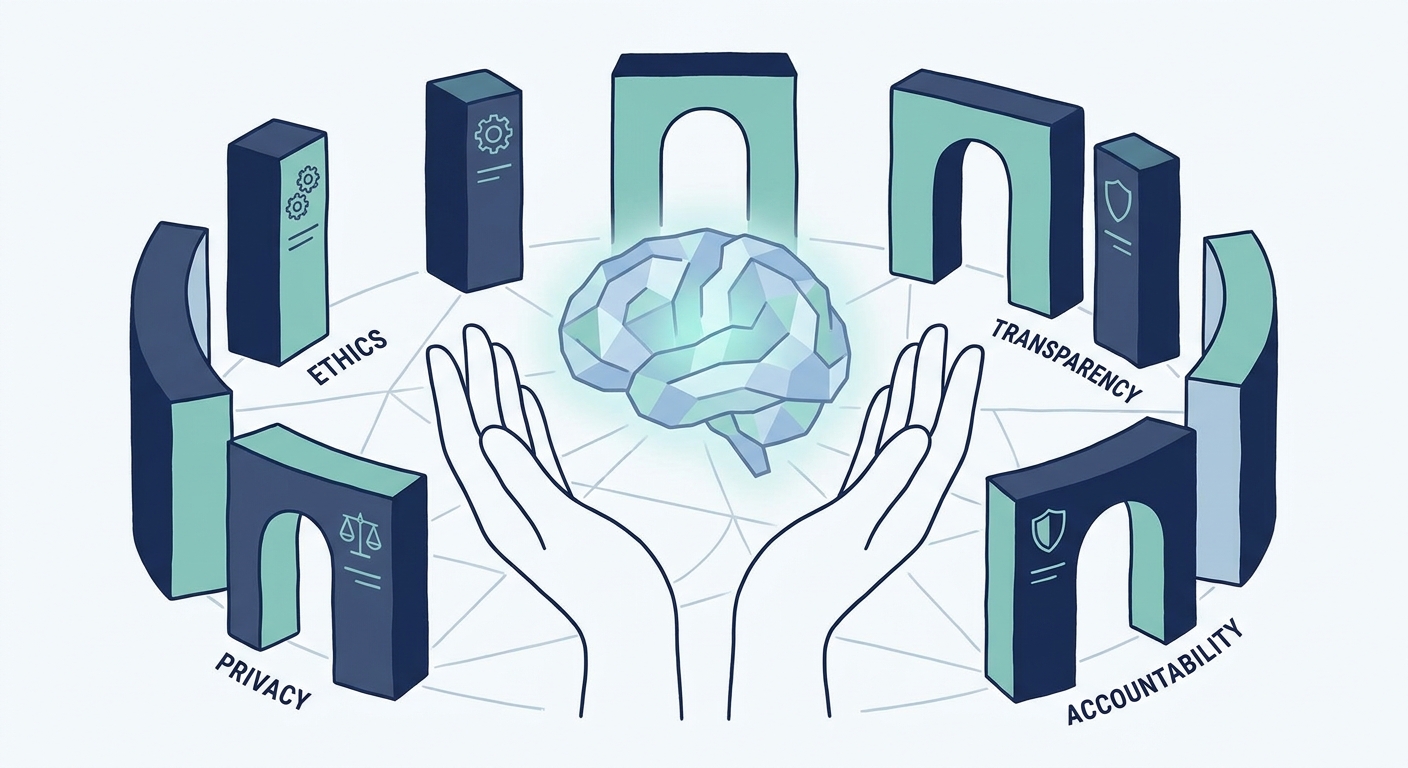
To evaluate any system, you have to define what "good" looks like. A trustworthy AI isn't just one that gets the job done; it’s one that works predictably, ethically, and securely. Think of it as a four-legged table: Reliability, Privacy, Fairness, and Explainability. If one leg is missing, the whole thing wobbles. And at the center? A "Human-in-the-loop" node. No matter how smart the machine is, human judgment must remain the final checkpoint for high-stakes decisions.
The 8 AI Trustworthiness Frameworks You Need to Know
1. NIST AI Risk Management Framework (RMF)
The NIST AI Risk Management Framework has become the gold standard for a reason. It’s voluntary, flexible, and doesn't try to dictate your entire business model. It gives you a roadmap to map, measure, manage, and govern risk.
- Primary Focus: Identifying risks and building a culture of accountability.
- The User Takeaway: Use this as your baseline. If a vendor looks at you blankly when you ask how they align with NIST’s "Govern, Map, Measure, and Manage" functions, they aren't ready for your enterprise.
2. The EU AI Act (Risk-Based Compliance)
This is the big one. The EU AI Act isn't a suggestion; it’s the law. It is Regulation (EU) 2024/1689, published in the Official Journal on 12 July 2024 (EUR-Lex, retrieved 2026-09-04, SOURCED). Its obligations arrive in stages rather than all at once: prohibitions applied from 2 February 2025, general-purpose AI and governance rules from 2 August 2025, and general application from 2 August 2026. The high-risk deadlines have since moved. After the amendment package the Commission calls the “AI Omnibus” — adopted 19 November 2025 and in force from 27 July 2026 — the Annex III high-risk rules apply from 2 December 2027 and the Annex I rules for AI in regulated products have “an extended transition period until 2 August 2028” (European Commission, regulatory framework for AI, retrieved 2026-09-18, SOURCED). An earlier version of this article gave 2 August 2027 for Annex I, which was correct when written and is now superseded. ANALYSIS — an earlier version of this article cited a private advocacy organisation’s website as the source for the Act rather than the legislation itself. It categorizes AI by risk level—from "minimal" to "unacceptable"—and lays down the law for what you need to do at each stage.
- Primary Focus: Legal compliance and protecting human rights.
- The User Takeaway: Even if you aren't based in Europe, pay attention. The EU is setting the global bar for documentation and auditing. If you want to play globally, this is your floor, not your ceiling.
3. The Data Nutrition Project
You wouldn't eat a mystery meal without checking the ingredients. Why treat your data pipeline any differently? The Data Nutrition Project pushes for "Data Nutrition Labels." They force transparency on where the data came from, what biases are lurking in there, and what the model is actually supposed to do.
- Primary Focus: Data provenance and transparency.
- The User Takeaway: Demand a "nutrition label" for every model you integrate. If a vendor can’t tell you what data fed their model, they can't tell you why it’s making mistakes.
4. The Algorithmic Justice League (AJL) Framework
Founded by Joy Buolamwini, the Algorithmic Justice League is all about the human cost of code. They focus on where machine learning meets human rights.
- Primary Focus: Social impact and bias mitigation.
- The User Takeaway: If your AI is involved in hiring, lending, or anything that affects a person’s livelihood, use this framework. It forces you to ask: "Who is getting hurt by this?" rather than just "How much efficiency did we gain?"
5. Microsoft’s Responsible AI Standard
This is a masterclass in how to turn abstract ethics into actual code. It’s a practical, enterprise-scale framework that treats "Responsible AI" as an engineering requirement, not a marketing fluff piece.
- Primary Focus: Operationalizing ethics in software development.
- The User Takeaway: If you’re building your own internal AI policy, don't reinvent the wheel. Use this as your template for turning ethics into actionable engineering tasks.
6. ISO/IEC 42001 (AI Management System)
ISO/IEC 42001 is the international management-system standard for AI governance. Certification means an accredited auditor found a management system in place and operating — it is a statement about process, not a guarantee that any given output is accurate. The standard itself is paywalled and iso.org returns HTTP 403 to automated requests, so we have not read it and make no claim about its contents (retrieved 2026-09-18).
- Primary Focus: Organizational governance and formal certification.
- The User Takeaway: Procurement teams, take note: look for ISO 42001 certification. It indicates a formal, auditable management system for the AI lifecycle. Ask what the certificate’s scope statement actually covers, and for the accuracy evidence separately — a certificate you cannot read is not evidence about the product you are buying.
7. IEEE P7000 Series (Ethical Design)
The IEEE P7000 series (the standard is IEEE 7000-2021, "Model Process for Addressing Ethical Concerns during System Design"; "P7000 series" is informal industry shorthand rather than IEEE's own naming, and the link previously here went to a generic standards homepage that did not substantiate the claim) is all about "value-based design." It argues that you shouldn't build the system and then check for ethics later; ethics should be baked in from the first line of code.
- Primary Focus: Human well-being and value alignment.
- The User Takeaway: This is your go-to for long-term planning. It ensures your AI goals actually align with your company values instead of just chasing the next shiny feature.
8. The "Human-in-the-loop" (HITL) Protocol
This isn't a document; it’s an operational necessity. It’s the rule that says an autonomous agent cannot make a final, irreversible decision without a human signing off on it.
- Primary Focus: Operational safety in agentic workflows.
- The User Takeaway: If your AI can book travel, send emails, or move money, you need a hard-coded HITL protocol. If the AI acts alone, it needs a human leash.
How Do You Evaluate Your Current AI Stack?
You don't need a PhD to audit your AI vendors. You just need to be annoying with your questions and disciplined with your documentation. Use this decision path to see if a tool is ready for your business.
Beyond the Frameworks: Avoiding "AI-Washing"
Marketing teams love to throw around "ethical AI" and "secure by design" like confetti. Don't buy it. A framework is only as good as the company’s internal culture. If a vendor says they’re "trustworthy" but can’t show you their testing processes or data sources, they’re engaging in "AI-washing."
Demand proof, not promises. A mature AI provider will be open about where their model fails. If you’re ready to get into the weeds of keeping your deployments secure, check out our AI security best practices guide for the technical controls that make these governance frameworks actually work.
Summary: The Future of Trust in 2027
By 2027, we’ll be looking at automated auditing—systems that watch other systems in real-time to stop bias and security leaks before they happen. Until we get there, keep your strategy simple: use the NIST RMF as your logic, follow regional laws like the EU AI Act, and for heaven's sake, never outsource your final judgment to an algorithm. If you’re ready to start, browse our vetted AI tools to find platforms that actually prioritize these frameworks.
Frequently Asked Questions
What is the difference between AI Safety and AI Trustworthiness?
Think of AI Safety as the "defensive" side—it’s about preventing crashes and keeping the system from doing something catastrophic. AI Trustworthiness is the "offensive" side—it’s about ethics, privacy, and making sure the system is doing the right things for the right reasons.
Do I need to be a developer to use these frameworks?
Absolutely not. Developers handle the technical implementation, but these frameworks are for business leaders and procurement managers. You’re the one deciding if a tool is safe for your company to use; these frameworks are your checklist to make that call.
Are these frameworks legally binding?
Some are, some aren't. The EU AI Act carries heavy fines if you ignore it. Others, like the NIST framework, are technically voluntary. But in the real world? They’re becoming the baseline that clients and insurance companies expect you to hit.
How can I tell if an AI tool is 'trustworthy' at a glance?
Look for a "Model Card" or "Data Nutrition Label." If a vendor can't explain where their training data comes from or how they implement human oversight, walk away. Transparency is the first sign of a mature product.
Related reading
- Start here: Verified AI Writing: How to Publish AI-Assisted Content You Can Stand Behind
- Top 7 AI Content Generators for Every Sort of Content
- Interacting with AI Assistants: A User Guide
- Master Copywriting: 7 Frameworks for Conversions
- What Smart Job Seekers Know About Decision Fatigue (And How AI Can Save Their Sanity)