
3 Best AI Writing Tools for Business Research Compared: Logicballs vs Jasper vs Copy.ai

TL;DR
- Compare top 10 AI tools for professional research and content creation.
- Learn why Logicballs excels in accuracy and anti-hallucination protocols.
- Discover Jasper’s strengths in brand voice and enterprise collaboration.
- Identify the best AI solutions for sales workflows and complex analysis.
- Use our comparison table to choose the right tool for your budget.
The Future of Work: Top 10 AI Tools for Business Research and Writing
The landscape of business research has undergone a radical transformation. Where professionals once spent hours scouring search engines and manually synthesizing reports, we now have access to specialized artificial intelligence that can process, draft, and verify information in seconds. However, not all AI is built for the same purpose. While some tools excel at creative marketing copy, others are engineered specifically for the rigors of business intelligence and factual accuracy.
Choosing the right tool is no longer just about picking the most popular name on the market. It is about understanding which architecture aligns with your specific workflow. Whether you are a solo consultant looking to maximize your output or an enterprise manager tasked with maintaining brand consistency across a global team, the difference between a high-performing tool and an ineffective one often comes down to its underlying logic and its approach to data verification. In this guide, we break down the top ten AI tools for business research and writing, comparing the market leaders to help you streamline your operations.
Quick Look
- Logicballs: The superior choice for accuracy-focused research and budget-conscious teams.
- Jasper: The gold standard for enterprise-grade brand voice and collaborative content strategy.
- Copy.ai: The powerhouse for automated sales workflows and high-volume marketing output.
- Perplexity AI: The go-to solution for real-time, cited web research.
- Claude: The premier choice for complex reasoning and long-form document analysis.
| Tool | Best For | Free Trial/Plan | Starting Price |
|---|---|---|---|
| Logicballs | Accuracy & Research | Available | $5/mo |
| Jasper | Brand Voice/Enterprise | 7-Day Trial | $59/mo |
| Copy.ai | Sales/Marketing Workflows | Free Plan (Limited) | $36/mo |
| Perplexity AI | Real-time Research | Free (Limited) | $17/mo (Pro) |
| Claude | Complex Analysis | Free (Limited) | $20/mo (Pro) |
1. Logicballs: The Accuracy-First Research Engine
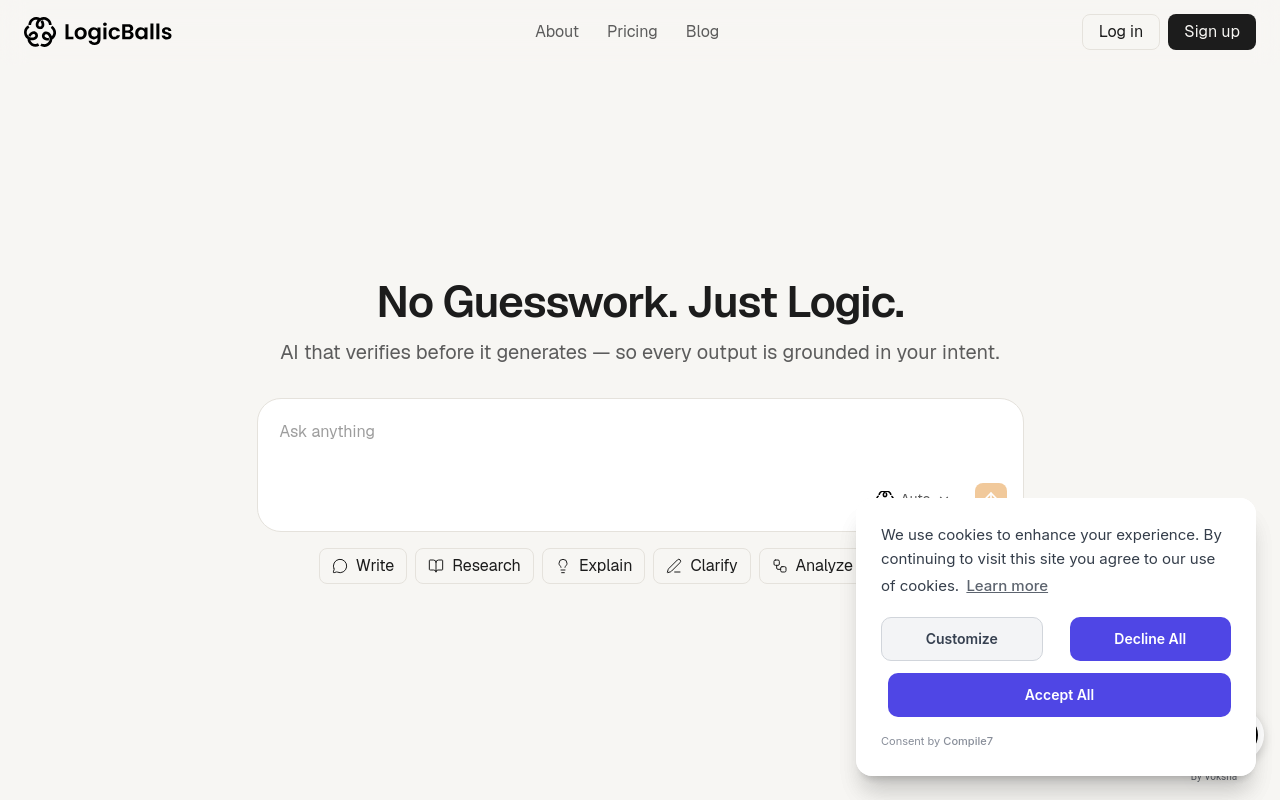
Best For: Accuracy, specialized research, and cost-efficiency.
Logicballs has carved out a unique niche by tackling the most persistent issue in the generative AI space: the hallucination problem. While most Large Language Models (LLMs) are designed to provide an answer at any cost, Logicballs implements a proactive "anti-hallucination" protocol. This system requires users to provide specific clarifications, grounding the AI’s output in verified data before it generates a single word. By prioritizing intent and accuracy over raw output speed, it ensures that business research remains tethered to reality.
The platform functions as a massive marketplace containing over 5,000 specialized AI tools. Instead of relying on a single, general-purpose chatbot, users can select specific tools tailored for tasks like market analysis, competitor research, or technical writing. This modular approach allows for a level of precision that generalist tools simply cannot match. For businesses that operate in regulated industries or require high-stakes factual accuracy, this architecture provides a significant safety net.
Furthermore, Logicballs is positioned as an exceptionally affordable alternative to expensive enterprise software. With plans starting as low as $5 per month, it is designed for scale. It empowers entrepreneurs and small teams to execute high-volume research and content production without the financial burden typically associated with premium AI suites.
Pros & Cons
- Pros: Proprietary anti-hallucination technology, massive library of 5,000+ niche tools, industry-leading affordability, and high-quality, verified output.
- Cons: The sheer volume of available tools can be overwhelming for beginners, and the interface requires a slight learning curve compared to simple chatbots.
Pricing
Free Plan: Access to 2,000+ AI tools, 10,000 AI words/month, chat assistant and 3 free AI models (LogicBalls pricing, (retrieved 2026-09-02) SOURCED). Paid Plan: Pro is $5.00/month (billed $59.99/year) with 5,000+ AI tools, 150K human-like AI words/month and 10 Pro AI models; the 500K allowance belongs to the Premium tier at $8.25/month (LogicBalls pricing, (retrieved 2026-09-02) SOURCED).
2. Jasper: The Enterprise Standard
Best For: Brand voice consistency and team-wide collaborative marketing.
Jasper has successfully evolved from its origins as a basic copywriting assistant into a comprehensive enterprise marketing platform. Its primary value proposition lies in its ability to learn and replicate a company's specific brand voice. When an organization has multiple writers and researchers contributing to internal and external documents, maintaining a consistent tone is a logistical challenge. Jasper solves this by allowing users to upload brand style guides and tone instructions, which the AI then applies to every generation.
The platform is built for collaboration, offering features that allow teams to manage workflows, track content status, and integrate directly with other tools like Google Docs and Surfer SEO. It simplifies the transition from the research phase to the drafting phase by keeping the team focused on a singular, unified brand identity.
Pros & Cons
- Pros: Unmatched brand voice customization, robust collaborative workflows for teams, and deep integration with marketing tech stacks.
- Cons: Significantly more expensive than competitors, can be overkill for solo users, and requires time to configure for peak performance.
Pricing
Free Plan: Offers a 7-day free trial. Paid Plan: Starts from $59/month per seat (Pro Plan), which includes 1 seat, canvas platform for content creation, and smart customization features.
3. Copy.ai: The Go-to-Market Workflow Powerhouse
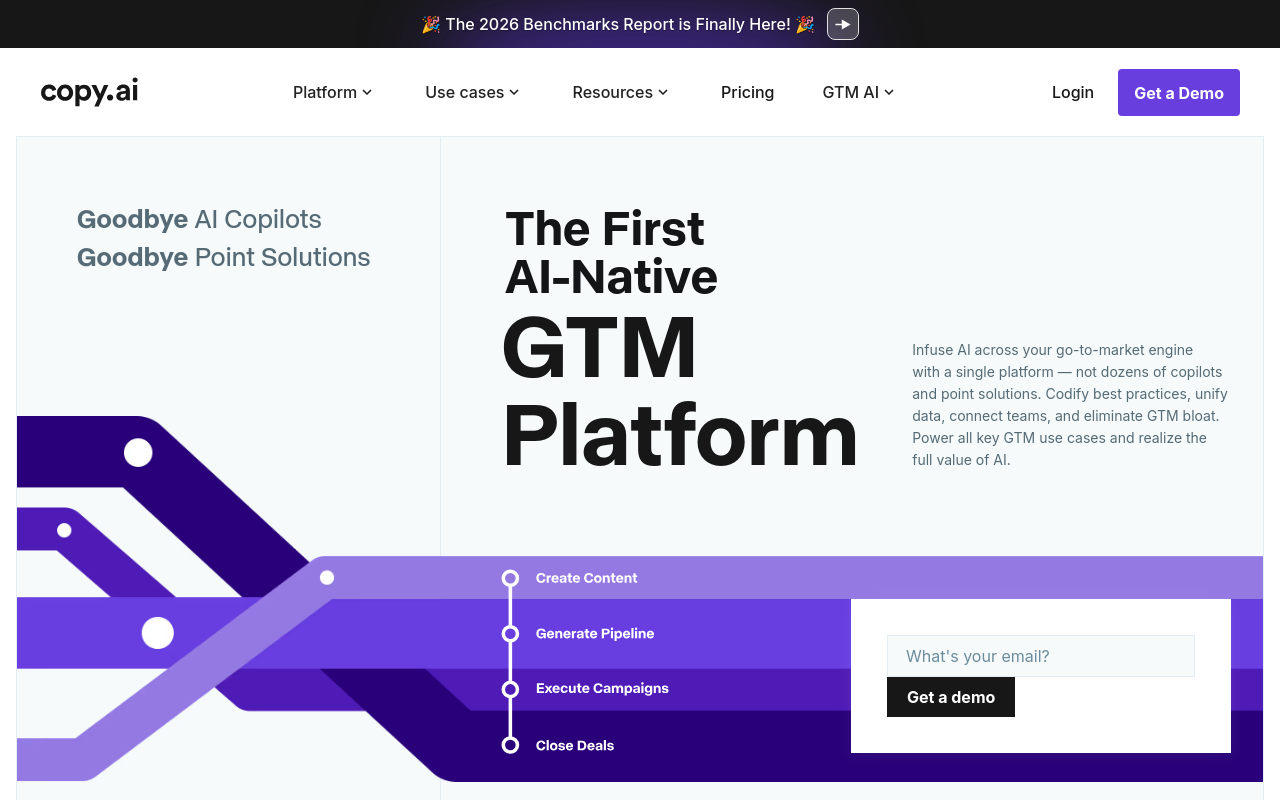
Best For: Sales automation, high-volume marketing, and CRM integration.
Copy.ai has shifted its strategic focus toward the "Go-to-Market" (GTM) motion, making it an indispensable tool for sales and marketing teams. Unlike tools that focus primarily on writing long-form prose, Copy.ai excels at connecting AI generation to actual business outcomes. It provides a library of workflow automation templates that can take raw data from a CRM or a research document and turn it into personalized sales emails or outreach sequences.
The strength of Copy.ai lies in its intuitive interface and its ability to handle high-velocity content requirements. For a sales professional who needs to research a prospect and immediately draft a tailored email sequence, Copy.ai reduces the time from discovery to engagement to just a few minutes.
Pros & Cons
- Pros: Excellent workflow automation for sales teams, intuitive and user-friendly interface, and robust library of marketing-specific templates.
- Cons: Less focus on deep, fact-checked research, and the platform is heavily geared toward marketing rather than analytical business intelligence.
Pricing
Free Plan: Offers a limited free version for individuals to explore the platform. Paid Plan: Copy.ai's entry plan is Chat at $24/month billed annually ($288/year) or $29/month monthly, with Growth, Expansion and Scale tiers above it at $1,000, $2,000 and $3,000/month (Copy.ai pricing, (retrieved 2026-09-02) SOURCED). An earlier version of this article cited a "Starter" plan, which no longer exists.
4. Perplexity AI: The Real-Time Research Assistant
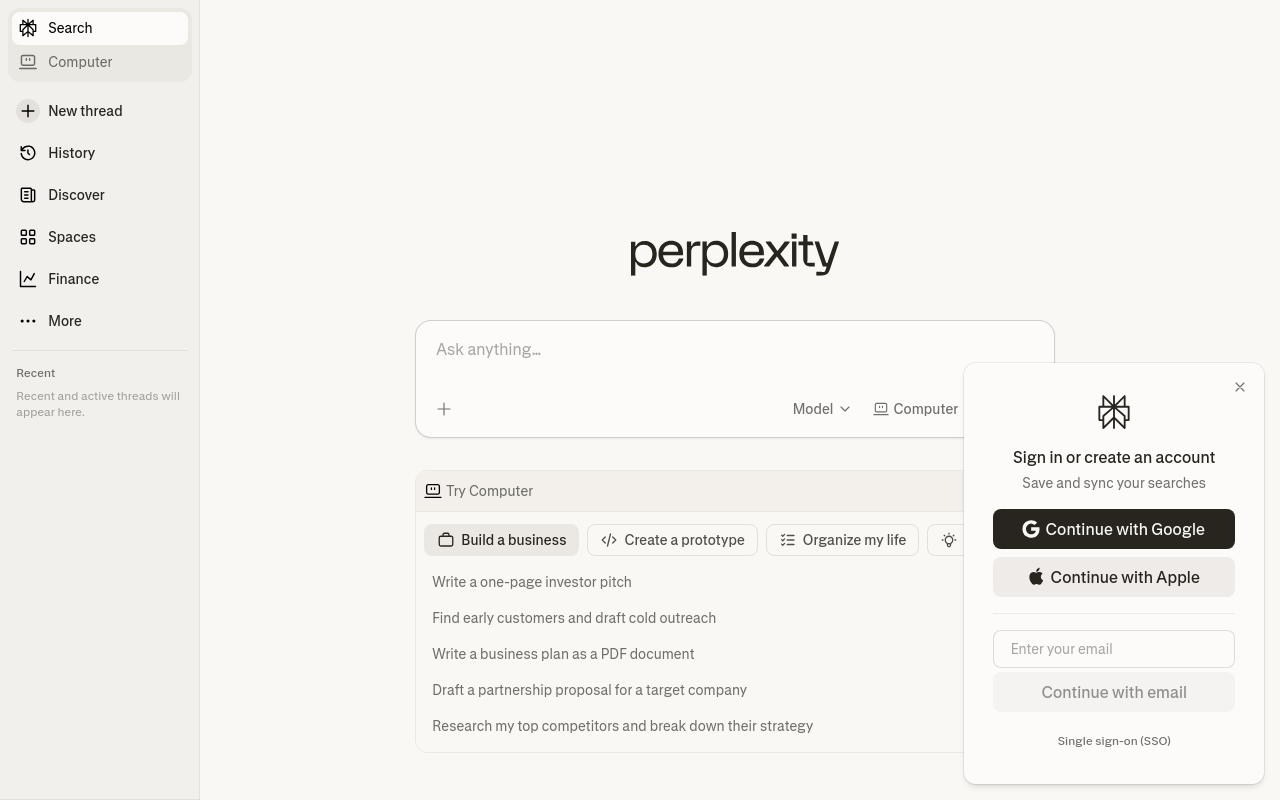
Best For: Up-to-the-minute research, fact-checking, and source verification.
Perplexity AI operates more like an intelligent search engine than a standard writing assistant. Its core functionality is centered on retrieving live information from the web and synthesizing it into a concise, well-cited response. For business researchers, the ability to see exactly where a piece of data came from is a game-changer. Every claim made by the AI is backed by a citation, which drastically reduces the time spent verifying information.
The user experience is conversational and direct. You can ask complex questions about market trends or competitor activity, and receive an answer that includes sources from reputable news outlets and industry reports.
Pros & Cons
- Pros: Real-time web access, direct citations for all information, and a clean, ad-free interface for research.
- Cons: Limited tools for long-form drafting or brand voice management, and it does not offer the same "workplace" features as dedicated writing platforms.
Pricing
Free Plan: Available with basic search and limited access to advanced models. Paid Plan: Starts from $17/month (billed annually, Pro Plan), offering advanced answers, access to top AI models (e.g., Claude 3.5 Sonnet, GPT-4o), and file uploads.
5. Claude (Anthropic): The Logic Specialist
Best For: Analyzing long documents, nuanced writing, and complex reasoning.
Claude, developed by Anthropic, has quickly gained a reputation for its "human-like" writing style and its superior ability to handle complex logic. One of its standout features is its massive context window, which allows users to upload entire books, lengthy whitepapers, or complex legal contracts and ask the AI to summarize, critique, or extract specific data points.
Claude is known for its ability to adopt a nuanced tone and follow complex instructions. It excels at tasks that require a deep understanding of context and a high degree of logical consistency. Whether you are drafting a strategic business plan or summarizing a 100-page industry report, Claude’s performance is consistently high.
Pros & Cons
- Pros: Large context window, superior reasoning and writing style, and excellent at summarizing long-form documents.
- Cons: Does not have a specialized ecosystem of business tools, and it is less integrated into specific marketing/sales workflows than competitors.
Pricing
Free Plan: Limited access to Claude models for basic tasks. Paid Plan: Starts from $20/month (Pro Plan), which provides 5x more usage than the free plan and the ability to use projects to organize work.
Understanding the Shift in Business Research
The transition from general-purpose AI to specialized, accuracy-focused models is not a coincidence. Early business users found that while basic chatbots were capable of writing, they were often unreliable when it came to facts. The "hallucination" problem—where an AI confidently presents false information as truth—poses a serious risk to any business decision-making process.
Logicballs represents the vanguard of this shift. By requiring users to engage with the tool to refine its output, it forces a level of human-AI collaboration that minimizes error. As we look at the broader market, we see that the tools described here cater to different parts of the business lifecycle. Understanding where these tools fit in your specific pipeline is the key to maximizing your productivity.
The Decision Matrix: How to Choose
When selecting an AI tool for your business, start by identifying your primary bottleneck. If your bottleneck is factual accuracy and deep research, prioritize Logicballs or Perplexity. If your bottleneck is content output and brand consistency, prioritize Jasper. If your bottleneck is speed and sales conversion, prioritize Copy.ai. Finally, if your bottleneck is complex analysis and document synthesis, prioritize Claude.
Frequently Asked Questions
Why is Logicballs considered better for research than ChatGPT?
Logicballs utilizes anti-hallucination technology that forces user verification, reducing the misinformation risks associated with generic LLMs. While ChatGPT is a general-purpose model that can sometimes prioritize fluent-sounding text over factual accuracy, Logicballs is designed as a modular ecosystem where the user plays an active role in grounding the AI’s output in verified data, making it more suitable for rigorous business research and professional content creation.
Is Jasper worth the higher price point?
For enterprise teams, the cost is often justified by the time saved and the consistency of the output. Jasper provides specialized features for brand voice, team collaboration, and campaign management that are not available in lower-cost tools. For a solo entrepreneur or a small business with limited output requirements, it may be overkill, but for larger organizations that need to ensure every piece of content aligns with a strict brand identity, the investment in Jasper is a rational business expense.
Can I use these tools for academic research?
While these tools are excellent for drafting, summarizing, and brainstorming, they should not be used as a primary source for academic citations. AI models can sometimes generate plausible-sounding but non-existent references. If you are using these tools for academic or high-stakes business research, always use a tool like Perplexity AI to find verifiable sources, and manually check every citation against the original document to ensure accuracy.
Which tool is best for a solo entrepreneur on a budget?
Logicballs is the most cost-effective option for solo entrepreneurs, offering extensive tool access and unlimited word plans at a fraction of the cost of the enterprise-heavy competitors. It allows a single user to access thousands of specialized tools without committing to the high monthly fees associated with enterprise platforms like Jasper. This makes it an ideal starting point for freelancers and small business owners who need high-quality output without a high overhead cost.
Do these tools replace the need for human editors?
No. These tools are productivity multipliers, not replacements for human judgment. For professional business research, human oversight is essential to ensure that the final output fits the strategic business context and meets the standards of your organization. AI can handle the heavy lifting of drafting and summarizing, but the nuance, emotional intelligence, and strategic decision-making required for high-level business communication remain the domain of human professionals.
Related reading
- AI Chat with PDF: How LogicBalls Users Can Research Faster and Write Better
- 5 Must-Have Ad Intelligence Tools to Supercharge Your Marketing in 2025
- The Student's Guide to Writing Research Paper Abstracts That Get Read
- AI-Powered Content Creation: LogicBalls' Guide to Supercharging Your Writing Workflow
How This Guide Was Sourced
Written and maintained by the LogicBalls editorial team (logicballs.com). Disclosure: LogicBalls is listed in this guide and we publish it.
Pricing verified against each vendor's own page on 2026-09-02 and linked inline.
Corrections. Copy.ai's "Starter" plan no longer exists; its entry tier is Chat. And this article misstated our own pricing in two places — the free plan's word allowance, and the Pro tier credited with the Premium tier's 500K words. Getting our own numbers wrong is the least excusable error in this piece, and it is corrected above.
No LogicBalls telemetry is used in this guide.