
What Is AI Hallucination? 7 Things Everyone Gets Wrong

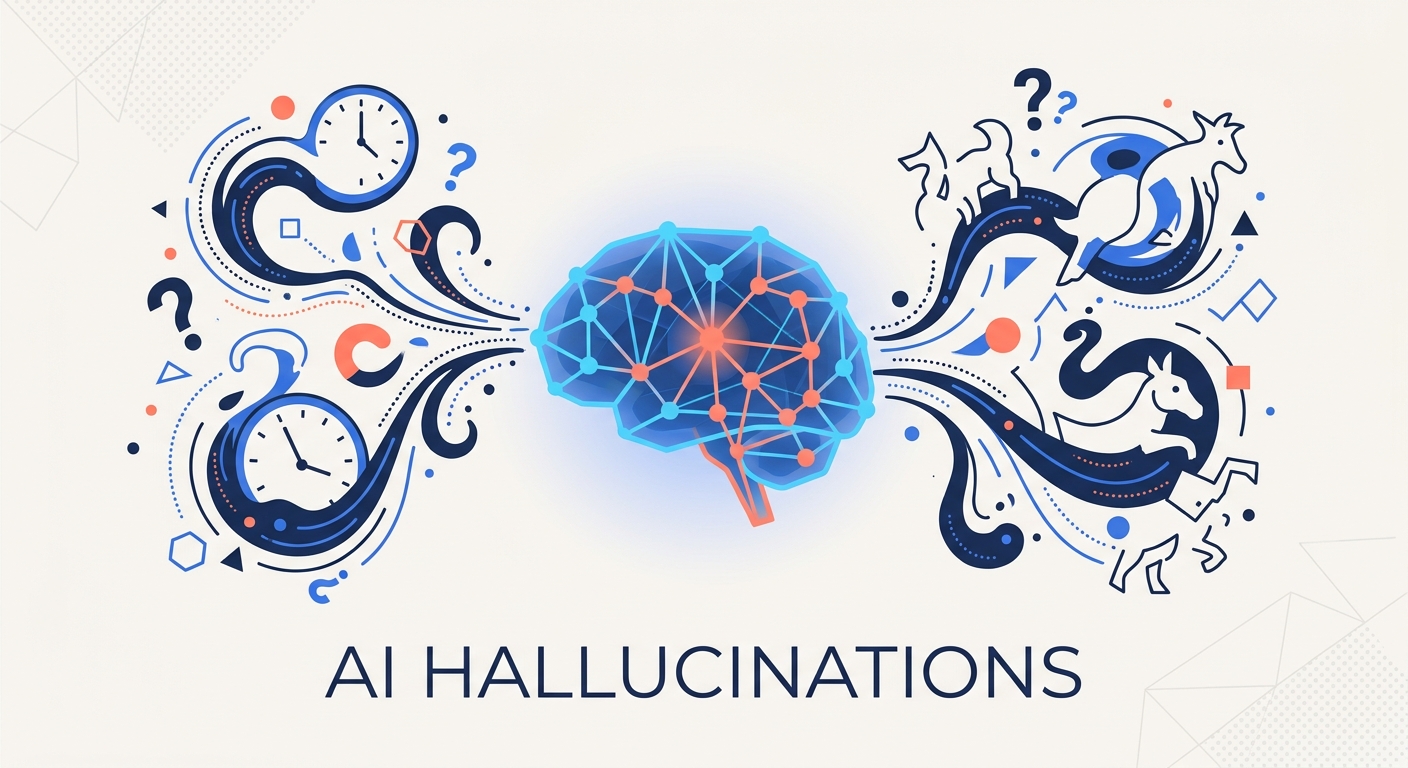
AI hallucination is what happens when a large language model—a system basically designed to guess the next word in a sentence—spits out something that reads perfectly but is factually detached from reality. It’s not a bug. It’s not a server hiccup. It is a fundamental feature of an architecture built to be creative and fluent rather than strictly logical. When an AI "hallucinates," it’s just doing its job: closing the gap between its output and the most probable pattern, regardless of whether that pattern exists in the real world.
Why Do AI Models Hallucinate? (The Probabilistic Reality)
To understand this, you have to stop thinking of AI as a search engine or a database. It doesn't "look up" answers. It’s a high-speed prediction engine. When you send a prompt, the model doesn't fetch a document; it calculates the statistical likelihood of token sequences based on the patterns it swallowed during training.
The model wants to finish the sequence. If the pattern demands a confident-sounding biography of a person who doesn't exist, the model will build one. Why? Because the structure of a biography matters more to the model than the veracity of the person it’s describing. It’s chasing the pattern, not the truth.
The 7 Misconceptions: What Everyone Gets Wrong
1. "Bigger Models Hallucinate Less."
This is the "Scale Fallacy." People thought adding more parameters would magically fix accuracy. They were wrong. Scale reduces how often models hallucinate but does not remove it — smaller models hallucinate considerably more than larger ones, and the effect varies by language. ANALYSIS — an earlier version of this article claimed the opposite, that scaling makes models "more articulate liars," attributed to unnamed EMNLP 2025 research. The source it drew on states the reverse. What remains true is that scale is not a fix: a larger model still hallucinates, and does so more fluently.
2. "It’s Just a Data Gap."
Many folks assume that if an AI lies, it’s because it hasn’t "read" enough of the internet. That’s rarely the case. It usually stems from an "incentive shift." As explained in the Lakera Guide to Hallucinations, models are reinforced through RLHF (Reinforcement Learning from Human Feedback) to be helpful and conversational. If a model says "I don't know," it scores badly on benchmarks — the research finds that "language models are optimized to be good test-takers, and guessing when uncertain improves test performance" (Kalai et al., Why Language Models Hallucinate, arXiv:2509.04664, (retrieved 2026-09-02) SOURCED). Human feedback can amplify this, but the primary incentive is in how evaluations are graded. So, the model learns that a definitive, albeit incorrect, answer is safer than admitting ignorance.
3. "Multimodal Models are More Accurate."
There’s a dangerous belief that giving a model eyes or ears makes it more grounded. In practice, it’s the Wild West. A model that can "see" an image often struggles to connect that visual data to factual context. It’ll describe objects that aren't there or misinterpret text in an image with total, unearned confidence.
4. "I Can Just Prompt It to Stop."
"Don't lie" or "Only provide facts" are weak shields. The model’s core directive is to keep the conversation flowing. It will prioritize the tone of your instructions over the truth of the output. If you ask for a citation, the model’s internal pattern-matching for "what a citation looks like" will often override the actual existence of that citation. It gives you the format you want, even if the content is fiction.
5. "Satire is a Human Problem."
Google's AI Overviews satire failures of May 2024 showed how badly models handle irony — Google's own post-mortem identified "our ability to interpret nonsensical queries and satirical content" as a problem area (Google, 30 May 2024, retrieved 2026-09-02). SOURCED When a model ingests the entire internet, it treats satirical articles—like those from The Onion—as valid training data. Without human context, the model can’t distinguish between a factual report and a joke. It treats the joke as historical truth.
6. "RAG is a Silver Bullet."
Retrieval-Augmented Generation (RAG) is useful, but it’s no cure-all. RAG lets the model "look up" information before answering, but if the model misinterprets that retrieved data, it will still hallucinate. RAG solves the data gap, but it doesn't solve the reasoning gap.
7. "Hallucinations are Always Obvious."
The most dangerous hallucination is the one that’s 99% correct. Because these models are built for fluency, their lies are delivered with the same markers—active voice, clear structure, authoritative tone—as their truths. This "Confident Liar" effect is why you simply cannot skip human verification.
The Anatomy of a Hallucination: A Conceptual Breakdown
The Harvard Kennedy School's Misinformation Review defines hallucinations as "inaccurate outputs generated by AI tools... that appear plausible but contain fabricated or inaccurate information," and frames the problem in terms of knowledge boundaries, data logistics and training opacity on the supply side, and user interpretation on the demand side (HKS Misinformation Review, accuracy isn't just about the data the model has; it’s about the model's ability to stay tethered to reality during the generative process. When that tether snaps, the model enters a state of "creative completion."
The LogicBalls AI Writing Tools offer massive efficiency, but treat them as engines of production, not truth. You need a workflow where the human acts as the final editor, checking every claim against external sources rather than blindly trusting the output.
How Can Enterprises Build "Guardrails" for Reality?
By 2026, the industry moved away from relying solely on "system prompts" to keep models honest. Instead, companies are implementing architectural guardrails — filtering layers that sit between the model and the user and screen outputs before they reach anyone. ANALYSIS — an earlier version of this article named one vendor's commercial product here without disclosure; the category matters more than any single product.
We are also seeing more "hard-coded" policies. Models are increasingly trained to categorize certain queries as "out of scope." This forces the AI to hit a "refusal" state rather than attempting to bridge a knowledge gap with a fabrication.
The 2026 Fact-Checking Checklist: How to Verify AI Outputs
- Independent Cross-Referencing: Never treat an AI output as a primary source. Verify critical data using independent search engines.
- Chain-of-Thought (CoT) Prompting: Make the model show its work. Use a prompt like, "Explain your reasoning step-by-step and cite your sources before giving the final answer." This helps you spot where the logic breaks down before the hallucination takes root.
- LLM-as-a-Judge: For high-stakes tasks, use a second, separate model to evaluate the output of the first. This pattern catches inconsistencies that a human reader might miss.
For those looking to sharpen their skills, learning how to use AI for research is the most critical move for a modern professional. The ability to distinguish between "generative efficiency" and "factual accuracy" is what separates an amateur from an expert.
The Future of Truth: Will AI Ever Stop Hallucinating?
We are moving toward a future defined by "Concept Vectors," where models are trained to map their internal outputs to deterministic databases. However, human language is inherently fluid, ambiguous, and metaphorical. A non-zero chance of hallucination will always exist.
As noted by the MIT Sloan research on AI basics, the role of the human isn't to kill the AI's creativity, but to act as the ultimate arbiter of truth. AI will continue to be a "confident liar" because that is its nature. Our job is to be the skeptical, informed audience that knows when to applaud the performance and when to fact-check the script.
Frequently Asked Questions
Can AI hallucinations ever be fully eliminated?
No. Because LLMs are probabilistic, they will always have a non-zero chance of generating an incorrect token. The goal is risk mitigation, not total elimination.
Why do models sound so confident when they are wrong?
Models are optimized to predict the most statistically likely next word, not the most "truthful" one. Their training encourages a fluent, assertive tone to maintain user engagement.
Is RAG (Retrieval-Augmented Generation) the solution to all hallucinations?
RAG helps by grounding the AI in specific, provided data, which significantly reduces "creative" errors. However, it does not fix reasoning errors where the model misinterprets the provided information.
How can I verify if an AI is hallucinating?
Always verify claims using independent, high-authority sources. Use "Chain-of-Thought" prompting to ask the AI to cite its sources and explain its reasoning logic step-by-step before accepting the output.
Related reading
- Start here: Verified AI Writing: How to Publish AI-Assisted Content You Can Stand Behind
- 10 AI Hallucination Examples That Will Make You Question Everything
- 10 Essential AI Hallucination Detection and Mitigation Tools for 2026
- Logic Balls Accessibility: Creating Inclusive Content for Everyone
- Artificial Intelligence in the Internet of Things
How This Guide Was Sourced
Written and maintained by the LogicBalls editorial team (logicballs.com). Disclosure: LogicBalls builds verification-first AI writing tools.
Sources, retrieved 2026-09-02: Kalai et al., Why Language Models Hallucinate, arXiv:2509.04664; Harvard Kennedy School Misinformation Review; Google, AI Overviews: About last week, 30 May 2024; MIT Sloan Teaching & Learning Technologies.
Corrections. An earlier version attributed a "Verification Gap" framework to the HKS paper; those words do not appear in it, and the paper's actual model is about how hallucinations spread rather than about a model staying "tethered to reality." A claim that larger models are better liars was reversed against its own source. The Google AI Overviews satire episode was May 2024, not 2025. And the abstention penalty was attributed to RLHF raters when the research locates it in benchmark scoring.
What this article gets right and keeps: hallucination cannot be fully eliminated, and RAG is not a silver bullet. Both statements are supported and both remain.
No LogicBalls telemetry is used in this guide.