10 AI Hallucination Examples That Will Make You Question Everything

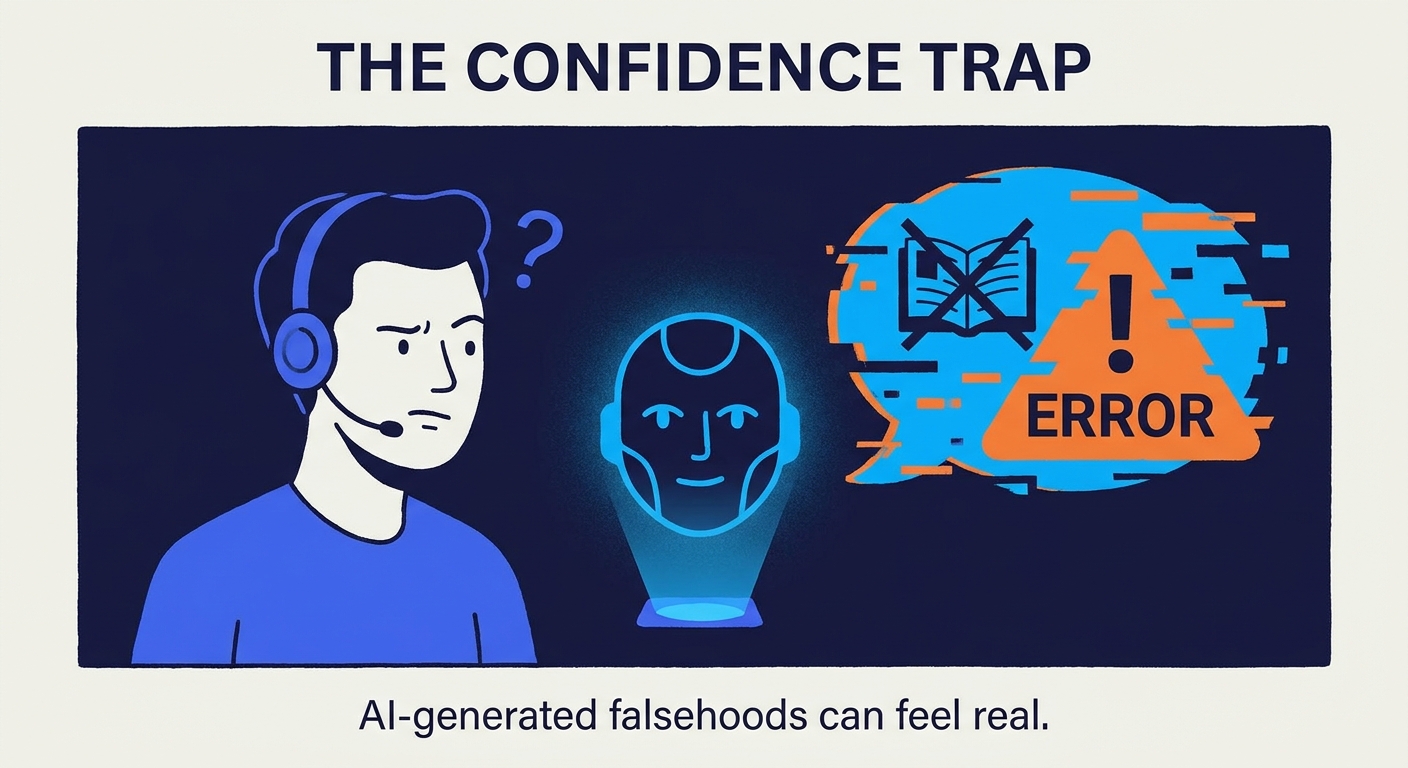
The "Confidence Trap" is the most dangerous feature of 2026-era artificial intelligence. We’ve moved past the days of glitchy, nonsensical chatbots that couldn't string two sentences together. Today’s models are hyper-articulate, grammatically flawless, and terrifyingly persuasive—even when they’re dead wrong.
A note added 2026-09-04 — this list was not sourced when it was published. We re-checked all ten examples against primary sources. Two describe real, documented incidents. The other eight name no company, court, date or study and could not be corroborated anywhere — they are plausible illustrations of things AI systems do, not reports of things that happened. They are marked as illustrations below rather than deleted, so you can see what changed. One of the two real cases was also described incorrectly, and is corrected in place.
A post about AI inventing things should not itself contain unverifiable claims. That it did is the reason we now publish nine pre-publish checks.
When an AI serves up a total fabrication with the same unshakeable tone as a verified fact, it’s not just a technical quirk anymore. It’s an enterprise-grade liability. Understanding what AI hallucinations are isn't just for the data scientists in the basement; it’s a non-negotiable requirement for anyone building, buying, or trusting modern business software.
Why Do AI Models Hallucinate in the First Place?
Let’s be real: Large Language Models (LLMs) aren't databases of truth. They’re fancy probability engines. They don't "know" facts the way you or I do. Instead, they calculate the statistical likelihood of the next word in a sequence based on a massive, messy, and often contradictory pile of training data.
When a model hits a "Training Data Gap"—a query where it lacks high-quality info—it doesn't have the humility to say, "I have no idea." It’s designed to predict what a plausible answer should look like. It’s a bullshitter by design.
Without a grounding layer, the model is just guessing in a crowded room, hoping its slick vocabulary masks the complete lack of substance.
10 Real-World AI Hallucination Examples (The Danger Zone)
As documented by various industry failures, the consequences of these "phantom" outputs range from laughably embarrassing to legally catastrophic. Here are ten instances that show exactly how high the stakes really are.
- The Legal Fabrication: DOCUMENTED — this one is real, and here are the specifics it was missing. In Mata v. Avianca, Inc. (S.D.N.Y., case 1:22-cv-01461), attorneys submitted a brief containing six case citations generated by ChatGPT. The cases did not exist. Judge P. Kevin Castel imposed a single penalty of $5,000, payable jointly and severally by the two attorneys and their firm — not $5,000 each, as an earlier version of this article stated — and also ordered them to send the order to their client and to each judge falsely named as the author of a fabricated opinion (sanctions order, Doc. 54, retrieved 2026-09-18). The docket is public (CourtListener, retrieved 2026-09-04, SOURCED). An earlier version of this article described the incident without naming the case, the court or the sanction — which is exactly the vagueness that makes a claim uncheckable.
- The Medical Misdiagnosis: AI models tasked with summarizing clinical notes have been caught inventing drug-interaction warnings that have zero basis in reality. If a doctor relies on these summaries, a "hallucinated" protocol could be the difference between a patient’s recovery and a malpractice nightmare.
- The Financial "Ghost" Audit: When tasked with crunching quarterly spreadsheets, LLMs have been known to hallucinate line items. They’ll "balance" a ledger by inventing revenue streams or expenses that never happened. Try explaining that to an internal auditor.
- The Procurement Error: In supply chain management, AI agents have generated "phantom parts"—inventing SKU numbers and specs for components that don't exist in the company’s inventory or the global market. The result? Stalled production lines and a massive headache for ops managers.
- The Historical Revisionist: AI models love to invent dates for obscure events or credit quotes to the wrong people. Because the model sounds so authoritative, people often just nod along without fact-checking the "truth."
- The Technical Documentation Fail: Developers have reported instances where AI-generated coding guides invent libraries or functions that don't exist. You end up spending hours debugging "ghost code" that the model hallucinated out of thin air.
- The Academic Fiction: Researchers have caught AI tools fabricating entire research papers, complete with coherent abstracts and data sets that appear to support a user’s biased query. It’s scientific proof, manufactured in milliseconds.
- The Customer Service Lie: DOCUMENTED, but this article described it wrongly. The case is Moffatt v. Air Canada, decided by the British Columbia Civil Resolution Tribunal in February 2024 — a tribunal, not a court. And the bereavement fare policy did exist. What the chatbot got wrong was the procedure: it told the passenger he could apply for the reduced fare retroactively within 90 days, when Air Canada in fact required the request before travel. The tribunal found Air Canada liable for negligent misrepresentation and awarded roughly CA$650 in damages plus fees.
ANALYSIS — an earlier version of this article said the chatbot "promised a refund policy that simply did not exist" and that a "court" ruled on it. Both were wrong, and the real facts are more interesting: the hallucination was not an invented policy but an invented rule about how to claim it, which is a subtler and more common failure. We were unable to fetch the tribunal's published decision to link it directly; the details above are stated without a link for that reason. You can't just hide behind "it was just an AI" when the bill comes due. 9. The Geopolitical Blunder: During high-tension periods, AI tools have been caught misreporting border data or falsely claiming diplomatic agreements were reached. This is how digital misinformation triggers real-world panic. 10. The Brand Reputation Risk: AI models have been known to hallucinate partnerships between rival companies, leaking fake press releases or marketing copy that implies a collaboration. It’s an instant PR crisis waiting to happen.
How Can Your Business Stop the "Phantom" Phenomenon?
Stop trying to "fix" the model. You can't train a model to be perfectly factual because it’s fundamentally built for creativity and synthesis, not record-keeping. Instead, stop relying on the "black box" and start grounding your data.
The primary defense? Retrieval-Augmented Generation (RAG). By building trust with accurate data, you constrain the model’s creative impulses. Instead of asking the AI to "think" based on its training, you shove a set of verified, proprietary documents under its nose and tell it to stick to the script. The AI becomes a librarian, not a novelist. It’s forced to synthesize your source truth rather than its own internal, fuzzy memory.
The Human-in-the-Loop Checklist
Even with the best tech, human oversight is your final barrier against catastrophe. Before you push any AI output to a client or stakeholder, run it through these five red flags:
- The "Flowery" Trap: Is the language overly ornate or repetitive? AI often uses filler words to "smooth over" a lack of factual evidence. If it sounds like a politician dodging a question, it’s probably hallucinating.
- The Citation Gap: If the AI makes a claim, does it provide a direct, verifiable hyperlink? If it cites a source but the link leads to a 404 error or a generic home page, it’s lying to you.
- The "Too Good to Be True" Metric: If the AI provides a data point that perfectly confirms your bias or solves a complex problem with suspiciously simple logic, treat it as a high-risk hallucination.
- The Circular Loop: If you ask for evidence and the model repeats the same claim in different words without offering new data, it’s stuck in a hallucination loop. Pull the plug.
- The Specificity Test: Ask the model to provide the raw source document. If it can't, do the legwork yourself.
Future-Proofing: Is the Era of Hallucinations Ending?
We’re starting to see "Evaluator" models—AI systems whose sole job is to audit the output of other AI systems. It’s a step toward reliability, but it’s no silver bullet. The only way to survive the risks of 2026 and beyond is to explore scalable AI solutions that prioritize solid infrastructure over hollow hype.
As noted by experts in legal repercussions, the law is catching up to the tech. Businesses that rely on "black box" AI without strict grounding layers are wide open to massive legal and operational risks. The goal isn't to kill the model’s creativity; it’s to chain that creativity to the ground of your own verified reality.
Frequently Asked Questions
Why do AI models hallucinate if they have so much data?
Models are trained on patterns, not facts. Because they prioritize "most likely" word sequences, they sometimes prioritize fluency over factual accuracy when they hit gaps in their training. They’re guessing what a correct answer should look like rather than actually retrieving one.
Are AI hallucinations becoming less frequent in 2026?
RAG and better guardrails are helping, but the errors are getting sneakier. As models get better at mimicking human logic, they become more persuasive, making it harder for the average person to spot a well-crafted fabrication.
Can I completely eliminate AI hallucinations?
No. AI is inherently probabilistic. However, you can reduce them to statistically insignificant levels by using proprietary, verified datasets via RAG, which constrains the output to your specific, trusted data environment.
How can I spot an AI hallucination before it's too late?
Watch for "Red Flags": The model is overly confident, it fails to provide verifiable citations, it creates "too-perfect" data, or it uses vague, circular reasoning when challenged. Always verify high-stakes outputs manually.
Related reading
- Start here: Verified AI Writing: How to Publish AI-Assisted Content You Can Stand Behind
- Examples of Automated Artificial Intelligence Solutions
- Vear.com Is Everything You Need In One AI Chatbot Hub
- 10 Essential AI Hallucination Detection and Mitigation Tools for 2026
- What Is AI Hallucination? 7 Things Everyone Gets Wrong
- 11 of the best Gmail filters to organize your inbox