Gemini Accuracy: What Google's Own Documentation Says
AI accuracybenchmarksmodel documentation

On this page
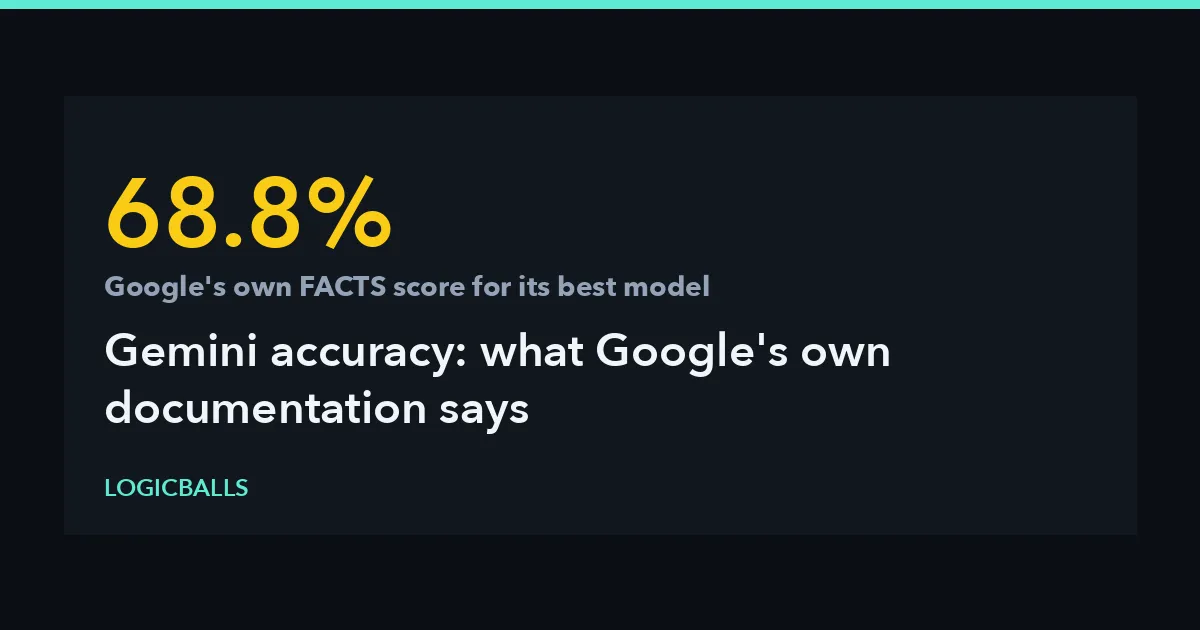
Google publishes more about Gemini's factuality than most vendors publish about anything, and the honest summary of it is that the numbers are improving and are nowhere near solved. Google's own FACTS Benchmark Suite reports Gemini 3 Pro at a 68.8% FACTS Score and notes that every model it evaluated scored "below 70%". The Gemini 3 Pro model card lists hallucination as a known limitation. And an independent grounded-summarisation leaderboard scores the Gemini 3 preview models worse than 2.5 on its particular task — which is not a contradiction, and the reason it is not is the useful part.
Everything below is from Google's own technical reports, model cards and product documentation, plus one independent benchmark, all retrieved 2026-09-06. No marketing pages are used as evidence.
Key Takeaways
- Google's own FACTS Benchmark Suite puts Gemini 3 Pro at 68.8%, and states that "all evaluated models achieved an overall accuracy below 70%, leaving considerable headroom" (retrieved 2026-09-06, SOURCED).
- The Gemini 3 Pro model card names hallucination as a known limitation, and gives a knowledge cutoff of January 2025.
- Google's Search help page says it directly: "AI Overviews can and will make mistakes."
- Grounding is conditional. The model "analyzes the prompt and determines if a Google Search can improve the answer" — you cannot assume any given answer was retrieved.
- An independent leaderboard ranks Gemini 2.5 Pro (7.0%) ahead of Gemini 3 Pro preview (13.6%) on hallucination rate. Different task, different measurement — and a clean demonstration of why one accuracy number never transfers.
What Google publishes, with the numbers
The FACTS Benchmark Suite
Google's most recent published factuality evaluation reports: "Gemini 3 Pro leads in overall performance, with a FACTS Score of 68.8%." It also reports "the error rate was reduced by 55% on FACTS Search and 35% for FACTS Parametric" between Gemini 2.5 Pro and Gemini 3 Pro, that "FACTS Multimodal saw the lowest scores, generally", and — the sentence worth keeping — that "all evaluated models achieved an overall accuracy below 70%, leaving considerable headroom for future progress" (FACTS Benchmark Suite, retrieved 2026-09-06, SOURCED).
The same source reports a second benchmark moving in the same direction: SimpleQA Verified "going from 54.5% accuracy on Gemini 2.5 Pro to 72.1% accuracy on Gemini 3 Pro."
What the FACTS grounding methodology measures matters. The earlier FACTS Grounding work describes judging responses "factually accurate if they are fully grounded in information contained in the provided document, with no hallucinations", scored by a panel of three frontier model judges, and states the scope limit plainly: "We did not include any examples that could require creativity, mathematics, or complex reasoning" (FACTS Grounding announcement and the leaderboard paper, arXiv:2501.03200, retrieved 2026-09-06, SOURCED).
So a FACTS score is about staying faithful to a document you provided. It is not a measure of what the model knows unaided.
The technical reports
The Gemini 1.0 technical report includes a factuality section reporting that post-training halved the inaccuracy rate — from 6.7% to 3.8% on its factuality set — raised attribution from 40.2% to 60.0%, and took appropriate hedging from 0% to 69.3% (Gemini 1.0 technical report, retrieved 2026-09-06, SOURCED). The same report states "there is a continued need for ongoing research and development on 'hallucinations' generated by LLMs".
The Gemini 1.5 report's expert question-answering evaluation, rated by human experts across 572 questions, shows accuracy rising from 50.0% (1.0 Pro) to 67.1% (1.5 Pro), with severely inaccurate answers falling from 26.7% to 6.3% (Gemini 1.5 technical report, retrieved 2026-09-06, SOURCED).
These are old models. They are included because they are the last place Google published a full factuality table with confidence intervals, and because the trend across them is the clearest evidence available that the numbers move a lot between generations.
The model card
The Gemini 3 Pro model card states that the model "may exhibit some of the general limitations of foundation models, such as hallucinations", and gives a knowledge cutoff of January 2025 (Gemini 3 Pro model card, retrieved 2026-09-06, SOURCED). The card carries no inline factuality benchmark numbers, deferring to a separate evaluations page.
The cutoff is the practically important line. Anything after January 2025 comes from retrieval or does not come at all.
What grounding does, and what it does not
Google's API documentation describes grounding as connecting the model "to real-time web content", with stated benefits including "Reduce model hallucinations by basing responses on real-world information" and "Provide citations: Build user trust by showing the sources for the model's claims" (Gemini API grounding documentation, retrieved 2026-09-06, SOURCED).
Two details in that documentation matter more than the marketing benefit list.
The model decides whether to search. The documented workflow is: "The model analyzes the prompt and determines if a Google Search can improve the answer", then "If needed, the model automatically generates one or multiple search queries and executes them." No threshold is published. The billing note confirms it from another angle — your project is billed "for each search query that the model decides to execute."
You can inspect what it actually cited. The API returns inline url_citation annotations with url, title, start_index and end_index, alongside the search queries executed. If you are building on the API, that metadata is the difference between hoping an answer was grounded and knowing which span came from which page.
Where an independent benchmark disagrees
Vectara's hallucination leaderboard measures one narrow thing: whether a model's summary of a supplied document introduces content the document does not support. On the version last updated 2026-05-11, the Gemini-family rows read (leaderboard repository, retrieved 2026-09-06, SOURCED):
| model | hallucination rate |
|---|---|
| gemini-2.5-flash-lite | 3.3% |
| gemini-2.5-pro | 7.0% |
| gemini-2.5-flash | 7.8% |
| gemini-3.1-flash-lite-preview | 8.2% |
| gemini-3.1-pro-preview | 10.4% |
| gemini-3-flash-preview | 13.5% |
| gemini-3-pro-preview | 13.6% |
Read that against Google's own FACTS numbers and the two appear to conflict: Google reports large factuality gains from 2.5 Pro to 3 Pro, and this leaderboard scores the 3-series preview models roughly twice as high on hallucination rate as 2.5 Pro.
They do not actually conflict, because they are not measuring the same thing. FACTS scores grounding across a suite including search-backed and parametric slices, judged by model panels. This leaderboard scores one task — summarise this document without adding anything — using its own detection model, on preview builds. Its maintainers state the limits themselves: "We are not evaluating the quality of the summaries, only the factual consistency of them", "this does not definitively measure all the ways a model can hallucinate", and "we do not recommend using this as a standalone metric."
That is the whole lesson of accuracy claims in one example. Both numbers are real, both were honestly produced, and neither predicts the other. We go through why in what "99% accurate" actually means when you buy AI.
What Google tells users to do
Its Search help page for AI Overviews is blunter than most vendor documentation: "Important: AI responses may include mistakes", and "AI Overviews can and will make mistakes" (AI Overviews help, retrieved 2026-09-06, SOURCED).
The same page's advice is worth quoting because it is the vendor's own instruction, not ours: "Always check important info in more than one place. Click the links to supporting information from the web and try other Google Search results too… Ask multiple versions of your question to get the best answers." Feedback is a thumbs-up or thumbs-down with a "Report a problem" category.
One documentation note, stated because we checked. The Gemini apps help page frequently cited for a "double-check" feature — the one that highlighted statements in green and orange — currently returns HTTP 200 with different content, describing only a Sources button and stating that "not all responses include related links or sources" (Gemini apps sources documentation, retrieved 2026-09-06, SOURCED). Third-party descriptions of the older feature are stale. We are reporting the discrepancy rather than the feature, because we can only cite the page as it currently reads.
What to do with all this
- Treat the knowledge cutoff as the hard line. January 2025 for Gemini 3 Pro. Anything later is retrieved or absent.
- Do not assume an answer was grounded. Search is conditional. On the API, read the
url_citationannotations; in a chat surface, look for the citation and open it. - Read a benchmark's task before its number. A FACTS score and a summarisation hallucination rate answer different questions, and neither is "how often will this be wrong for me".
- Follow the vendor's own advice. Google says check important information in more than one place. That is a reasonable instruction and it is worth more than any of the percentages above.
How This Guide Was Sourced
Written and maintained by the LogicBalls editorial team (logicballs.com). Disclosure: LogicBalls builds AI writing tools and routes work to multiple model providers, Google's among them. This post is about documented capability, not a purchase comparison — it names no alternative and recommends none.
Sources. Gemini 1.0 and 1.5 technical reports and the Gemini 3 Pro model card, from Google's own hosted PDFs. The FACTS Grounding and FACTS Benchmark Suite announcements and the leaderboard paper on arXiv. The Gemini API grounding documentation. Google Search's AI Overviews help page and the Gemini apps sources page. One independent measurement, Vectara's hallucination leaderboard, quoted with its maintainers' own stated limits. All retrieved 2026-09-06 and linked inline.
What is quoted and what is not. Every figure above was read in the source document. No number here comes from a third-party summary, a "Gemini vs" roundup or a press write-up.
What changed under us. A widely-cited Google help page URL for AI Overviews returns HTTP 404 and is not linked here. The Gemini apps page cited elsewhere for a "double-check" feature no longer documents it. Both are noted in the text rather than papered over.
What is not claimed. We ran no evaluation of our own and publish no accuracy figure for any model. Model behaviour, benchmark scores and documentation all change between releases, which is why every claim above carries a retrieval date.
No LogicBalls telemetry is used in this guide.
Frequently Asked Questions
Is Gemini accurate?
On Google's own factuality suite, its best model scored 68.8% and every model evaluated scored below 70%. That is a real number on a defined task, and it is not a prediction about your work.
Does turning on grounding stop hallucinations?
Google's documentation says grounding reduces them by basing responses on real-world information. It also documents that the model decides whether to search at all, so grounding available is not grounding applied.
Why does one benchmark say Gemini 3 is better and another say it is worse?
Because they measure different tasks. Google's suite scores grounding across several slices; the independent leaderboard scores one summarisation task with its own detector, on preview builds. Both can be right.
What is Gemini's knowledge cutoff?
The Gemini 3 Pro model card states January 2025. Later information has to come from retrieval.
How should I verify a Gemini answer?
Google's own advice: check important information in more than one place, open the supporting links, and ask the question more than one way. On the API, read the citation annotations to see which span came from which source.
Related reading
- AI Accuracy Rate: What "99% Accurate" Actually Means When You Buy AI
- How to Stop ChatGPT From Making Things Up
- Free AI Fact-Check Checklist: 42 Checks Before You Publish
- 8 AI Trustworthiness Frameworks Every User Should Know About
- Verified AI Writing: How to Publish AI-Assisted Content You Can Stand Behind
Related Articles
 AI accuracyClaude Hallucination Rate: What the Published Data Actually ShowsThree published measurements put Claude's hallucination rate at 9.8%, at 60.8%, and at 6% higher than the previous model. All three are correct, and none of them is the number.Ankit Agarwal13 min read
 AI accuracyCopilot and Work Documents: What Microsoft's Documentation Says About AccuracyMicrosoft publishes no accuracy figure for Copilot over work files. It does document permissions, indexing and long-document limits, and each one is a way an answer goes wrong.Ankit Agarwal10 min read
 AI accuracyIs ChatGPT Accurate? What the Published Research MeasuresThere is no single accuracy number. Published measurements for GPT-class models run from 7.6% to 62.5% on short-form facts and 3.1% to 23.3% on summary faithfulness, and each measures a different task.Ankit Agarwal11 min read
 AI accuracyHow to Fix Gemini Giving Wrong AnswersTen fixes drawn from Google's own Gemini documentation - five in the Gemini app, five in the API - plus the three problems no setting or prompt can fix.Ankit Agarwal11 min read