Free vs Paid Anti-Hallucination AI Tools: Is LogicBalls Worth It Over the Rest?

TL;DR
- ✓ Free AI models frequently hallucinate facts due to their predictive design flaws.
- ✓ Paid anti-hallucination tools use RAG pipelines to ensure factual accuracy and citations.
- ✓ Manual fact-checking of free AI output consumes valuable time and billable hours.
- ✓ Professional tools provide structural integrity for high-stakes business and research workflows.
If you’re treating AI like an oracle, you’re already bleeding money. In 2026, the line between a professional workflow and a total disaster isn’t speed—it’s factual integrity.
Sure, free AI tools are great at churning out fluent, confident-sounding nonsense. But professional-grade anti-hallucination tools have stopped being "nice-to-haves" and started being core infrastructure. Whether LogicBalls is "worth it" comes down to one simple question: What’s your reputation worth? If your work demands 99% accuracy, sticking to a free model isn’t being frugal. It’s just offloading the headache of fact-checking onto your own back, hour after unpaid hour.
The Reality of AI Hallucinations in 2026: Why "Accuracy" Is the New Currency
We’re long past the honeymoon phase of AI. Two years ago, we were tickled pink that a machine could summarize a document at all. Today? We expect it to do that without inventing facts.
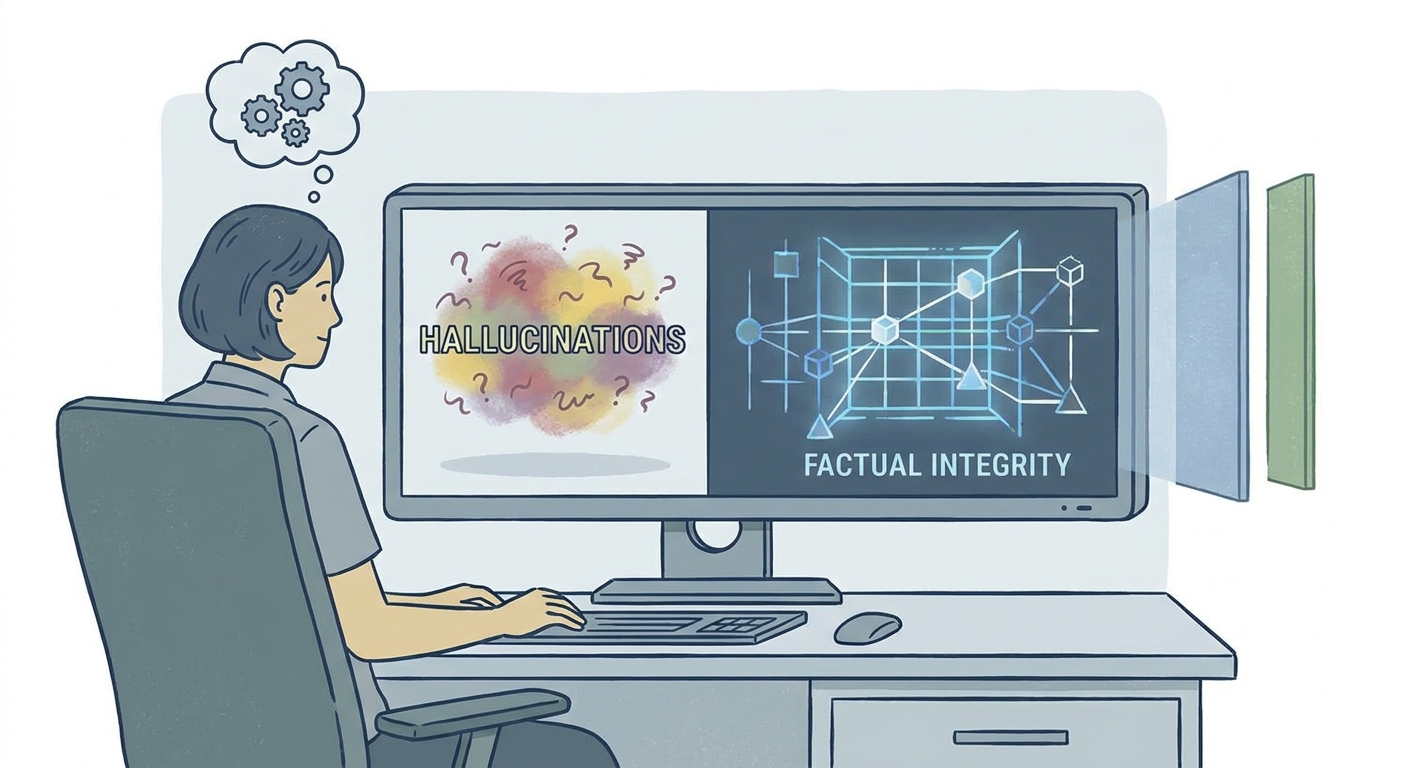
Here’s the cold, hard truth: Hallucination isn’t a "bug" you can patch. It’s a structural design flaw. LLMs are, at their heart, gambling engines. They predict the next likely word based on patterns, not truth. They don’t "know" facts; they know how sentences are supposed to look. According to current industry data on model reliability, hallucination rates vary enormously by task and benchmark. The source cited here makes exactly that point: benchmarks "measure different aspects (summarization faithfulness vs. knowledge calibration vs. citation accuracy), making single 'hallucination rate' claims misleading." ANALYSIS — an earlier version of this article attributed a long-document "factual drift" finding to that page, which does not discuss it. Relying on a standard, free LLM for anything high-stakes is like playing Russian Roulette with your credibility.
Free vs. Paid: What Are You Actually Paying For?
The gap between a free chatbot and a specialized anti-hallucination tool is a chasm. When you use a free tool, you’re relying on the model’s internal weights—basically its "memory." And memory decays. It gets fuzzy. It gets biased.
When you pay for a professional tool, you’re paying for a RAG (Retrieval-Augmented Generation) pipeline. Think of it as a bouncer for your AI. Instead of letting the model hallucinate whatever sounds good, this pipeline forces the AI to crawl the web, parse credible sources, and stick to the facts you’ve provided.
The "hidden cost" of the free stuff? It’s your time. If you spend 20 minutes fact-checking a 500-word output, you’ve basically paid for a subscription with your own billable hours.
How Do Modern Anti-Hallucination Tools Actually Work?
The industry has moved on from "prompt engineering"—the desperate act of telling an AI, "Please don't lie to me." That never worked. Now, we use system-level verification.
The secret sauce is RAG. Instead of guessing, the tool reaches out into a trusted index, grabs the relevant data, and forces the AI to summarize only that. Then, it forces the AI to cite its sources. It’s not just about getting the right answer; it’s about showing your work. ANALYSIS — an earlier version of this article claimed that longer documents produce more hallucination, citing a long-context benchmark. That benchmark reports the opposite: "there is no correlation found between haystack place and hallucination rates" (AIMultiple, retrieved 2026-09-02). SOURCED The claim has been removed. Long-context retrieval is still worth verifying, but not for the reason previously given. The longer the document, the more likely the AI is to trip over its own feet. Modern tools break open that "black box," giving you a clear paper trail back to the source material.
Is LogicBalls Worth the Upgrade? A Balanced Review
LogicBalls hits a sweet spot. It isn't an enterprise beast that requires a PhD to configure, and it isn't an entry-level chatbot that leaves you guessing. Its real power is integration. Most tools make you copy-paste data back and forth until you’re blue in the face. LogicBalls treats verification like a UX issue—it just works.
If you’re hunting for a deep dive, check out our list of 10 Essential AI Hallucination Detection Tools for 2026. But if you value a frictionless workflow, LogicBalls is built to give you those verification markers without killing your creative tempo.
Which Anti-Hallucination Tool Matches Your Workflow?
- The Researcher: You live and die by citations. You don't just need a "fact check"—you need a map that links every single claim back to a source.
- The Corporate User: Compliance is your middle name. You need to know why the AI said what it said, and you need a log of every step for the audit trail.
- The Content Creator: You need to move fast, but you can’t afford a viral "hallucination scandal." You need a safety net that catches errors before you hit publish.
Why Citation Verification Is the New Benchmark for Success
We’re done with "vibes-based" AI evaluation. Who cares if the AI sounds smart? The only benchmark that matters is the "Citation Check." GPTZero's investigation of ICLR 2026 submissions found that "50 submissions included at least one obvious hallucitation" — a fabricated citation — across 300 papers examined (GPTZero, (retrieved 2026-09-02) SOURCED) ANALYSIS — an earlier version of this article cited that piece under an invented title and attributed an editorial conclusion to it that it does not draw. If you want to see how your current work stacks up, run it through our AI Pros and Cons Tool to see the difference between a loose guess and a verified analysis.
The Verdict: When to Stick with Free and When to Upgrade
If you’re just brainstorming blog post ideas or drafting a casual email, stick with the free stuff. It’s fine. But if your work carries professional weight—legal summaries, technical docs, or client-facing content—a specialized tool is a business necessity. You aren't buying software; you’re buying an insurance policy against the next time your AI decides to confidently lie to your boss. For my money, LogicBalls is the smartest way to get that insurance without the enterprise-grade bloat.
Frequently Asked Questions
Are "Free" AI tools inherently worse at hallucinating than paid ones?
Free tools generally lack the dedicated, real-time RAG layers and automated verification engines that power paid platforms. While the underlying models might be similar, the "packaging"—the ability to ground the model in verified data—is what separates a hallucinating chatbot from a reliable research assistant.
Can any AI tool eliminate hallucinations 100%?
No. Even the most robust tools are designed for risk mitigation, not total elimination. The goal of an anti-hallucination tool is to make errors visible and traceable; the "human-in-the-loop" remains the final filter for absolute, 100% factual certainty.
What should I look for in an anti-hallucination tool?
Look for automated citation support, source transparency, and seamless integration into your existing workflow. A tool that provides direct links to the source material is significantly more valuable than one that simply claims to be "fact-checked."
Is LogicBalls suitable for professional or academic research?
Yes. LogicBalls is specifically optimized for verifying long-text outputs, making it highly effective for academic and professional workflows where citation accuracy and source traceability are critical for maintaining credibility.
Related reading
- Start here: Verified AI Writing: How to Publish AI-Assisted Content You Can Stand Behind
- 10 AI Hallucination Prevention Strategies Used by Top AI Labs
- Free vs Paid AI Writing Assistants
- Free vs Paid Tax Filing Tools: Why TaxBuddy’s Expert Filing Plan is Worth It
- AI-Powered Content Creation: LogicBalls' Guide to Supercharging Your Writing Workflow