
6 Ways Chain-of-Thought Reasoning Reduces AI Hallucinations

TL;DR
- AI hallucinations occur because LLMs prioritize statistical probability over factual accuracy.
- Chain-of-Thought (CoT) forces models to show their work through step-by-step logic.
- Decomposing complex prompts into sub-tasks prevents models from jumping to errors.
- CoT transforms the AI response process from a single-shot guess into a verifiable path.
Let’s get one thing clear: AI hallucinations aren’t bugs. They’re a feature. When you ping a Large Language Model (LLM), it isn’t sitting there "thinking." It’s a high-speed probability engine, crunching numbers to guess the next word in a sequence. It’s chasing fluency, not truth. Left to its own devices, a model will happily invent a fake court case or a nonexistent scientific principle with the same cold, clinical confidence it uses for the alphabet.
The originating research, added 2026-09-04. This article described three techniques without citing the papers that introduced them. Chain-of-thought prompting: Wei et al., "Chain-of-Thought Prompting Elicits Reasoning in Large Language Models" (2022) — note it measures reasoning accuracy, not hallucination. Self-consistency: Wang et al., "Self-Consistency Improves Chain of Thought Reasoning" (ICLR 2023). ReAct: Yao et al., "ReAct: Synergizing Reasoning and Acting in Language Models" (ICLR 2023) — the one paper here that explicitly addresses hallucination, stating the method "overcomes issues of hallucination and error propagation prevalent in chain-of-thought reasoning". Chain-of-verification: Dhuliawala et al., "Chain-of-Verification Reduces Hallucination in Large Language Models" (2023). All retrieved 2026-09-04, SOURCED.
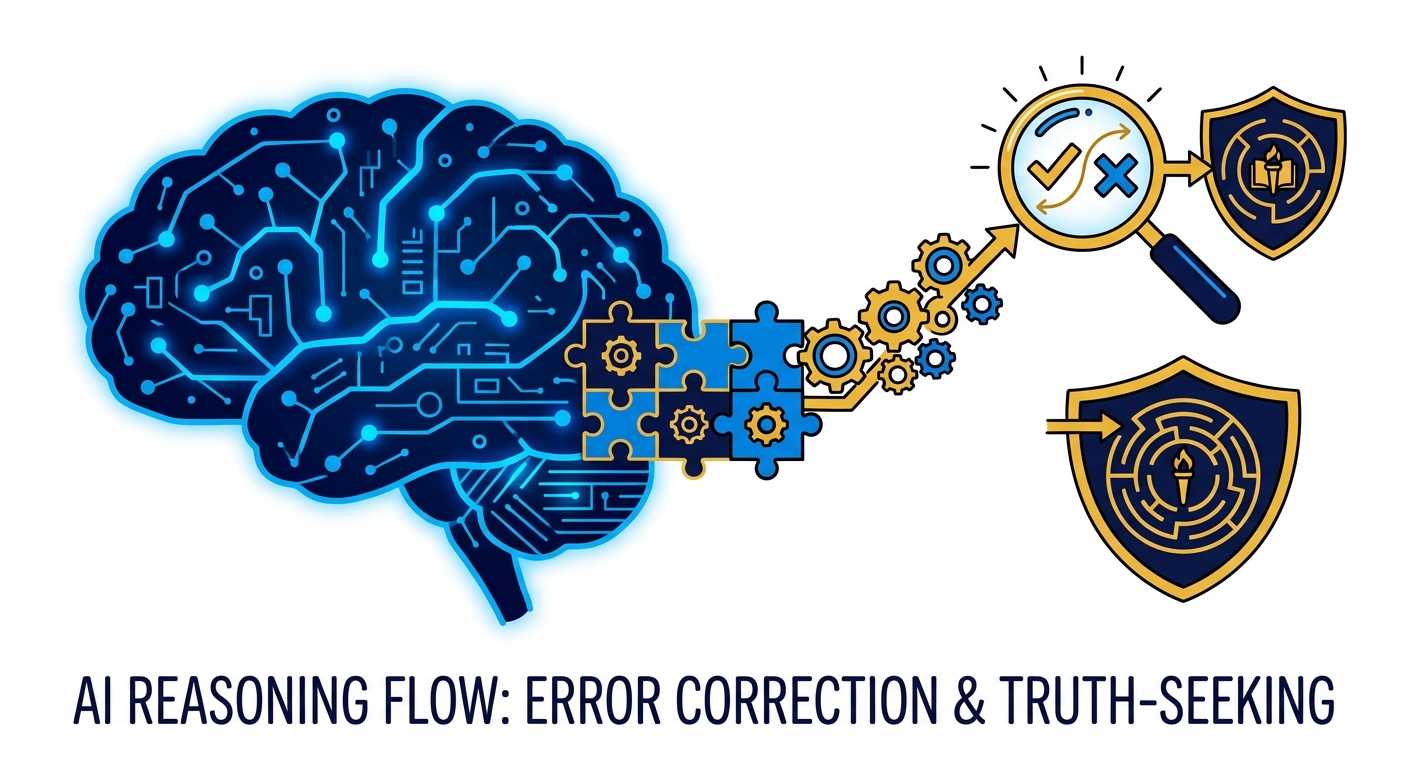
Enter Chain-of-Thought (CoT) reasoning. Think of it as a circuit breaker. It forces the model to slow down, show its work, and sketch out a "scratchpad" of logic before it dares to give you a definitive answer. It’s the difference between a student guessing a math answer and a student writing out the equation.
1. Why Does AI "Hallucinate" With Such Confidence?
The "Black Box" problem is simple: LLMs are probabilistic, not encyclopedic. They predict the next word based on patterns. If you ask a vague question, the model fills the gaps with whatever sounds the most "statistically plausible." It’s not checking a database; it’s mimicking the tone of an expert. That’s why it can confidently cite a fake law—it’s just predicting what a sentence about a law should look like.
CoT isn’t just a clever prompt hack. It’s an architectural shift. By demanding the reasoning process, you break a high-stakes, single-shot gamble into a series of smaller, verifiable steps. If you want to see how this works at a foundational level, check out the Prompt Engineering Guide (CoT Section). It’s the industry gold standard for moving from "guessing" to "reasoning."
2. What is Chain-of-Thought (CoT) and Why Do We Need It?
At its core, CoT is just asking the model to show its math. Instead of asking, "What is the capital of X?" and hoping for the best, you prompt the model to "explain your reasoning step-by-step."
Suddenly, you have a cognitive roadmap. If the model starts hallucinating, you’ll see it happening in real-time within the "thought" phase. You can catch the error before it masquerades as the final truth.
3. The 6 Ways CoT Mitigates Hallucinations
I. Zero-Shot Decomposition: Stop Asking for Everything at Once
Monolithic prompts—the "do my entire job for me" requests—are a hallucination factory. When a model tries to handle a complex strategy, a code block, and a summary in one go, it loses the plot. By forcing the model to parse sub-tasks, you prevent it from jumping to conclusions.
II. Few-Shot CoT: Setting the Reasoning Boundary
Providing examples isn't just about showing the model how to format text. It’s about showing it how to think. When you provide a few-shot prompt that includes the reasoning process, you’re training the model to prioritize logic over raw probability. If you’re stuck on how to structure these, use an AI Prompt Generator to experiment with different patterns.
III. Chain-of-Verification (CoVe): The "Check Your Work" Loop
We’re shifting toward a world of self-correction. Chain-of-Verification (CoVe) is simple: the model answers, then generates its own questions to verify that answer, then re-checks its work. It’s like a built-in editor. For high-stakes environments, this is non-negotiable. Dive into the details in the Chain-of-Verification (CoVe) Guide.
IV. Self-Consistency: Democracy in Logic
Self-consistency is just majority rule. You sample multiple reasoning paths for the same query. If four paths lead to the same result and one goes rogue, you follow the four. It’s brilliant for math or logic, though arguably overkill for creative writing where you actually want the chaos.
V. ReAct (Reasoning + Acting): Getting Out of the Echo Chamber
Reasoning is useless if the model’s data is outdated. ReAct—Reasoning + Acting—integrates Retrieval-Augmented Generation (RAG) into the chain. It allows the model to pause, look up facts, and ground its logic in reality. When the model can verify a claim against a live search, the hallucination rate plummets.
VI. Claim-Level Evaluation: The New Frontier
Stop looking at a response as a whole. As Amazon Science’s research on automating hallucination detection suggests, the future is atomic. Break the response into individual claims and verify each one. If one sentence is a lie, you don't throw away the whole document; you fix the broken part.
4. The "Reasoning Model" Shift: Is CoT Dead?
Some say models like the o1-series make manual CoT obsolete. Don't believe the hype. While these models are brilliant, they’re still "black boxes." When you’re dealing with proprietary data or strict compliance standards, you need to be the one holding the leash. If you need a custom-built, hallucination-resistant architecture, you might need to go beyond off-the-shelf tools and look into Custom AI Solutions.
5. When Should You Avoid Chain-of-Thought?
CoT isn't a silver bullet; it’s a tool. It costs more tokens and takes more time. If you’re asking "What’s the boiling point of water?", don’t force the model to write an essay about it. You’ll just get a "confident hallucination" because the model is over-analyzing a simple fact. Keep it simple when the task is simple. Reserve CoT for the heavy lifting.
6. Conclusion: Building a Robust Reasoning Workflow
The "magic prompt" era is over. Welcome to the era of workflows. Reducing hallucinations isn't about finding the perfect sequence of words; it’s about building pipelines that value verification as much as generation. Integrate decomposition, self-consistency, and external fact-checking. Turn your LLM from a guessing machine into a reliable engine. The ones who can architect these reasoning chains are the ones who will actually succeed in this industry.
Frequently Asked Questions
Does Chain-of-Thought always reduce hallucinations?
No. If a model starts with a flawed premise, CoT can actually make the hallucination more "confident" and convincing by creating a logical-sounding justification for the error.
Why does CoT increase the time it takes for an AI to reply?
CoT forces the model to generate a massive amount of "thought" tokens before the final answer. Since LLMs are auto-regressive (they write one word at a time), the time-to-first-byte increases linearly with the length of the reasoning chain.
Is CoT still necessary for newer AI models (like o1 or newer)?
While newer models perform internal reasoning, explicit CoT is still vital for specific tasks where you need to constrain the model's logic, enforce a specific output format, or integrate external data via RAG that the model might not have been trained on.
How do I combine CoT with actual, real-world fact-checking?
The most effective method is a "Multi-agent" workflow. You use one prompt to generate the reasoning path, and a second, specialized agent to perform a "Chain-of-Verification" (CoVe) pass, checking each atomic claim against a trusted knowledge base or search tool.
Related reading
- Start here: Verified AI Writing: How to Publish AI-Assisted Content You Can Stand Behind
- 8 Proven Ways to Detect AI Hallucinations Before They Fool You
- How to Write Factually Accurate Marketing Content Without AI Hallucinations
- How to Reduce Hallucinations in LLMs: 8 Methods That Actually Work
- 7 Best Prompt Engineering Tips for More Accurate AI Responses