Choosing the Right AI Content Generation Tool: A Comparison for 2026

TL;DR
- ✓ Shift from passive chat tools to active agentic AI for content production.
- ✓ Prioritize tools that integrate directly into your existing CMS and workflow.
- ✓ Evaluate AI software based on context windows and secure data siloing capabilities.
- ✓ Eliminate subscription bloat by consolidating your fragmented AI tech stack.
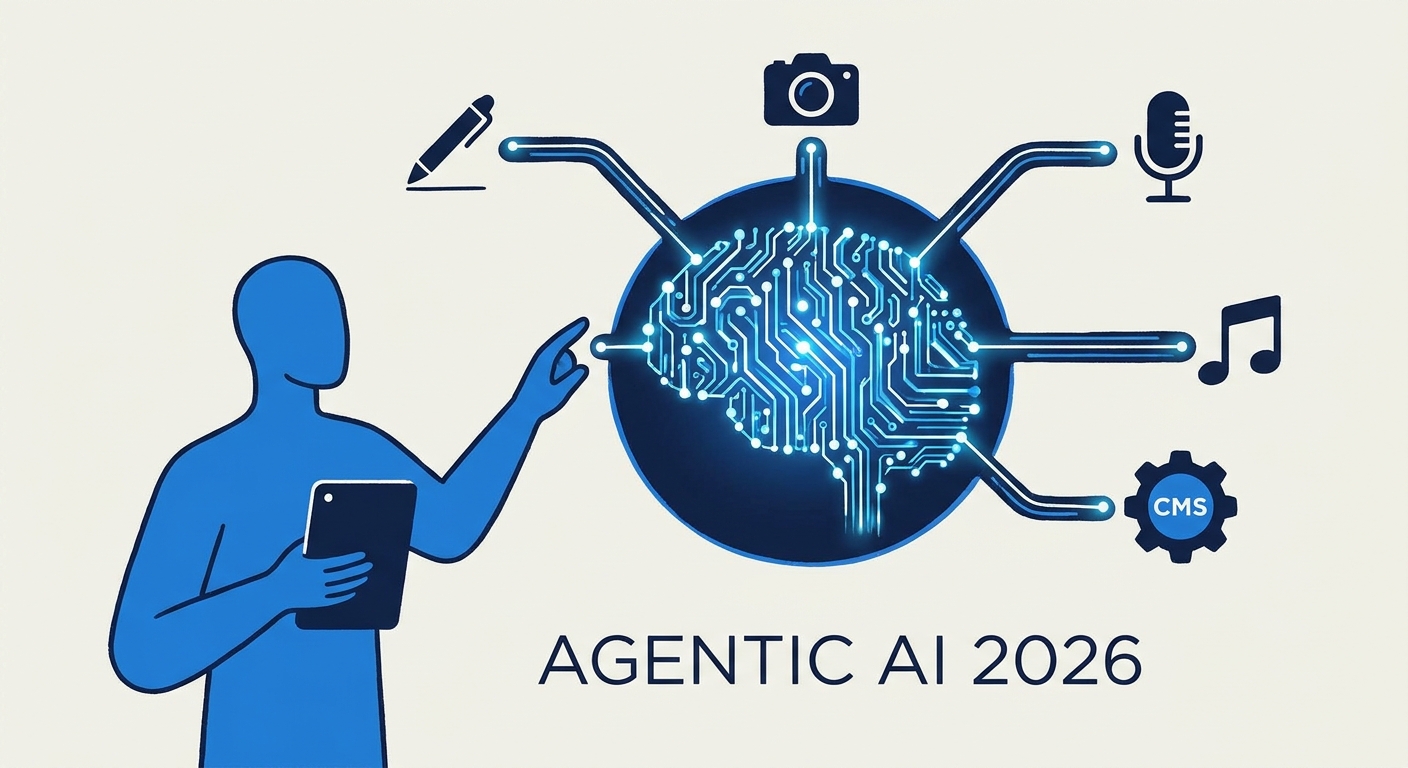
If you’re still treating AI like a glorified chatbot—a place to dump a prompt and wait for a generic paragraph—you’re losing the productivity war. In 2026, the competitive edge isn't about who generates text the fastest. It’s about who plugs "Agentic AI" directly into their operational nervous system.
The days of hopping between standalone browser tabs are over. You need agents that research, format, and push content straight into your CMS. Your tech stack should function less like a dusty typewriter and more like a junior associate who never sleeps, never complains, and actually knows your brand inside out.
The Shift to Agentic AI: Why 2026 is Different
For years, we were stuck in the "passive generation" trap. You asked, it answered, and you spent the next hour cleaning up the mess. That model? It’s dead. As highlighted in the State of Marketing AI Report 2026, the industry standard has moved toward multi-step execution.
An "Agentic Baseline" means your tool does more than predict the next word in a sequence. It acts. It pulls data from your internal knowledge base, cross-references it with live SEO trends, and serves you a draft that’s actually ready for human eyes. If your AI tool can’t bridge the gap between "spark of an idea" and "published asset," you’re paying for a subscription that’s actively slowing you down.
How Do You Evaluate AI Tools for Your Specific Needs?
Before you open your wallet for yet another SaaS subscription, pause. You need a "Workflow-First" evaluation framework. Stop obsessing over feature lists and start hunting for friction points.
Ask yourself: Does this tool live where I work? If you find yourself constantly exporting, copying, pasting, and reformatting, you’ve already lost the efficiency battle.
Key metrics for 2026 aren't just about output speed. Look at latency, the ability to handle massive context windows, and "Zero-Training" security compliance. If a tool doesn’t guarantee your data is siloed and kept far away from their public training models, it’s not an asset. It’s a liability.
Is Your AI Stack Suffering from "Subscription Bloat"?
There’s a dangerous tendency to layer tool upon tool, creating a "Frankenstack" that nobody knows how to use. We see teams juggling five different AI subscriptions—one for images, one for long-form, one for social, one for SEO. The result? Massive "context switching" costs. Every time your team jumps from a standalone AI tab to your Marketing Automation Tools, you lose focus. You lose momentum.
Consolidation is the theme of 2026. You’re better off investing in a high-quality, flexible platform that handles 80% of your needs exceptionally well, rather than chasing 100% perfection across a dozen fragmented, incompatible apps.
Which AI Tool Categories Should You Prioritize?
Text and SEO: Precision Over Prolificacy
Generic LLMs are falling behind. They’re great for brainstorming, but when it comes to ranking, they lack the technical nuance of fine-tuned engines. You need tools that understand search intent, entity mapping, and current SERP dynamics. If you want a reliable starting point, a specialized AI Content Generator that understands SEO architecture will always outperform a general-purpose chat interface.
Visuals and Design: Scaling High-Definition Assets
The cost-efficiency revolution in text-to-video has finally hit the SMB market. The barrier to entry for high-quality video content has collapsed. Higgsfield is a clear example, running an AI Video Generator that holds a character consistent across an entire multi-shot sequence and locks the color grade and style presets to a brand's existing look. You don’t need a production studio to create product demos or social ads anymore—thanks to advanced product walkthrough platforms. The best tools now allow for consistent character models and brand-aligned aesthetics, meaning your video assets can finally match the visual identity of your written content.
Integrated Workflow Tools: The Death of the Standalone Tab
The future is ambient. The best tools are the ones you forget are there—the plugins that live inside your CMS, your Slack workspace, or your design software. These tools don’t ask you to "prompt"; they ask you to "execute" within the context of your existing project.
How Can You Maintain Human-Grade Brand Voice?
The "robotic" trap is the greatest risk to your brand equity. When AI sounds like everyone else, it sounds like no one. To combat this, you must prioritize tools that feature "Brand Voice Engines." These aren't just simple custom instructions; they are layers of logic that ingest your style guides, your best-performing historical content, and your unique brand lexicon to filter all AI output.
If you aren't using a Brand Voice Consistency Guide to calibrate your AI, you’re essentially letting a stranger write your copy. Human-in-the-loop frameworks are non-negotiable. The AI provides the speed; the human provides the soul and the final editorial polish.
Why Is Enterprise Data Privacy the Ultimate Differentiator?
The honeymoon phase of "free and open" AI is over. Data privacy is now the primary line in the sand between a toy and a business tool. According to the Gartner Magic Quadrant for GenAI, enterprises are moving exclusively toward vendors who provide clear "Zero-Training" clauses. This ensures your proprietary strategies, customer data, and internal reports stay within your walls. If a vendor can’t provide a clear contractual guarantee regarding data sovereignty, walk away.
How to Future-Proof Your Content Strategy
The only way to future-proof is to remain stack-agnostic. Models change every six months; your workflows should be modular enough to swap out a model without rebuilding your entire process. Build your strategy around your data and your brand voice, not the specific API wrapper you happen to be using today. Furthermore, stay disciplined regarding AI Ethics & Copyright Guidelines. As the legal landscape around AI-generated media evolves, ensure your content creation process is documented, transparent, and ethically grounded.
Frequently Asked Questions
How do I choose between a general-purpose AI and a specialized tool?
Choose general-purpose models for ideation, brainstorming, and creative exploration. Use specialized tools for high-stakes, repetitive, or niche-heavy tasks where precision, SEO compliance, and workflow integration are required.
Is it safe to feed my company's data into these AI tools?
Only if the tool provides a "Zero-Training" guarantee or an enterprise-grade private instance. Always verify that your data is not being used to train the provider's public models before uploading any proprietary information.
How do I maintain a consistent brand voice across different AI tools?
Centralize your style guide. Use tools that allow for custom "Brand Voice" uploads or fine-tuning, and ensure every team member is using the same documentation to calibrate their AI outputs.
Will AI content generation replace human writers in 2026?
No. AI acts as a "Co-pilot," not a replacement. It handles the heavy lifting of drafting and research, but human writers are essential for high-level strategy, emotional resonance, and final editorial judgment.
What is the most common mistake companies make when adopting AI tools?
The most common mistake is failing to integrate AI into existing workflows. Teams often treat AI as a separate task, which leads to "context switching" and a massive drop in overall productivity.
Related reading
- Choose the Right Doc Review Tool for Your Team
- AI Content Generation Software: How to Choose the Right Platform for Your Brand
- Choosing the Right AI Tools for Email Marketing
- How to Choose the Right AI Content Creation Software for Your Specific Niche
- Need an AI Content Generation Tool? Here’s What to Look for in 2026