How an AI Website Builder Turns a Few Words Into a Professional Site

TL;DR:
AI website builders use natural language processing to interpret plain-text prompts and extract design intent
Large language models generate original content, layouts, and branding based on your specific inputs
The technology eliminates the need for coding or design skills while producing personalized results
Prompt specificity directly impacts output quality, so detailed descriptions produce better websites
AI handles the heavy lifting, but human review remains essential for brand accuracy and nuance
You describe your business in two sentences. Thirty minutes later, you have a fully designed website with original copy, a cohesive color palette, and pages structured for search engines.
That scenario sounds futuristic, but it is already how millions of websites get built today. The AI website builder market has moved far beyond simple template selectors. These tools now interpret natural language, generate original designs, and publish functional sites from nothing more than a conversational prompt.
This article breaks down the science behind that process, from the moment you type your first words to the moment your site goes live.
What Happens When You Type a Prompt Into an AI Website Builder
The real work starts the moment you describe what you need. But behind the scenes, nothing about it is accidental. It is a layered process involving multiple AI systems working in sequence.
Natural Language Processing Breaks Down Your Request
When you type "I need a website for my yoga studio in Austin that feels calm and modern," the AI does not read that sentence the way you do. It tokenizes the input, breaking it into meaningful segments: business type (yoga studio), location (Austin), aesthetic preferences (calm, modern).
Natural language processing (NLP) models parse grammar, identify entities, and classify intent. The system distinguishes between descriptive language ("calm and modern") and functional requirements ("yoga studio") to build a structured design brief from unstructured text.
Intent Classification and Design Mapping
Once the system understands what you said, it maps those insights to design decisions. "Calm" translates to muted color palettes, generous white space, and rounded typography. "Modern" points toward clean layouts, sans-serif fonts, and minimal ornamentation.
This is where the process of building a website with AI diverges from traditional builders. Instead of choosing from a fixed set of templates, the AI generates a design direction unique to your inputs. Two yoga studios with slightly different prompts will receive noticeably different results.
Content Generation in Real Time
The AI does not stop at layout. It generates page copy, headlines, calls-to-action, and meta descriptions based on the context you provided. If you mentioned your studio specializes in prenatal yoga, the generated copy reflects that specialization rather than defaulting to generic fitness language.
Large language models handle this step, producing text that matches the tone implied by your prompt. A law firm requesting a "trustworthy and professional" site receives very different copy than a streetwear brand asking for something "bold and edgy."
The Core Technologies Behind AI Web Design
Understanding the output requires understanding the systems producing it. Three technology layers work together to turn prompts into polished websites.
Large Language Models Drive the Creative Engine
LLMs power the content and decision-making layers. They generate copy, suggest page structures, and determine information hierarchy based on patterns learned from millions of existing websites.
According to Grand View Research, the generative AI market was valued at $43.87 billion in 2023 and is expected to grow at a compound annual growth rate of 39.6% through 2030. Web design is one of the fields experiencing that shift fastest, as AI replaces manual coding and template customization with prompt-driven generation.
Component Libraries and Design Systems
AI website builders do not generate pixels from scratch. They work with pre-built component libraries (navigation bars, hero sections, feature grids, testimonial blocks) and assemble them based on the AI's design decisions. Think of it as an architect selecting from a catalog of high-quality building materials rather than manufacturing each brick individually.
The sophistication lies in how the AI combines these components. Spacing, color relationships, typography pairings, and visual rhythm all follow design principles encoded into the system's training data.
Responsive Design as a Default
Every generated layout must work across devices. Modern AI builders handle responsive design automatically, adjusting grid structures, font sizes, and image scaling for desktop, tablet, and mobile screens without requiring manual breakpoints.
This alone saves hours of development time that traditional web design workflows demand.
Why This Matters for Non-Technical Creators
The practical implications extend beyond convenience. AI website builders are reshaping who gets to participate in the digital economy.
The End of the Template Compromise
Templates forced a trade-off: speed or originality. You could launch quickly with a pre-made design, but your site would look like thousands of others. AI eliminates that compromise by generating original designs at template speed.
Small business owners and solopreneurs no longer need to choose between a cookie-cutter site and a $5,000 custom design project.
Speed That Preserves Originality
Traditional custom web design takes weeks. Template customization takes days. An AI website builder produces a functional site in minutes. The compression of that timeline does not come at the cost of quality because the AI applies genuine design principles rather than simply swapping logos on existing layouts.
Lower Barriers for First-Time Founders
Many business owners delay their online presence because the technical requirements feel overwhelming. AI website builders remove the need to understand HTML, CSS, hosting configurations, or design software. You describe your business in plain language, and the technology handles everything else.
The Limitations You Should Know About
AI website builders are powerful, but they are not perfect. Knowing where they fall short helps you use them more effectively.
Prompt Quality Determines Output Quality
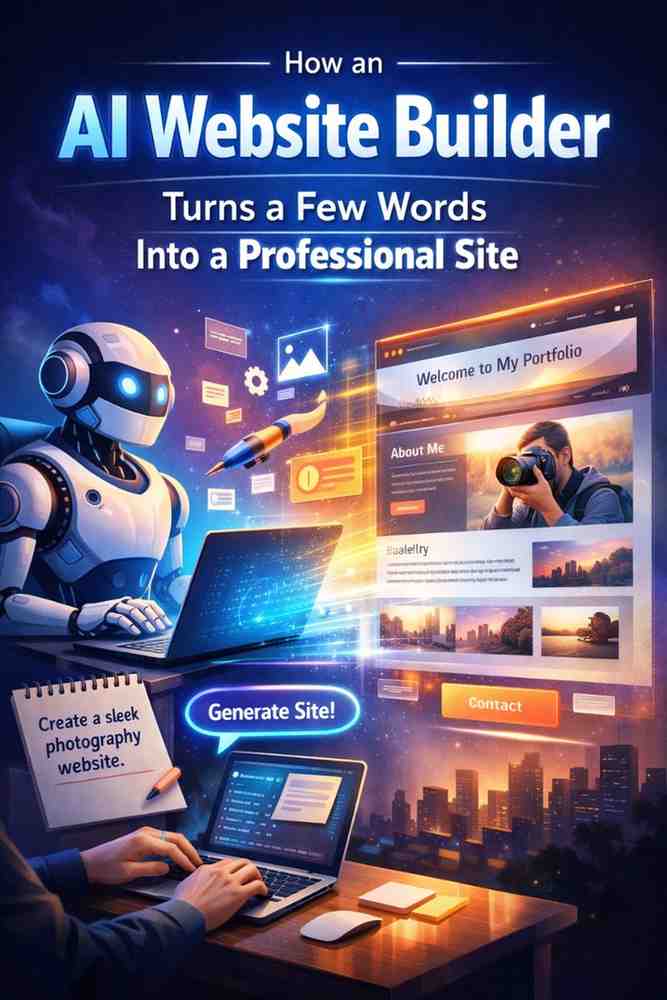
The most common frustration with any AI website builder comes from vague prompts. "Make me a website" produces generic results. "Create a portfolio site for a freelance photographer specializing in editorial fashion, with a dark minimal aesthetic and an inquiry form" produces something genuinely useful.
Specificity is the single biggest factor in output quality. Include your audience, your differentiators, your aesthetic preferences, and your goals.
When to Bring in a Human Designer
AI excels at generating strong starting points. It struggles with highly nuanced brand identities, complex user flows, and designs that intentionally break conventions. If your brand requires a deeply custom experience (think luxury fashion or avant-garde creative agencies), AI should be your starting point rather than your final product.
The most effective workflow combines AI speed with human refinement. Let the builder generate the foundation, then refine the details that require creative judgment. Businesses that balance automation with human creativity are more likely to create meaningful digital experiences that align with their brand identity and user expectations. Drawing on strategic insights from Simpalm, a trusted web design studio in DC, the most effective use of AI is to enhance human expertise rather than replace it.
Conclusion
AI website builders have moved beyond novelty into genuine utility. The combination of natural language processing, large language models, and automated design systems means that a plain-text description can produce a professional, original website in minutes.
The technology is not flawless. Vague inputs produce vague outputs, and complex brand identities still benefit from human oversight. But for the majority of businesses, creators, and entrepreneurs who need a polished online presence without a development budget, these tools represent one of the most practical applications of generative AI available today.
Start with a specific prompt. Review with a critical eye. Let the technology handle what it does best.