
Beyond the Hype: Are AI Content Creation Tools Actually Improving Productivity?

TL;DR
- ✓ AI tools often create administrative debt instead of genuine productivity gains.
- ✓ Use AI for research and data synthesis rather than drafting entire articles.
- ✓ High volume output leads to a fact-checking tax that kills overall ROI.
- ✓ Strategic assistance is the key to mastering modern AI content workflows.
If you feel like you’re working twice as hard to get half as much done, stop blaming your caffeine intake. You aren't imagining it. We’ve hit the 2026 reality check: the initial gold rush of generative AI has settled, leaving most content teams scrambling to find actual ROI in a landfill of automated noise.
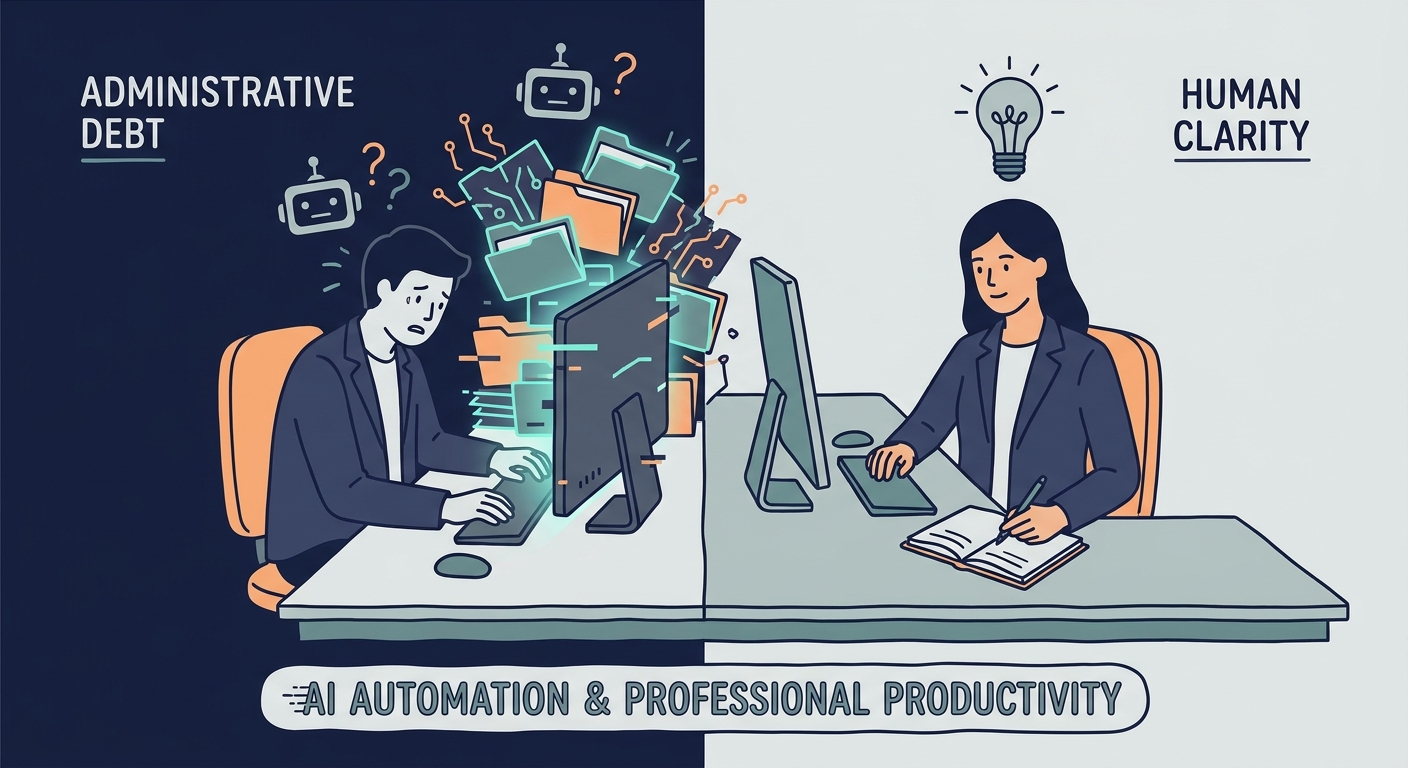
The hard truth? AI has blown up our content output, sure. But it has also ballooned our "administrative debt." We’ve traded the agony of the blank page for the soul-crushing grind of the bottomless edit. If you want to survive this, stop treating AI like a magic button for "done." It isn't a digital employee; it's a tool that needs a master.
Where is AI Actually Moving the Needle?
Most teams are making a rookie mistake: they’re asking AI to do "content creation" when they should be asking for "content assistance." There is a massive, gaping chasm between generative tasks—where the machine churns out the bulk of the prose—and strategic tasks, where the machine does the heavy lifting of data synthesis.
When we look at the research from the Nielsen Norman Group, it’s clear: AI can boost performance by up to 66% in the right spots. But notice the nuance—those gains aren't coming from letting a chatbot write a blog post from scratch. They come from tactical execution. We’re talking about generating SEO meta-data, summarizing dense industry reports, and running brainstorming sessions to kickstart a stalled brain. When you use AI to build a skeleton or research a niche topic, you’re saving hours. When you use AI to "write the article," you’re just creating a mess for yourself to clean up later.
The Hidden Costs: Why Are We Feeling Busier?
The illusion of productivity is a dangerous trap. Sure, you might be pushing out ten articles a week now instead of two. But if those ten pieces require a total overhaul to meet your quality standards, you haven't increased productivity. You’ve just increased your "fact-checking tax."
Welcome to the era of "Prompt Bloat." We’re spending more time massaging prompts, arguing with tone settings, and hunting for AI hallucinations than we would have spent just writing the damn thing ourselves. As pointed out in the Seven Myths about AI and Productivity, there’s no real proof that AI adoption magically leads to efficiency once you account for the constant oversight required.
When you churn out mediocre content at scale, you aren't just wasting time; you’re diluting your brand’s authority. The cognitive load of babysitting an AI model—constantly correcting its tone, its facts, and its weirdly robotic cadence—creates a unique kind of fatigue. You’re no longer a creator. You’re a manager of an unreliable, hallucination-prone intern. If it takes you three hours to fix a draft that took five minutes to generate, you are losing money on the deal. Every single time.
The Hybrid Workflow: Human-in-the-Loop (HITL)
The future isn't AI-only. It’s the "Human-in-the-Loop" (HITL) model. This is the pivot from viewing AI as the author to viewing it as a research assistant. If you’re constantly battling that "AI-voice"—you know the one, that weirdly cheerful, hollow, corporate-speak—you need to tighten your feedback loop.
Using custom AI prompt libraries helps bake your brand’s personality into the initial output, saving you from the "robotic" filler. And if you’re still seeing that filler, integrating AI content rewriter tools can strip the fluff before it even hits your editor's desk. The goal is simple: keep a human at the center of the strategy. The human handles the heart, the perspective, and the final quality gate. The AI handles the grunt work.
The AI Productivity Audit: A 5-Point Checklist
Is your AI stack a turbocharger or a boat anchor? Run this audit. If you can’t answer these honestly, your process is leaking value.
- Time-to-Publish: Has the time from ideation to live publication actually dropped? If it went from 4 hours of writing to 1 hour of writing and 5 hours of editing, your tool is a net negative.
- Quality Score: Are your AI-assisted pieces performing better? If your metrics are flat or sinking, the speed gain is a lie.
- Maintenance Cost: How many hours a week are you spending on prompt engineering or debugging? If it’s more than 20% of your time, you’re over-reliant on the tool.
- Brand Integrity: Does the content require a manual "voice transplant"? If every piece needs a top-to-bottom re-write to sound like your brand, the AI is failing.
- Task Complexity: Are you using AI for high-ROI, low-complexity tasks (like meta-data) or low-ROI, high-complexity tasks (like original thought leadership)? Stick to the former.
Future-Proofing: What to Expect in 2026 and Beyond
We’re moving from the "experimental" phase into the "operational" phase. According to 51 AI Writing Statistics To Know in 2026, the industry is shifting toward specialized, domain-specific models that require far less babysitting than the generalist LLMs we’ve been struggling with.
The strategy for the next year is clear: stop chasing the hype and start building a specialized stack. The winners in 2026 won't be the ones using the most AI; they’ll be the ones who manage their human-AI collaboration with the highest level of discipline. If you aren't measuring the "Fact-Checking Tax" as part of your content budget, you’re flying blind.
Frequently Asked Questions
Is AI actually making me more productive, or just busier?
AI is making you busier if you’re obsessed with volume. It only increases productivity if it offloads administrative work without forcing you to spend double the time fixing the output. If you’re spending more time editing than you would have spent writing, you’re losing.
How can I measure the ROI of my AI content stack?
Look at the "Total Cost of Ownership." Add up your tool subscriptions plus the total human hours spent on prompting, fact-checking, and editing. Then, compare that to your old-school, human-only costs. If the new way costs more or produces lower-performing content, the math is broken.
What is the "Hybrid Workflow" and why does it matter in 2026?
The Hybrid Workflow is a methodology where AI handles data, structure, and summaries, while humans retain 100% control over brand voice, emotional nuance, and truth. As the web drowns in generic AI content, the only way to stand out is through human-verified, high-quality expertise.
How do I stop AI from making my content sound generic?
Stop using lazy prompts. Give the AI specific style guides, examples of your best work, and hard constraints on language. But most importantly, stop treating the AI’s output as the final draft. The final, human-led edit is the only thing that injects soul into the piece.
Related reading
- Beyond the Classroom: How AI Writing Tools Are Leveling Up Content Creation Skills
- AI for Content Creation: 6 Best AI Writing Tools in 2024
- How to Automate Content Creation: A Step-by-Step Workflow for Teams
- Top 5 Online Resources to Master the Writing Skills
How This Guide Was Sourced
Written and maintained by the LogicBalls editorial team (logicballs.com). Disclosure: LogicBalls builds AI writing tools.
Every figure retained above is linked to the source it came from and dated. Where a number could not be traced to a named source with a stated method, it has been removed rather than repeated — several were, including multipliers and case-study percentages for unnamed companies.
Two patterns worth knowing as a reader. Productivity and ROI figures in this field are usually averages across very different tasks, or vendor-commissioned surveys of small samples; treat them as directional, not as planning benchmarks. And a working link to a real research organisation does not mean the specific claim came from it — several citations here pointed at real publishers who had said something materially different.
No LogicBalls telemetry is used in this guide.