10 Content Marketing Strategies for Brick-and-Mortar Businesses to Attract and Retain Customers
local marketingcontent marketingsmall businessretail marketingdigital signage

On this page
- Building a local content marketing strategy
- Creating engaging social media content that actually gets saved
- Using video marketing to showcase products and services
- Developing personalized promotional campaigns
- Using interactive digital signage to create engaging in-store experiences
- Measuring marketing ROI and customer engagement
- A practical checklist you can run this month
- Turning first-time visitors into regulars
- Where to start tomorrow
Most store owners I talk to have the same complaint: they post on Instagram, they run a sale, and the foot traffic barely moves. The problem usually isn't effort. It's that their content never gives a nearby person a reason to walk through the door today.
Here's the fix. Local content marketing works when every piece of content points at a real moment in someone's week, not at your brand in general. That's the lens for all ten strategies below. And if you're already investing in screens and touchpoints, tools like interactive digital signage turn a passive window display into something a customer can actually play with.
You'll get the attraction playbook first, then the retention tactics, then a straight answer on how to measure any of it. Short on time? The Five-Minute Rule near the end is the one change I'd make this week.
Building a local content marketing strategy
Start with a radius, not a persona. Your customer is within a few miles of the door, and that single constraint changes everything about what you publish.
I'd build your plan around three pillars: proximity, timing, and proof. Proximity means every post names your neighborhood or street. Timing means you publish around local rhythms, like payday weekends, school breaks, or the farmers market on Saturdays. Proof means you show real customers and real shelves, never stock photos of people laughing at a salad.
The practical structure: one Google Business Profile post a week, two short videos, one email to your list, and a monthly event or promotion. That's it. A small store beating a big chain on content almost always wins by being more specific, not more frequent.
Creating engaging social media content that actually gets saved
Forget follower counts. Saves and shares are what tell the algorithm your content matters to people nearby, and they're what your customers actually use as a shopping list.
- Show the shelf, the counter, or the back room. Behind-the-scenes footage outperforms polished product shots for local businesses.
- Post prices and hours in the caption. Those are the two things people search for before they leave the house.
- Reply to every local comment within the day. A friendly reply is free advertising to that person's friends.
My contrarian take: posting three times a week with genuine store footage beats daily reposts of generic graphics. I've watched boutiques kill their reach by scheduling recycled quote cards for a month straight.
Using video marketing to showcase products and services
Video is the closest thing to a test drive you can put online. A 20-second clip of a product in use answers more questions than a full product page.
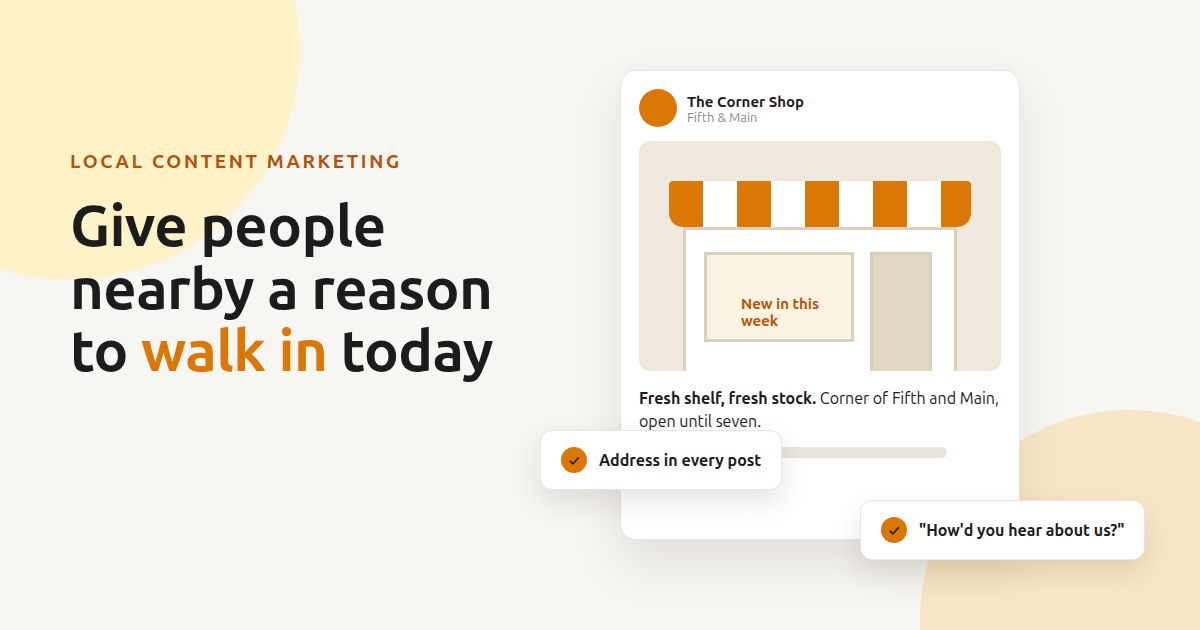
Shoot vertically, keep the first two seconds moving, and always end with where you are. "Corner of Fifth and Main, open until seven." That last line is the whole point for a brick-and-mortar shop, because a beautiful video without a location does nothing for foot traffic.
One texture tip that sounds strange but works: record on a Tuesday afternoon when the light through your window is best, and keep the ambient store noise low. Customers hear a busy, calm shop and read it as trustworthy. Empty silence reads as an empty store.
Developing personalized promotional campaigns
Personalization for a physical store isn't fancy software. It's remembering that the guy who buys coffee every morning gets a free refill on his birthday, and the customer who bought running shoes last spring gets a heads-up about new trail models.
Segment your list into four simple buckets: regulars, lapsed customers, first-timers, and event attendees. Each gets a different message. Regulars get early access. Lapsed customers get a low-pressure "we miss you" with a reason to return. First-timers get a thank-you and a reason to come back a second time, since the second visit is where the habit forms.
According to consumer research from Nielsen, shoppers consistently say they respond better to offers tied to their own habits than to blanket discounts. Your list is small enough to treat each bucket personally, and that's an advantage no national chain can match.
Using interactive digital signage to create engaging in-store experiences
This is where most local content strategies stop, and it's a mistake. Your in-store experience is content too, and it's the only content a customer physically walks into.
Interactive digital signage turns a wall screen into a touchpoint. Think a touchscreen kiosk that lets shoppers build a gift basket, a lift-and-learn display where picking up a product triggers more detail on screen, or a check-in screen that texts a follow-up offer to a visitor's phone. The content lives where the buying decision actually happens, which is at the shelf.
A concrete scenario: a neighborhood pet store I'd model this on put a lift-and-learn sensor under its premium food line. Lifting a bag showed ingredients, feeding guidelines, and a comparison against the cheaper brand. The display didn't shout. It just answered the question the customer already had in their hand. That's the difference between signage and messaging.
Measuring marketing ROI and customer engagement
Skip vanity metrics. Count the things that show up in your register: redemptions, code uses, foot traffic on promotion days, and repeat visits from your list.
Ask every new customer one question at checkout: "How'd you hear about us?" Log the answers in a spreadsheet for a month. That one column will tell you more than any dashboard, because it catches the word-of-mouth referrals no analytics tool can see.
The government's small business guidance at USA.gov walks through the basics of tracking revenue and expenses, which is the foundation any ROI math rests on. Get that clean first, then layer in your marketing numbers.
A practical checklist you can run this month
Here's the part I'd actually act on. This is the Five-Minute Rule: for every piece of content you publish, spend five minutes asking whether a person who lives two blocks away could act on it today. If not, rewrite the call to action until they can.
Then run this sequence:
- Claim and fill out your Google Business Profile completely, including photos and hours.
- Set up a simple email capture at the register and on your website.
- Record one product video on your phone and post it with your address in the caption.
- Build your first segmented email to regulars only.
- Pick one in-store screen or display and give it a job: wayfinding, product info, or a check-in offer.
- Start the "how'd you hear about us" log.
One honest judgment call: I'd pick interactive in-store content over another social platform every time for a retail shop. A screen in your own store doesn't depend on an algorithm deciding whether anyone sees it.
Turning first-time visitors into regulars
Retention is where local content quietly wins. The businesses that last aren't the ones with the biggest launch. They're the ones whose content reminds you, gently and often, that they're still there and still worth the walk.
Build in a reason to return. A monthly workshop, a loyalty punch card, a seasonal tasting, a repair clinic. Content about the event pulls people in; the event itself is what turns a purchase into a habit. According to data from Shopify, repeat customers spend more per order than new ones across retail broadly, which matches what most shop owners I know see at the counter.
And don't underestimate the unglamorous stuff. A short email that says "we saved your favorite for you" beats a flashy campaign every time for a customer who already trusts you.
Where to start tomorrow
Pick two strategies from this list, not ten. The local content plan and the "how'd you hear about us" log make the strongest pair, because one builds reach and the other tells you whether it worked. Every other tactic on this page gets easier once those two are running.
Your storefront already tells a story to anyone walking past. The question is whether your content is telling that same story to the person scrolling their phone two streets over. What would you change about your window display if you knew it was the first thing a customer saw online?
Related Articles
 AI marketingAI Tools for Promoting Local Businesses in the Food IndustryDiscover how AI tools can revolutionize marketing for local food businesses, from content creation to customer engagement. Learn practical strategies and affordable solutions.Pratham Panchariya6 min read
- whatsapp marketingBest WhatsApp Marketing Software for Small BusinessesWati for easy API onboarding, Manychat for WhatsApp plus Instagram, AiSensy or Interakt in India. Meta's per-message fees vs platform fees, compared.Hitesh Kumawat12 min read
 outsourcing for small businessBest Outsourcing Companies for Small BusinessesStruggling to scale? Discover the best outsourcing companies for small businesses to help you streamline operations and reduce costs. Find your perfect partner.Govind Kumar7 min read
 AI content generationCan AI Content Generation Tools Really Replace Marketing Teams? Industry Insights for 2026Will AI replace marketing jobs? Discover why 2026 marketing success depends on agentic workflows and human-AI collaboration, not total automation.Ankit Agarwal9 min read