ALM Corp Report Reveals 2026 Shift Toward Enterprise MarTech Stack Consolidation and Infrastructure Optimization
enterprise MarTech consolidation 2026MarTech infrastructure optimizationAI-integrated stacksSaaS ecosystem churnmarketing technology audit


The Great MarTech Purge: Why 2026 is the Year of Consolidation
The marketing technology landscape has finally hit the wall. After years of unchecked expansion, 2026 marks a hard pivot from "collecting tools" to "optimizing infrastructure." We’ve reached a point of structural recalibration where the sheer volume of software has plateaued, and the industry is undergoing a brutal, Darwinian shakeout.
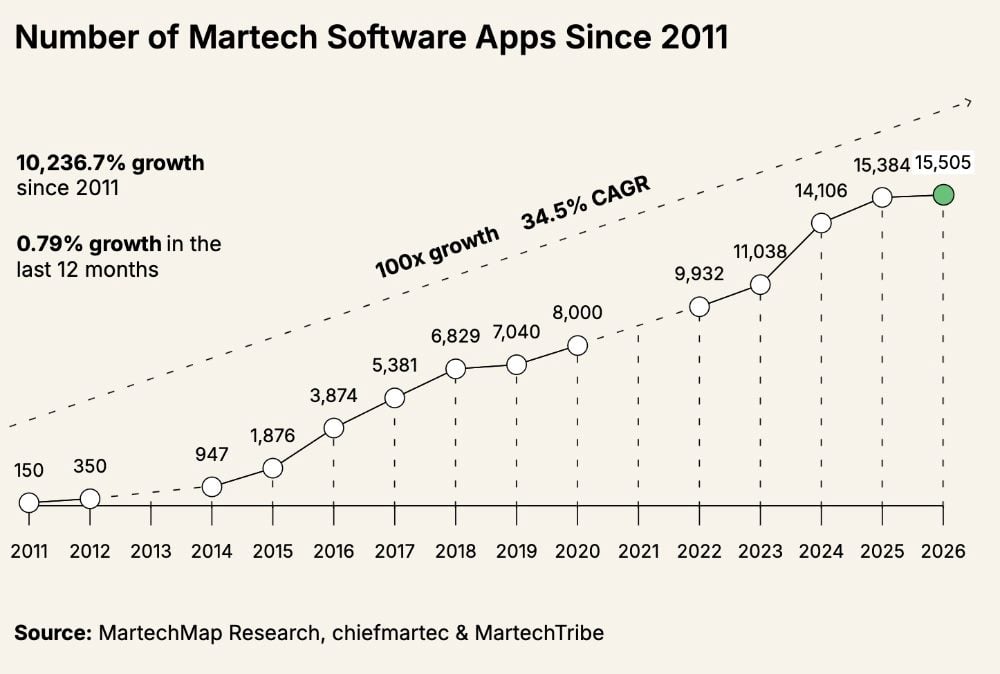
The numbers tell the story: the martech ecosystem now sits at 15,505 products. That’s a growth rate of just 0.79% over last year. If you’re looking at the headline, it looks like stagnation. But look closer, and you’ll see a massive churn. We are watching a violent industry renewal where bloated, redundant software configurations are being tossed aside in favor of lean, AI-integrated stacks.
As the State of Martech 2026 report makes clear, the gold rush of SaaS accumulation is over. Between 2011 and 2026, the industry exploded 100x, but that party has ended. The inflow of new products has cratered by 40% compared to 2025. Enterprises are no longer impressed by shiny new point solutions; they’re busy conducting forensic audits to find out why their operational costs are ballooning while their data visibility remains a mess.
The Darwinian Shift: Survival of the Integrated
The market is currently a revolving door. In the last year, 1,488 new products launched, while 1,367 were unceremoniously cut. This isn't just noise; it’s a signal. The market has stopped rewarding the "feature-of-the-week" model and started demanding foundational infrastructure. The folks over at ChiefMartech have been tracking this transition, noting that the real winners are no longer simple content generators, but sophisticated orchestration platforms.
SaaS providers are scrambling to move up the food chain, positioning themselves as the "system of record" or the "workflow engine." AI is no longer a standalone feature; it’s the connective tissue—the value layer—that makes personalization actually work. But this shift is exposing a nasty truth: our data is a disaster. As AI moves from basic automation to complex orchestration, the limitations of our fragmented, siloed data environments are becoming the biggest bottleneck in the enterprise.
Auditing Your Stack: A Survival Guide
For agencies, the pressure is double. You’ve got to keep your own house in order while managing the chaotic delivery needs of your clients. ALM Corp’s latest audit framework is a wake-up call: stop treating your internal operations and your client-facing tools as the same beast. The "bloat" is real—especially in those all-in-one CRMs that promise to do everything from AI content generation to deep-dive reporting. Often, they do none of it well.
To clean up the mess, you need to be ruthless. Categorize every tool in your stack into one of three buckets:
- Keep: These are your workhorses. They provide clear, measurable value, your team actually uses them, and they play nice with the rest of your ecosystem.
- Cut: If you’re paying for it but nobody logs in, or if it’s just a redundant feature of a platform you already own, kill it. It’s dead weight.
- Consolidate: If you have five different tools doing five slightly different versions of the same job, stop the madness. Migrate to a single, unified platform and stop paying for the complexity.
The 2026 Martech Landscape report highlights the scale of this shift:
| Metric | 2026 Value |
|---|---|
| Total Martech Products | 15,505 |
| Annual Growth Rate | 0.79% |
| New Products Added | 1,488 |
| Products Removed | 1,367 |
| Inflow Growth vs 2025 | -40% |
The AI Reality Check
Integrating AI has changed the rules of the game. As MarTechTribe points out, we’ve moved past deterministic, rule-based workflows. We’re now in the era of probabilistic, dynamic experiences. But here’s the kicker: these AI models are only as good as the data you feed them.
This is the "real crisis" beneath the martech plateau. Years of ad-hoc tool adoption have left us with a mountain of technical debt. If your data is siloed and your governance is weak, no amount of AI orchestration is going to save you. You’re just automating your own fragmentation. Organizations that don't bridge these integration gaps are going to find themselves with a very expensive, very broken AI strategy.
From Feature-Chasing to Infrastructure-First
We are currently in a phase where tools are being sorted into categories: Growth, Renewal, Stability, and Decay. The smartest players are betting on Stability and Renewal. They’ve stopped asking, "What new tool can we add?" and started asking, "How can we optimize what we already have?"
This requires a total shift in mindset. It’s about infrastructure, not features. Agencies and enterprises that perform regular, rigorous audits—looking at usage, ownership, and whether these tools actually talk to each other—are the ones that will survive the reset.
As the industry matures, the focus will inevitably shift to the quality of the underlying data and the reliability of the architecture. The "all-in-one" promise is dying, replaced by a pragmatic, infrastructure-first approach that respects the complexity of digital marketing. As noted by CMSWire, the winners in this new era won't be the ones with the most tools. They’ll be the ones who treat their tech stack as a strategic asset, not a junk drawer of disparate software.
Related Articles
 New Industry Analysis Reveals Shift Toward AI-Driven MarTech Stacks and Enterprise Consolidation for 2026New Industry Analysis Reveals Shift Toward AI-Driven MarTech Stacks and Enterprise Consolidation for 2026Ankit Agarwal5 min read
 enterprise MarTech consolidation 2026ALM Corp Report Reveals 2026 Shift Toward Enterprise MarTech Stack Consolidation and Infrastructure OptimizationDiscover why 2026 marks a major shift in enterprise MarTech. Learn how AI integration and infrastructure consolidation are replacing legacy tool bloat.Govind Kumar4 min read
 agentic AINew MarTech Industry Report Highlights 2026 Product Launches for AI-Driven Business Process AutomationDiscover how the $1T MarTech industry is shifting to agentic AI in 2026. Explore new business process automation trends and the future of autonomous workflows.Govind Kumar4 min read
 autonomous agentic workflow platformsNew Industry Report Forecasts Autonomous AI Agents Will Redefine Digital Marketing Workflows by 2026New industry reports reveal autonomous AI agents will redefine digital marketing workflows by 2026. Discover trends in agentic workflows and AI ROI strategies.Deepak Gupta4 min read