Industry Analysis: AI-Driven Workforce Realignment Set to Accelerate Demand for Enterprise Productivity Software

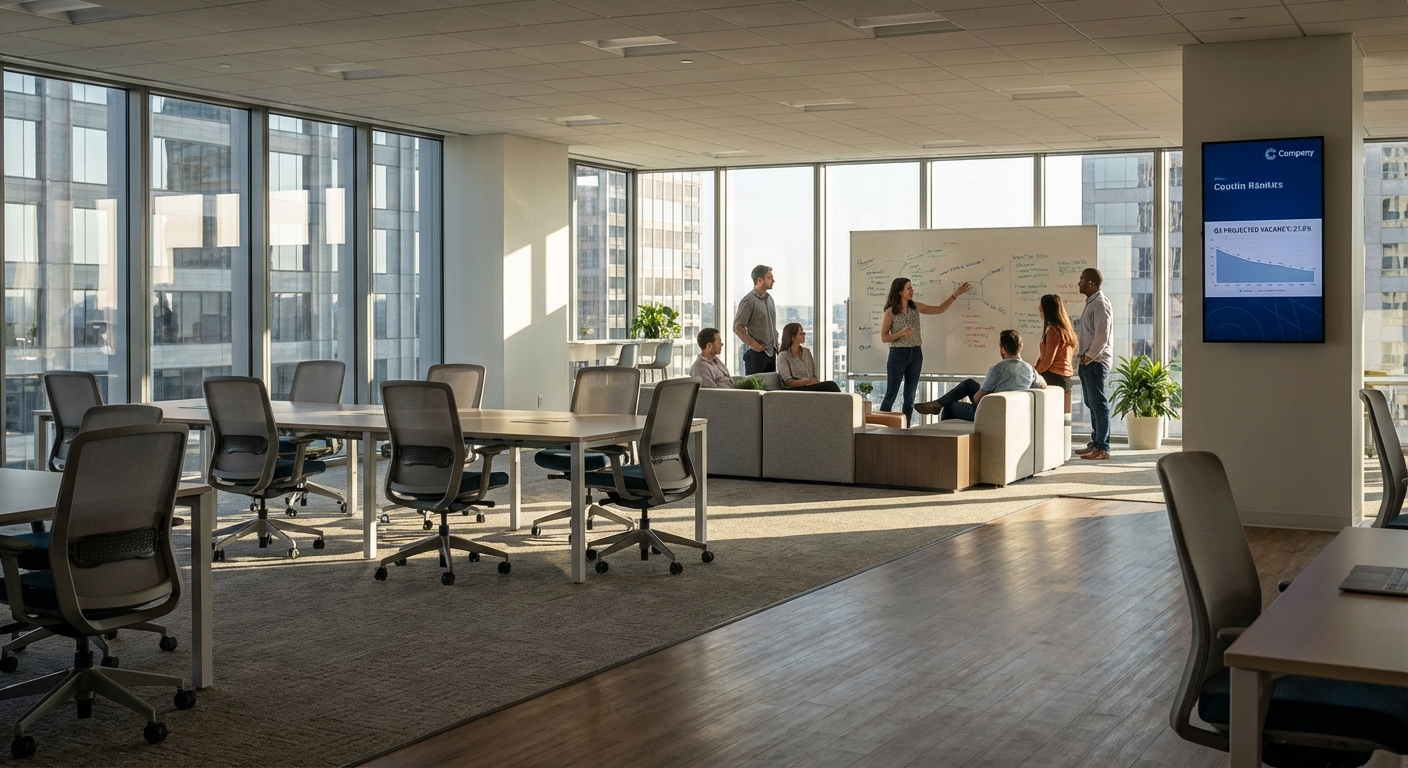
The professional world isn't just changing; it’s being rewired. Generative AI has moved past the hype cycle and into the engine room of the U.S. economy, fundamentally altering how we hire, work, and occupy space. If you’re looking for a return to the headcount growth of the last decade, you’re looking in the wrong place. We are staring down a period of stagnation in office-based employment that is likely to hold firm through 2030.
As companies strip away the friction of legacy workflows, they’re trading human bodies for software muscle. This realignment is creating a paradox: while the demand for traditional office square footage is hitting a wall, the appetite for enterprise productivity software is exploding.
The Stagnation Forecast
The numbers tell a sobering story. Projections suggest office-using employment growth will flatline, hovering around a meager +0.3% between 2026 and 2030. Why? Because the low-hanging fruit—entry-level roles and back-office administrative tasks—are being harvested by AI.
This isn't necessarily a "jobless" future, but it is a highly selective one. The roles currently at the highest risk are those defined by routine and repetition. Conversely, high-skill positions that hinge on empathy, complex negotiation, and nuanced relationship-building are seeing a different trend: augmentation. These workers aren't being replaced; they’re being supercharged.
The structural mechanics of this shift are laid out in this research on the future of the office. It’s clear that the old playbook—hiring based on credentials and raw headcount—is being tossed out in favor of a model that prioritizes the ability to synthesize data and orchestrate AI-integrated workflows.
Realignment and the New Professional Value
We are in the middle of a massive redefinition of what "professional value" actually looks like. As noted in the AI and The Future of Work Report, the most valuable employee is no longer the one who can process the most data, but the one who can facilitate the best collaboration between human intuition and machine output.
Teams are becoming leaner, faster, and significantly more tech-dependent. Here is how the landscape is shaking out across different professional tiers:
| Role Category | Displacement Risk | Primary AI Impact |
|---|---|---|
| Entry-Level | High | Automation of routine tasks |
| Back-Office | High | Process efficiency and consolidation |
| High-Skill/Specialized | Low | Augmentation of complex workflows |
| Relationship-Driven | Low | Enhancement of human-centric output |
The American Staffing Association has been tracking these signals of change closely. For the staffing industry, 2026 is a pivot point. The demand has shifted away from generalists and toward those who can provide technical oversight and high-level strategic synthesis. If you can’t manage the software that does the work, you’re finding yourself increasingly sidelined.

The Flight to Quality
If headcount is stagnant, why are people still building offices? The answer lies in the "flight to quality." AI-driven firms aren't looking for rows of cubicles; they’re looking for collaborative hubs. The physical office is being repurposed as a strategic asset for team-based problem solving, rather than a place to park bodies for eight hours a day.
The modeling approach used to track these shifts reveals a stark reality: commodity office space is becoming obsolete. As we look toward 2030, a few critical trends are defining the commercial real estate and software landscape:
- Geographic Concentration: Tech hubs like the San Francisco Bay Area, Manhattan, Seattle, Los Angeles, and Austin remain the focal points for AI-heavy enterprises.
- Vacancy Projections: We are looking at potential vacancy rates hitting 21.5% by 2030, driven largely by the death of the "average" office building.
- Software Over People: There is a direct, measurable correlation between shrinking administrative headcount and ballooning budgets for enterprise-grade automation suites.
- Design for Interaction: Office layouts are moving away from silos and toward high-value, relationship-driven collaboration zones.
The labor trends and AI’s workforce impact confirm that this isn't a temporary dip or a post-pandemic hangover. It’s a structural adjustment. The requirement for robust software infrastructure is officially outpacing the requirement for physical square footage.
Strategic Implications: The Software-First Office
This shift is forcing a hard look at capital allocation. Companies are moving money out of payroll and into the software stack. If your organization is still measuring success by total headcount, you’re likely misreading the market. Success today is measured by the speed of adaptation—how quickly can your team synthesize data into actionable outcomes using the tools at their disposal?
The human role is evolving into something more elevated: oversight, ethics, and high-stakes decision-making. As AI handles the heavy lifting of data synthesis, the human becomes the pilot, not the engine.
These themes, explored in various industry-focused discussions, highlight that we are in the "mid-transition" phase of AI adoption. It’s the most dangerous time to be complacent. Firms that fail to align their workforce capabilities with their software infrastructure now will find themselves unable to catch up as the market matures toward the end of the decade.
The conclusion is clear: we are witnessing a permanent change in the professional environment. The office of the future will be smaller, more expensive, and significantly more tech-intensive. As companies navigate this realignment, the reliance on advanced enterprise software will be the primary lever for survival. In an automated economy, the companies that thrive won't necessarily be the ones with the most employees—they’ll be the ones with the best software architecture and the human talent to command it.