New Industry Analysis Reveals Accelerated Adoption of AI-Driven Automation in Enterprise Productivity Workflows


The Great Workflow Pivot: Why Enterprise AI is Moving Beyond the "Chatbot" Phase
The enterprise world is finally waking up. For the last two years, we’ve been obsessed with AI as a parlor trick—a way to draft a quick email or summarize a meeting. But that’s changing. We are witnessing a fundamental shift as companies stop treating AI as a series of isolated experiments and start baking it into the very architecture of their operations.
The numbers tell the story. The global Artificial Intelligence (AI) tools market hit a staggering $150 billion valuation in 2024. And it’s not slowing down. Projections put the sector on a steady climb toward a $500 billion valuation by 2033, growing at a 15% clip. Meanwhile, the workflow automation market is arguably even more aggressive, expected to balloon from $29.9 billion in 2026 to $87.7 billion by 2033.
This isn't just about buying software; it's about a total rethink of how work actually gets done.
The Death of the "Task-Level" Mindset
Early AI adoption was messy. We gave employees tools to draft memos or generate code snippets, but those tools lived in a vacuum. You’d get a great output from an AI, but then you’d have to manually copy-paste, format, or upload it elsewhere. That’s where the friction lived.
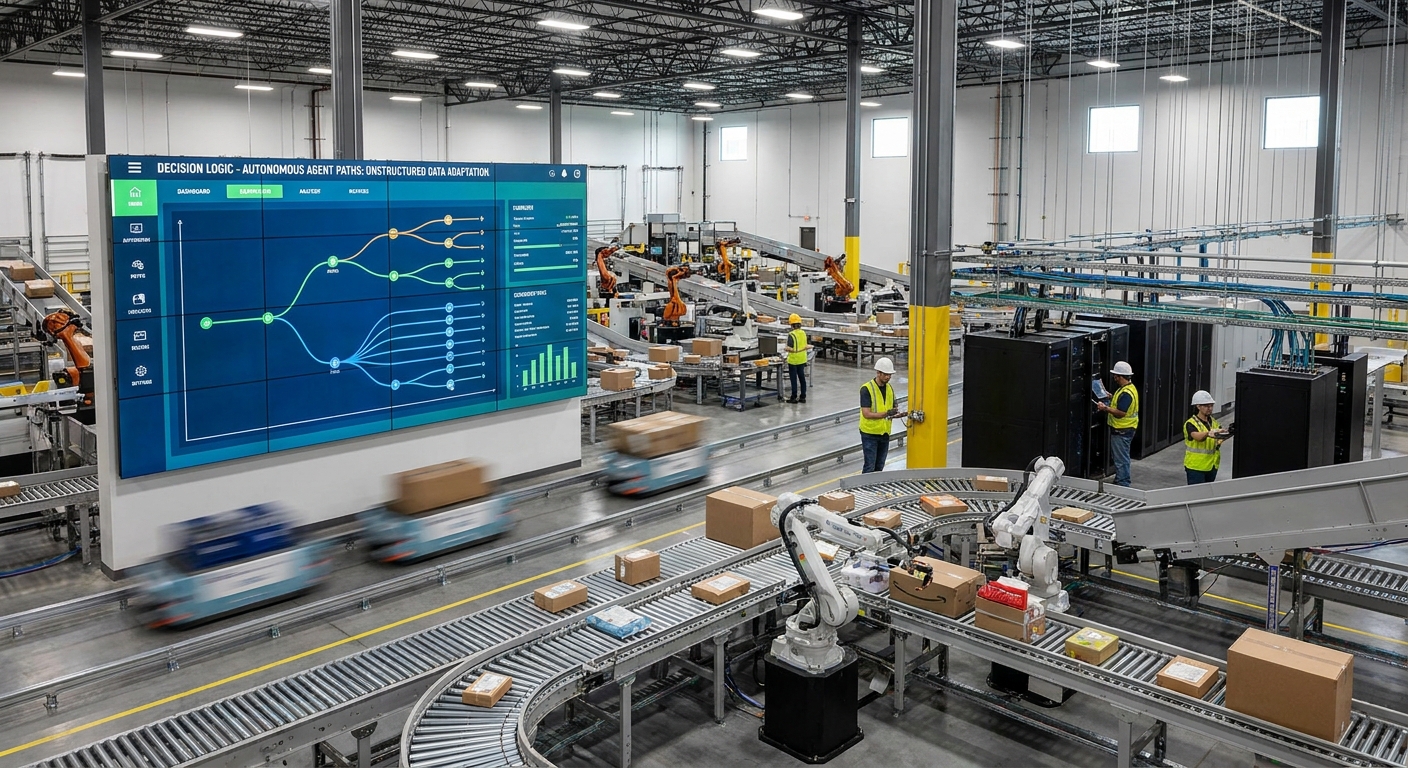
Current research—including sharp insights from MIT Sloan Ideas Made to Matter—suggests that the real magic happens when you stop focusing on the task and start focusing on the chain. It’s called "task chaining." Instead of having a human bridge the gap between five different AI tools, companies are now clustering these tasks into automated sequences.
Image courtesy of MIT Sloan Ideas Made to Matter
The biggest enemy of productivity isn't a slow employee; it’s "coordination cost." Every time a human has to step in to validate a handoff between two systems, the process loses momentum. By designing workflows where AI manages the entire chain, firms are slashing those hidden costs. The lesson? The design of the workflow is now just as important as the AI model itself.
The Engines of Automation
What’s driving this massive shift? It’s a perfect storm of cloud computing, the Internet of Things (IoT), and increasingly capable machine learning models. Whether you’re in manufacturing or high-stakes finance, if you aren't using NLP and automated logic to handle the heavy lifting, you’re already falling behind.
Look at how the market is actually deploying these tools:
- The IoT Explosion: The integration of IoT into process automation has jumped from 33% in 2021 to a massive 57.5% today. The physical world is finally talking to the digital one.
- Regional Leaders: North America is holding the lead with a 31% market share, while Europe trails at 24.4%.
- The On-Premise Holdout: Despite the "cloud-first" mantra, 56.1% of the market still prefers on-premise deployment. Security concerns, it seems, still trump convenience.
- The Backbone Players: If you’re looking for the infrastructure, the heavy lifting is being done by platforms like Microsoft Power Automate, Zapier, UiPath, and Automation Anywhere. These are the pipes through which modern enterprise data flows.
The Fragility of the Chain
There is a catch, though. Because "task chaining" relies on a seamless sequence, it’s only as strong as its weakest link. If you chain five AI-driven tasks together and insert one step that requires complex human intuition or physical dexterity, the whole thing grinds to a halt.
Organizations are realizing they need to audit their processes with a surgical eye. You can't just automate everything; you have to automate the right things. If a task requires a high level of judgment that the current model can’t reliably replicate, you’re better off leaving it to a human—or redesigning the workflow entirely to avoid the bottleneck.
| Metric | 2026 Estimate | 2033 Projection | CAGR |
|---|---|---|---|
| Workflow Automation Market | $29.95 Billion | $87.74 Billion | 16.6% |
| AI Tools Market | $150 Billion (2024) | $500 Billion | 15.0% |
Who’s Running the Show?
The competitive landscape is a "who’s who" of tech giants. Google, Microsoft, IBM, AWS, NVIDIA, Oracle, SAP, Salesforce, and Meta are all racing to embed predictive analytics and generative AI into the ERP and CRM systems that keep the lights on. They aren't just selling tools; they’re selling the integration layer.
As noted in the research on AI automation and task chaining, the future isn't about more AI—it’s about better structural organization.
We are officially moving past the era of "AI novelty." The initial excitement of seeing a chatbot write a poem has worn off. Now, we’re in the era of integration. The companies that win over the next decade won't necessarily be the ones with the smartest AI; they’ll be the ones that have mastered the art of clustering tasks into reliable, automated, and high-velocity workflows. The novelty is dead. The integration has begun.