Industry Analysis Forecasts Shift Toward Custom Enterprise Software Development to Support AI Integration by 2026

The Custom Software Pivot: Why Enterprises are Ditching Off-the-Shelf for AI Readiness
The global custom software market is undergoing a seismic shift. For years, companies played around with AI like it was a shiny new toy. Now? They’re moving to full-scale operational integration. The era of "good enough" standardized software is ending. To survive the next decade, businesses are realizing they need bespoke architectures—software built specifically to handle the heavy lifting of machine learning and complex data pipelines.
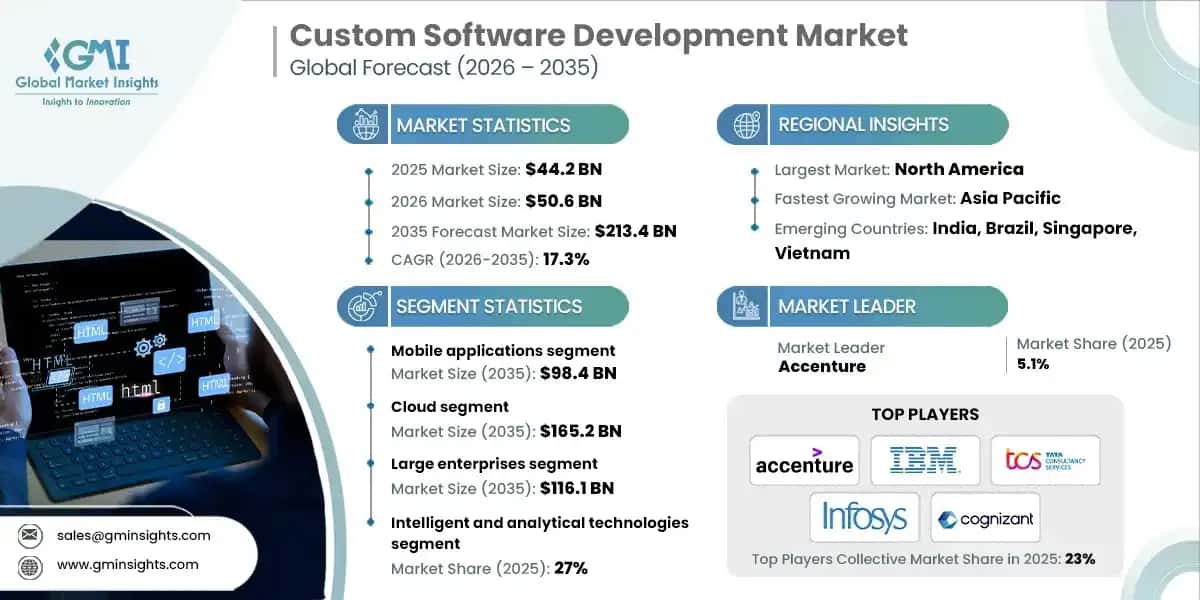
Image courtesy of Global Market Insights Inc.
The numbers tell a stark story. We’re looking at a valuation jump from USD 50.6 billion in 2026 to a staggering USD 213.4 billion by 2035. That’s a 17.3% CAGR. It’s not just growth; it’s a fundamental re-platforming of the global economy. Organizations are scrambling to align their digital guts with the reality of generative AI and cloud-native computing.
The 2026 Global Software Industry Outlook—part of the wider TMT series—marks this as a point of no return. The planning phase is over. The "let’s see what AI can do" meetings are being replaced by the "let’s build the infrastructure to make it work" reality.
The Heavy Hitters and the Market Split
The market is still top-heavy. Five giants—Accenture, IBM, TCS, Infosys, and Cognizant—control nearly a quarter of the entire sector. Accenture leads the pack with a 5.1% share, largely because they’ve become the go-to partner for massive, high-stakes migrations. When you’re moving a legacy bank or a global supply chain into an AI-integrated environment, you don’t hire a boutique shop; you hire the firms that have already done it a thousand times.
Why the "Buy" Option is Dying
It’s no longer just about features. It’s about technical survival. Legacy systems are essentially anchors in an AI-driven race. As Keyhole Software’s 2026 trends analysis points out, the shift is driven by four non-negotiable pillars:
- AI/ML Integration: You can’t just bolt AI onto a 20-year-old database. You need custom pipelines that actually talk to your models.
- Cloud-Native Architectures: By 2028, if you aren't cloud-native, you’re essentially operating in the dark ages. Monolithic systems are being dismantled.
- Zero-Trust Security: Security used to be a wall around the office. Now, it’s baked into every line of code. It’s the fastest-growing priority in the enterprise space.
- AI-Generated Delivery: We’re moving past low-code. We’re entering an age where AI writes the boilerplate, and humans act as the architects.
As the Deloitte 2026 Software Industry Outlook notes, the old "buy versus build" debate is settled. If you buy, you’re using the same tools as your competitor. If you build, you’re using your own data to create a moat. In the AI era, proprietary software is the only true competitive advantage left.
The Growth Trajectory
The capital expenditure here is massive, but it’s seen as a necessity rather than a cost center.
| Metric | Data Point |
|---|---|
| 2025 Market Valuation | USD 44.2 Billion |
| 2026 Market Valuation | USD 50.6 Billion |
| 2035 Projected Valuation | USD 213.4 Billion |
| CAGR (2026-2035) | 17.3% |
| Top 5 Market Share | 23% |
This growth is fueled by the broader technology trends identified by Deloitte, specifically the normalization of remote, globalized development. The talent pool is no longer limited by how far a developer can commute. This has turned software development into a 24/7, global assembly line.
The Developer’s New Role
We are witnessing a shift in the developer’s identity. They aren't just typing code; they are auditing AI-generated output. This changes the velocity of delivery. You can iterate faster, test more aggressively, and deploy with more confidence—provided your data architecture is clean.
The Deloitte Technology, Media, and Telecommunications predictions emphasize that this is a strategic alignment problem. If your software strategy doesn't match your business goals, you’re just burning cash on fancy tech.
As we push toward 2035, the line between "tech companies" and "traditional enterprises" will vanish. Every company is becoming a software company. If you aren't building the foundational layers today to support the AI of tomorrow, you’re already falling behind. The market isn't just growing; it’s evolving into the bedrock of the next decade of enterprise.