ALM Corp Report Reveals 2026 Shift Toward Enterprise MarTech Stack Consolidation and Infrastructure Optimization

The MarTech Shakeout: Why 2026 is the Year of the Great Consolidation
The marketing technology landscape has finally hit a wall—and for once, that’s a good thing. After years of frantic, gold-rush-style tool accumulation, 2026 marks a definitive shift toward strategic renewal. We’re no longer chasing the "next big thing" in software; we’re busy fixing the plumbing.
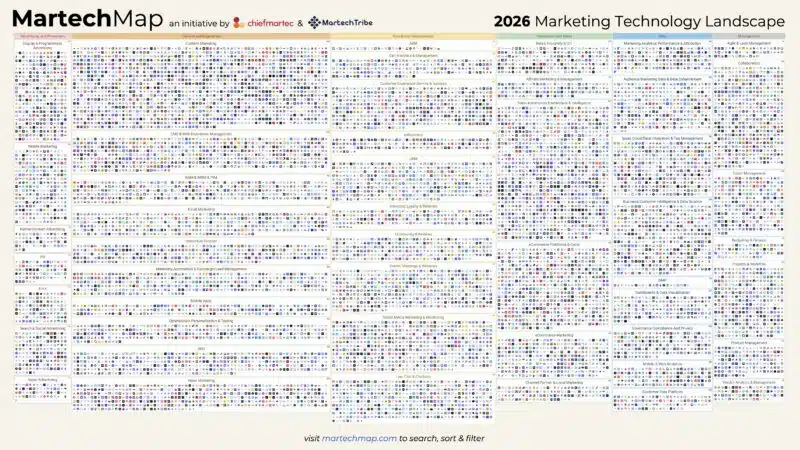
According to the latest industry data, the total count of martech solutions has settled at 15,505. That’s a measly 0.79% growth over last year. To put that in perspective, consider the explosive expansion between 2011 and 2025, where the market grew nearly a hundredfold. That era of unbridled bloat is officially dead.
Image courtesy of Martech.org
Don’t let the stagnant headline number fool you, though. Underneath the surface, the industry is churning like a washing machine. We saw 1,488 new products hit the market, but 1,367 were kicked to the curb. Enterprises are finally pruning their stacks, ditching fragmented, rule-based relics in favor of adaptive, AI-driven architectures. As the 2026 Martech landscape report makes clear, this isn't stagnation—it’s a necessary, painful, and long-overdue renewal.
The New Hierarchy of Tools
The role of the traditional SaaS platform is changing fast. These tools used to be the shiny objects driving marketing innovation; now, they’re being relegated to the basement. They’ve become foundational infrastructure—glorified systems of record or workflow engines.
In this new order, AI is the real "value layer." It’s moved past the parlor trick of writing blog posts and is now handling the heavy lifting: complex orchestration, data governance, and the messy work of integration.
This consolidation is driven by a simple, brutal truth: structural friction is killing productivity. Companies are finally forcing their data, automation, and media activation into converged platforms. The old walls between martech, adtech, and salestech are crumbling, and frankly, it’s about time. Businesses want to unify campaign management with media buying, and they’re tired of paying for three different tools to do one job.
As outlined in the State of Martech 2026, the industry is currently split into four camps: Growth, Renewal, Stability, and Decay. The current focus on "Renewal" is exposing just how fragile our data quality really is. As AI takes the wheel, the cracks in legacy data architectures are becoming impossible to ignore. Firms are realizing that buying another specialized point solution is just adding weight to a sinking ship.
Market Dynamics: The 2026 Shift
| Metric/Category | 2025 Status | 2026 Status |
|---|---|---|
| Total Solutions | 15,384 | 15,505 |
| Annual Growth | High | 0.79% (Plateau) |
| Primary Focus | Tool Proliferation | Consolidation/Renewal |
| AI Application | Content Generation | Orchestration/Strategy |
| Data Model | Rule-based/Segmented | Context-based/Probabilistic |
We are witnessing a departure from the rigid, segment-driven models that defined the last decade. We’re moving toward context-based, probabilistic personalization. Marketers are using AI to build dynamic experiences, trying to shrink their stacks while boosting relevance. We’re even seeing the rise of "vibe coding" and AI-assisted development, which allows internal teams to build their own custom solutions. Why pay a third-party vendor a fortune for a feature you can build in an afternoon?
The barrier to entry for new, standalone tools has skyrocketed. With the inflow of new products dropping by 40% compared to 2025, the market is sending a clear signal: the days of winning by sheer volume are over. As Martech.org notes, value is now captured by platforms that can actually prove ROI through integration and enterprise-wide scaling.
The 2026 Agenda: Back to Basics
If you’re wondering where the smart money is going, look at these four pillars:
- Data Consolidation: It’s all about the "single source of truth." If your CRM and CDP aren't talking to each other, you’re just guessing.
- Automation Scaling: AI is moving out of the experimental lab and into the core of media orchestration.
- Media Efficiency: Stop fragmenting your spend. Integrating programmatic and retail media buying into the core stack is the only way to keep costs in check.
- Infrastructure Optimization: If a SaaS tool isn't pulling its weight, cut it. The goal is a lean, converged suite, not a sprawling collection of apps.
The high churn rate of 1,367 products proves that the real crisis isn't a lack of innovation—it’s a lack of integration. If your data quality is poor, your AI is just a very expensive way to make mistakes faster. For the rest of 2026, the focus will remain on the "plumbing." It’s not sexy, but it’s what keeps the lights on.
The line between "martech" and "business infrastructure" is vanishing. The winners in this environment won't look like specialized marketing tools; they’ll function like integrated business operating systems. We’ve moved past the "feature-chasing" phase of the digital marketing lifecycle. We’re now in the "maturity" phase, where the goal is to optimize what we have and build a data foundation that can actually handle the weight of AI.
Data from industry observers like ChiefMartec and MartechTribe confirms it: the era of "martech bloat" is dead. Enterprises are finally measuring their tech stacks by their ability to drive actual growth, not by how many boxes they can check on a feature sheet. This disciplined approach is the new baseline, and frankly, it’s the most refreshing trend we’ve seen in years.