We Found Another Publisher's Affiliate Links on Our Own Site
content verificationaffiliate disclosureeditorial standards

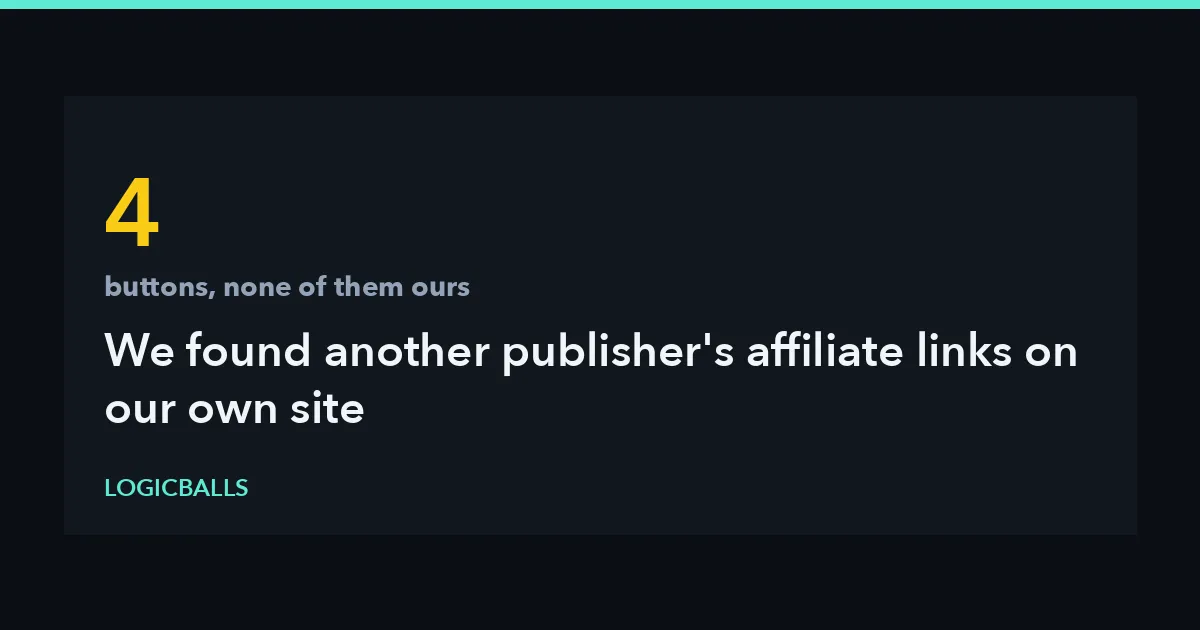
Four "Try this" buttons on our payment-processing article were affiliate links. They were not ours. Each carried a different publisher's affiliate network ID, and one of them still had that publisher's own article path embedded in its tracking parameters. Any commission went to them. The undisclosed-endorsement problem stayed with us. The article carried no affiliate disclosure of any kind, because as far as anyone here knew, there was nothing to disclose.
This is how we found it, what it means legally, and the two-minute check that will tell you whether the same thing is on your site.
Key Takeaways
- Four buttons carried a third party's affiliate parameters — an affiliate-network redirect with a publisher ID that was not ours, plus campaign tags naming that publisher (audit of 80 posts, 2026-09-03, ANALYSIS).
- One tracking parameter contained the other publisher's own article URL path, which is what made the origin unmistakable rather than coincidental.
- We earned nothing from any of them. Commission credits the publisher ID in the link, and that ID was not ours.
- The disclosure obligation still applied to us. The US Federal Trade Commission requires disclosure of material connections in endorsements, and a page carrying affiliate links with no disclosure is a problem for the page's publisher.
- A corpus-wide check found it in exactly one post, which is the good news. We would not have known either way without looking.
What we found
While re-checking a round-up of payment processors, we resolved every outbound link through its redirects — the ordinary check for whether a link goes where its anchor text claims.
Four of them did not resolve directly to the vendor. They went through an affiliate network's redirect service first, then on to the vendor's site with a set of tracking parameters attached. The parameters included a publisher ID, a campaign name and a sub-ID.
None of it was ours.
The detail that settled it: one link's sub-ID parameter contained a URL path from another publisher's website — the address of their article about cheap credit card processing. Another link's campaign tag named that publisher directly. A third sat on a landing page path built for them.
Four buttons, one origin. Someone had copied the calls-to-action out of a competitor's article, tracking and all, and they had been live on our site ever since.
Why this is worse than a broken link
We were doing free affiliate marketing for another publisher. Every reader who clicked one of those buttons and signed up generated a commission credited to someone else's account. Our traffic, their revenue.
We carried the legal exposure they did not. In the United States, the Federal Trade Commission's endorsement rules require that a material connection between an endorser and a seller be disclosed clearly. A page that recommends products, links to them through affiliate tracking, and says nothing about it is the exact case those rules address. The fact that the commission went elsewhere does not help — the reader still could not tell that the recommendation sat on a monetised link.
It is visible evidence of copied content. Affiliate parameters are a fingerprint. A publisher ID belonging to someone else is not something that appears by accident, and anyone who resolves the link can see it.
The links did not even serve the reader. They pointed at partner landing pages rather than at the pricing a reader needed. One had gone stale and redirected to a vendor's homepage, losing the offer entirely.
How we found it, and how you can
The check takes about two minutes per article and needs nothing but a terminal.
1. Resolve every outbound link through its redirects. Following redirects is the important part — the tracking is often only visible in the final URL after two or three hops.
curl -sIL -o /dev/null -w "%{http_code} %{url_effective}\n" "<the link>"2. Read the final URL for tracking parameters. The ones worth grepping for:
ref= · via= · utm_medium=affiliate · utm_source= · fpr= · rfsn= · aff · partner · gclid · irgwc · afsrc
3. Check for affiliate-network domains anywhere in the redirect chain. Common ones include sjv.io, pxf.io, impact, shareasale, partnerstack, firstpromoter, rewardful and tapfiliate. A hop through one of those is an affiliate link regardless of what the final URL looks like.
4. If you find a publisher ID, check whether it is yours. This is the step that turns "we have affiliate links" into "we have someone else's affiliate links". Look at your own network account for the ID you were assigned and compare.
5. Run it across everything, not just the article you are looking at. A single grep over your whole content directory takes seconds:
grep -rlE "sjv\.io|pxf\.io|utm_medium=affiliate|shareasale|partnerstack" content/Ours returned exactly one file. That was worth knowing with certainty rather than assuming.
How it probably happened
We cannot prove the mechanism, and we are not going to pretend otherwise. What the evidence supports is that the buttons and their URLs were taken from an existing article rather than written.
That is a normal failure mode when content is produced quickly, whether by a person or with AI assistance: a structure is borrowed, the surrounding prose is rewritten, and the links come along unchanged because nobody looks at them. Links are the part of an article people copy without reading.
The lesson we drew is not "check for affiliate links". It is that a link is a piece of content in its own right and needs the same review as a sentence. Ours had not been read for a long time.
What we did
All four links were repointed at the vendors' own pricing pages with the tracking stripped, so a reader lands where the anchor text says. The article now states plainly that it contains no affiliate or referral link of any kind.
We also ran the check across every published post. It found this one article and one separate case of a retailer's affiliate tag elsewhere. Both are now recorded.
Resolving every outbound link through its redirects is now a required step before anything is published here.
How This Guide Was Sourced
Written and maintained by the LogicBalls editorial team (logicballs.com). Disclosure: LogicBalls builds AI writing tools. The article described here is ours, and it has been corrected.
Method. Every outbound link in 80 reviewed posts was resolved through its full redirect chain on 2–3 September 2026 using curl -sIL, and the final URLs were checked for tracking parameters and affiliate-network hops. A corpus-wide grep across all 530 published posts was run for the same patterns.
The other publisher is not named. They did nothing wrong. Their affiliate links appearing on our site is our failure, not theirs, and naming them would turn a correction into an accusation of someone who has no case to answer.
On the legal point. The FTC's endorsement guidance is a US rule and this is a general description of it, not legal advice. If you find undisclosed affiliate links on your own site, the question of what to do about it is one for a lawyer in your jurisdiction, not for a blog post.
AI involvement. The article containing these links was AI-assisted and published without a link audit. This post was AI-assisted and reviewed before publication.
No LogicBalls telemetry is used in this guide.
Frequently Asked Questions
How would affiliate links get onto a site without anyone knowing?
By being copied along with the content around them. Links are rarely re-read once written, and an affiliate URL looks like any other long URL. Nothing about it is visible to a reader or an editor unless someone resolves it.
Does an undisclosed affiliate link matter if we earned nothing from it?
The earning and the disclosure are separate questions. A reader clicking a recommendation on a monetised link cannot tell where the money goes, only that the recommendation and the link exist. That is what disclosure rules address.
What is the fastest way to check a whole site?
A single grep for the affiliate-network domains and the common tracking parameters across your content directory. It takes seconds and gives you a definite answer. If it returns nothing, you know. If it returns files, resolve those links individually.
Should every outbound link be stripped of parameters?
No — plenty of parameters are legitimate, including a vendor's own campaign tags. The question is whether the link monetises the recommendation, and whether the reader is told. Strip what does not serve the reader, disclose what does.
Conclusion
Four buttons on one of our articles carried another publisher's affiliate tracking. We earned nothing and carried the disclosure problem anyway, and we would not have found it by reading the article — only by resolving the links.
The check is two minutes with curl, or seconds with a grep across a whole site. The reason to run it is not that this is common. It is that you cannot know either way until you look, and a link is content that nobody re-reads.
Related reading
Related Articles
 content verificationWe Audited Our Own 530 Blog Posts. Five Recommended Products That Do Not Exist.We fact-checked every product recommendation on our own blog. Five were for products that do not exist, including a parked domain and a fitness tracker sold as a to-do app.Ankit Agarwal9 min read
 content verificationHalf the Prices in Our Own Tool Round-Ups Were WrongWe re-read every price in our tool round-ups against the vendors' own pricing pages. About half were wrong, and every error pointed the same direction: too cheap.Ankit Agarwal8 min read
 AI contentAI Content Errors: The 14 Mistakes That Reach Published PagesThe 14 error types we found auditing 80 of our own AI-assisted posts, ranked by how often they occurred, with the check that catches each one.Ankit Agarwal9 min read
 AI contentVerified AI Writing: How to Publish AI-Assisted Content You Can Stand BehindA practical standard for publishing AI-assisted content: what models get wrong, what actually catches it, and what the research says about detection. With our own audit data.Ankit Agarwal11 min read