Half the Prices in Our Own Tool Round-Ups Were Wrong

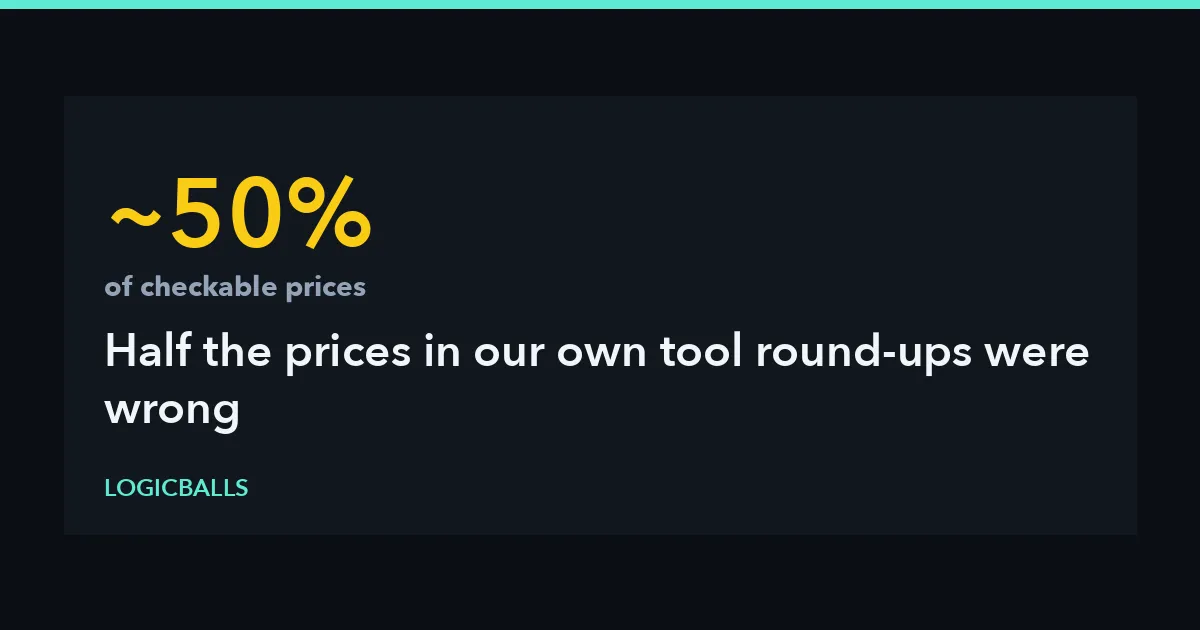
We opened every vendor's pricing page and re-read every price in our own tool round-ups. Roughly half were wrong. One product was listed at half its real cost. Another had its entry tier quoted at about a third. Two were credited with free plans that do not exist. Several named plans that had been retired years earlier. The errors were not random: almost all of them made the product look cheaper or more generous than it is.
This post covers what we found across 80 reviewed posts on 2 and 3 September 2026, why software pricing rots faster than almost any other fact in a blog post, and the check that catches it.
Key Takeaways
- About half of all checkable prices were wrong. Across three review batches covering roughly 60 products, the error rate on prices held near 50% (audit of 80 posts, 2026-09-02/03, ANALYSIS).
- The errors were directional. Nearly every wrong price understated the cost or overstated the free tier. A reader budgeting from our numbers would have under-budgeted.
- Two products were credited with free plans they do not have. Both offer only a time-limited trial.
- Plan names go stale faster than prices. Several posts named tiers the vendor had retired, which makes the whole paragraph unusable even where the number happened to be close.
- Hedging is not sourcing. Phrases like "typically", "usually" and "around" appeared alongside exact figures with nothing behind them. That combination is a stronger warning sign than a bare number.
What we checked
For every product in a round-up, we opened the vendor's own pricing page and compared four things: the plan names, the price, the billing period, and the free-tier limits. Third-party review sites and comparison aggregators were not used as sources at any point — they are where stale prices come from.
Where a vendor renders prices in the browser rather than in the page itself, we recorded the figure as unverifiable rather than substituting one from elsewhere. That happened with several vendors and is worth knowing: if an automated check cannot read a price, neither can most tools that claim to monitor pricing.
What the errors looked like
A note-taking app at half price
One post listed a popular note-taking app at roughly half what it charges, on both the monthly and the annual figure. Not a stale price from a previous year — a number that appears never to have been correct.
A shared-inbox tool at about a third
A post on email tools expected a business plan to "start around $15-$20 per user per month". The vendor publishes $55 per user per month on annual billing. A team of ten budgeting from our article would have been out by several thousand pounds a year.
Two free tiers that do not exist
Two products were described as having free plans for individuals. Both offer only a time-limited free trial. This is the error most likely to waste a reader's afternoon: you pick the tool because it is free, sign up, and discover it is not.
Plans that were retired years ago
Several posts named plan tiers that no longer exist. One described a two-tier structure that had been replaced by a four-tier one, with different limits and different names. Even where a price is roughly right, naming a plan the vendor has retired makes the paragraph impossible to act on.
A free tier described as "limited features"
One post said a product's free tier had "limited features". The vendor's actual limits are specific and much tighter: a capped number of lists, a capped number of tasks per list, a few reminders a day. "Limited features" is not wrong, exactly. It is just useless — and it hides the one number that would have made the tier easy to evaluate.
Why prices rot faster than other facts
Three reasons, and they compound.
Vendors change pricing more often than they announce it. There is no changelog for a pricing page. A tier can be renamed, repriced or removed between one quarter and the next with no notice to anyone who has written about it.
Round-ups copy each other. A price that enters circulation gets repeated across dozens of articles, and each repetition makes it look better sourced than it is. Several of the figures we corrected trace to numbers that were plausible at some point and then simply kept going.
Prices are regional and often rendered client-side. The same page can serve different currencies to different visitors, and many vendors now build the pricing table in the browser rather than the page. An article written from one region's view, or from a page that never fully loaded, is wrong for most readers from the moment it is published.
Hedged language is not sourcing
The clearest signal in the whole review was not a wrong number. It was the language around wrong numbers.
Every pricing block in one post carried a hedge — "typically", "usually", "around", "may vary" — while quoting exact dollar figures with no source. That combination reads as caution and functions as invention. A hedge attached to a specific number is a stronger warning sign than a bare number, because it signals the writer knew the figure was uncertain and published it anyway.
The honest version is to state where the figure came from and when it was read, or to say plainly that the vendor does not publish it.
The check
For each product in a round-up, before publishing:
- Open the vendor's own pricing page. Not a comparison site, not the previous version of your own article.
- Copy the plan names exactly as the vendor writes them. A retired plan name invalidates the paragraph even when the number is close.
- Note the billing period. Most published prices are the annual rate presented as a monthly figure. Say which one you mean.
- Read the free-tier limits, not the word "free". The specific caps are what a reader needs.
- Record the date you read it, in the article, next to the number.
- If the price will not render, say so. "The vendor renders prices in the browser and no figure could be read at source" is a legitimate thing to publish. Substituting a number from a review site is not.
That last point is the one most likely to be skipped, and it is the one that keeps an article honest as it ages.
What we did about it
Every wrong figure was corrected in place, with the earlier value named so a returning reader can see what changed. Figures that could not be read at source are labelled as unverified rather than replaced with a guess. Nothing was deleted.
Every price now carries the date it was read. That is not decoration — it is the only thing that lets a reader judge whether to trust it six months from now.
How This Guide Was Sourced
Written and maintained by the LogicBalls editorial team (logicballs.com). Disclosure: LogicBalls builds AI writing tools. This post is about failures in our own published content.
Method. 80 published posts were reviewed claim by claim on 2–3 September 2026, selected by search impressions. Every price was compared against the vendor's own pricing page, fetched on the day of review. Third-party review sites and comparison aggregators were not used as sources. Where a page rendered prices client-side or blocked automated requests, the figure was recorded as unverifiable.
On the "about half" figure. This is an approximate rate across roughly 60 products in three review batches, not a precise measurement — the denominator varies because some vendors publish no prices at all, and those cannot be scored right or wrong. It is stated as approximate for that reason.
Vendors are not named here. The individual corrections are published on the posts themselves, where a reader who acted on the old figure will actually see them. Repeating them in a list here would turn a correction into a pile-on, and the point of this post is the pattern rather than any one vendor.
AI involvement. The posts containing these errors were AI-assisted and published without price verification. This post was AI-assisted and reviewed before publication.
No LogicBalls telemetry is used in this guide.
Frequently Asked Questions
Why not name the products with wrong prices?
The corrections are published on the articles themselves, which is where someone who used the old number will find them. This post is about the failure rate and the cause. A list of vendors we got wrong would read as though the vendors did something, and they did not.
Is a 50% error rate unusual for software round-ups?
We have not measured anyone else's, so we are not going to claim it is typical. What we can say is that our own rate was that high across three separate batches, and that nothing in how those articles were produced was unusual.
How often should a pricing round-up be re-checked?
Quarterly is defensible for stable categories, and more often for anything in a fast-moving one. The honest alternative is to date every figure and let readers judge, which is what we now do.
Does this mean AI got the prices wrong?
AI-assisted drafting produced plausible-looking figures, and no one opened the pricing pages. Both halves matter. A model will produce a number in the right format whether or not it is correct; verifying it is an editorial job.
Conclusion
About half the prices in our tool round-ups were wrong, and nearly all of them were wrong in the direction that made a product look cheaper or more generous than it is.
The fix is not clever. It is opening the vendor's pricing page, copying the plan names exactly, noting the billing period, and writing down the date. The part most people skip is the last one — and it is the only part that tells a reader, a year later, whether the number in front of them is worth anything.