Understanding Automated Machine Learning

TL;DR
- AutoML eliminates manual coding bottlenecks to accelerate model deployment.
- It shifts AI focus from experimentation to systematic enterprise orchestration.
- The technology democratizes AI access for business analysts and domain experts.
- Automated pipelines ensure consistent, auditable, and scalable predictive models.
Automated Machine Learning (AutoML) isn’t just another tech trend; it’s the bridge between a pile of raw, messy data and actual, profitable business decisions. In a market where being first is everything, speed is your primary currency.
At its core, AutoML is about killing the friction. It cuts out the manual slog of picking models and tweaking hyperparameters. It lets companies turn historical data into engines for prediction without needing a basement full of PhDs to write every single line of code. By automating the grind, it lets your team stop worrying about boilerplate syntax and start tackling the high-level problems that actually move the needle.
Beyond the Hype: The 2026 Reality
Let’s be real: we’re way past the "let’s play with AI" phase. By 2026, the industry has shifted into what I call the "Orchestration Era." It’s not enough to just have a model anymore. The challenge is governing, scaling, and maintaining them in the real world. According to recent analysis on top AI and machine learning trends, enterprise maturity is no longer about having a cool sandbox project. It’s about weaving AI into the fabric of your existing workflows.
AutoML is the backbone of that maturity. It provides the guardrails. It ensures that when you deploy a model, it’s not just a "black box" that works today and breaks tomorrow—it’s consistent, auditable, and performant. The shift is palpable. We’re moving away from experimental, manual coding toward systematic orchestration, where the software handles the heavy lifting and humans act as the master architects.
What Is AutoML, Really?
Think of AutoML as the automation of the entire machine learning pipeline. For years, the biggest bottleneck to AI adoption was the scarcity of talent. You needed people who were part mathematician, part software engineer, and part data janitor. It was as much an art as it was a science. As defined by the professional standards for AutoML, the goal is simple: make these high-level capabilities accessible to the people who actually understand the business—the analysts and domain experts.
By offloading the repetitive, boring stuff—like testing fifty different algorithms or hunting for the perfect learning rate—AutoML democratizes AI. It turns a closed-door "black box" process into a transparent, repeatable workflow that can be triggered by a business need, not just a six-month engineering sprint.
How Does the Pipeline Actually Work?
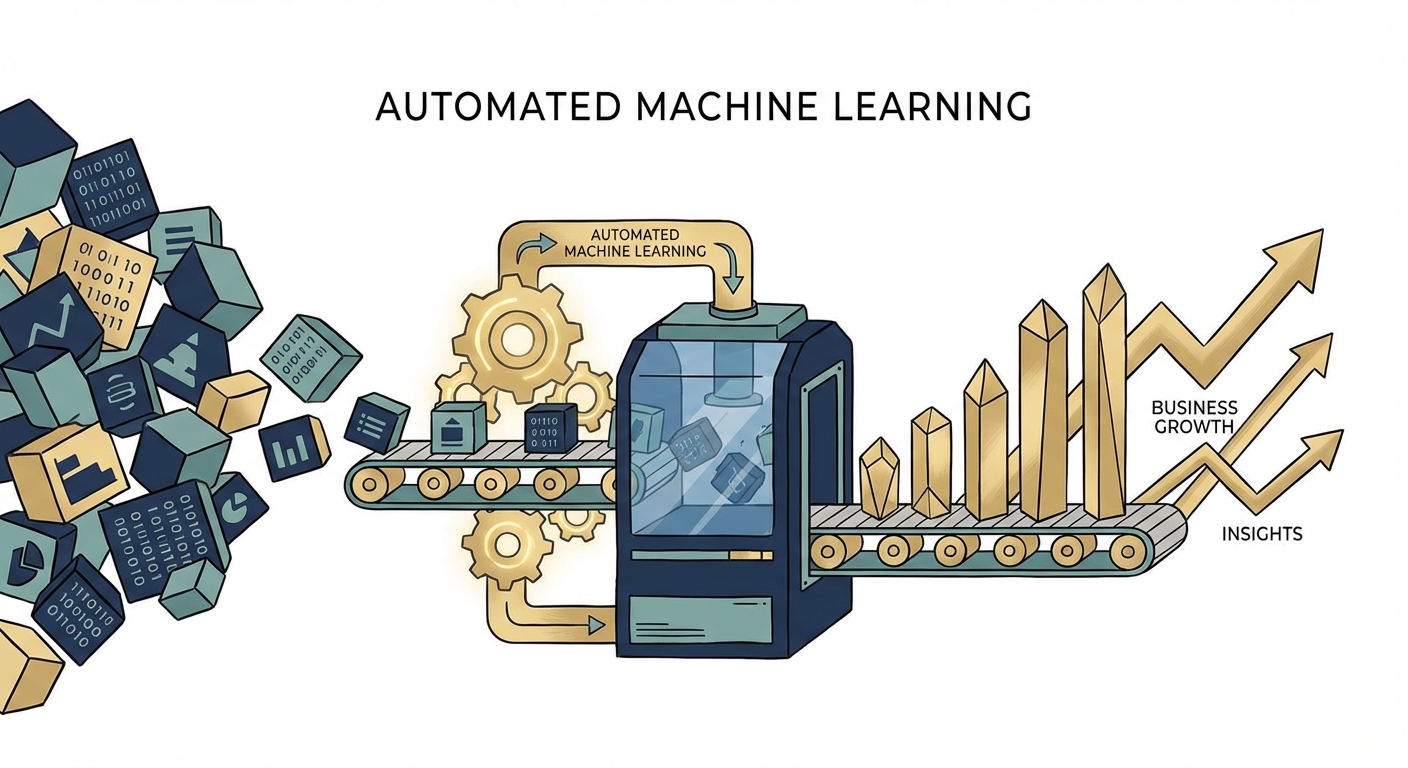
To get it, visualize the journey from a stagnant, dusty database to a living, breathing, predictive asset. The pipeline is built to cycle through thousands of possible configurations simultaneously. It burns through the failures and iterates on the successes.
It starts with Data Ingestion and Cleaning. The system handles the missing values, flags the outliers, and normalizes inputs automatically. Next comes Feature Engineering, where the platform suggests transformations to boost accuracy. Then, the Parallel Training phase kicks in—this is where the "magic" happens. The system tests everything from gradient boosting to deep neural networks against your data. Finally, the Best Model Selection engine picks the winner based on your specific metrics (accuracy, precision, or latency), and it’s prepped for Deployment.
The Hybrid Shift: Why You Still Need Humans
There’s a dangerous myth that AutoML is a "magic button" that makes human experts obsolete. That’s nonsense. If anything, successful companies use AutoML as a force multiplier. By automating repetitive tasks, your team buys back the time they need for high-value creative work—like defining the logic that drives a model or spotting the ethical risks that a machine might miss.
The division of labor is simple: the machine is a beast at high-volume iteration. The human is the expert at nuance. An AutoML tool can tell you which model is statistically the most accurate, but it cannot tell you if that model’s logic aligns with your brand’s ethics or your long-term product vision. Humans are the ultimate auditors. They steer the ship.
Is Your Data Actually Ready?
Before you start an experiment, look in the mirror. You’ve heard of "Garbage In, Garbage Out," right? AutoML is powerful, but it’s not a miracle worker. If your data is biased, incomplete, or poorly labeled, the model will just scale those mistakes up.
Before you pull the trigger, run through this checklist:
- Consistency: Is your data in one place, or is it scattered across legacy systems and spreadsheets?
- Volume: Do you have enough history to actually learn patterns?
- Labeling: Are your target variables defined? A model can't predict "success" if you haven't defined what that looks like mathematically.
- Relevance: Does your dataset actually contain the variables that drive the outcome?
Build vs. Buy: The Decision Matrix
Deciding to build a custom solution or buy an AutoML platform usually comes down to three things: complexity, talent, and time.
If you’re solving a standard problem—churn prediction, demand forecasting, or sentiment analysis—the "buy" route is almost always the winner. It lets you scale business operations without having to go on a massive, expensive hiring spree for data scientists. But, if you’re working with proprietary hardware or unique, high-latency data structures, you might need to build custom.
Decision Matrix:
- High Complexity / Low Data Science Talent: Buy/AutoML.
- Low Complexity / High Data Science Talent: Build (to maintain full control).
- High Complexity / High Data Science Talent: Hybrid (Build the core, use AutoML for iterative testing).
Governance and the Future of AI
We’re also seeing a massive shift toward "Green AI." Training massive models from scratch is an energy-sucking nightmare. AutoML helps here by finding the most efficient architecture early, saving you from endless, brute-force training cycles.
Plus, as regulators get sharper, Explainable AI (XAI) is mandatory. You need a paper trail. Modern AutoML tools must document why a prediction was made. For a technical deep dive on how these systems maintain transparency, look for platforms that put governance and auditability front and center.
Quick-Start Guide: Your First Experiment
Ready to dive in? Keep it simple:
- Define Your Objective: Be laser-focused. Are you doing classification ("Will they leave?") or regression ("How much will we sell?")?
- Curate and Clean: Spend 80% of your time here. If the data is noisy, the result will be useless.
- Initiate and Iterate: Select your platform, run the pipeline, check the results, and refine. It’s a loop, not a one-time event.
Frequently Asked Questions
Is AutoML going to replace data scientists?
No. AutoML automates the repetitive, manual labor of the data science lifecycle, such as hyperparameter tuning. This frees up data scientists to focus on higher-level strategy, architecture, and ensuring that models align with business goals.
Does AutoML require coding skills?
It depends on the platform. Many modern AutoML tools offer "no-code" studio interfaces tailored for business analysts, while others provide "code-first" SDKs for developers who want to integrate model training directly into their existing software workflows.
What are the biggest risks of using Automated Machine Learning?
The primary risks are model bias and the "black box" problem. If the input data is biased, the model will be biased. Furthermore, without proper validation and explainability features, it can be difficult to understand why a model is making certain decisions.
How do I know if my data is ready for an AutoML project?
Your data is ready if it is clean, structured, and sufficiently large to provide statistically significant patterns. If your data is fragmented, lacks clear labeling, or is missing key variables, you should prioritize data engineering before attempting an AutoML experiment.