
Traditional SEO vs AI SEO: What's Different in 2026?

TL;DR
- ✓ Traditional SEO focuses on indexing links while AI SEO prioritizes semantic entity ingestion.
- ✓ Generative Engine Optimization replaces keyword density with becoming a cited factual source.
- ✓ The rise of AI overviews demands high-quality content that answers complex user queries.
- ✓ Success in 2026 requires optimizing for inference engines rather than just search crawlers.
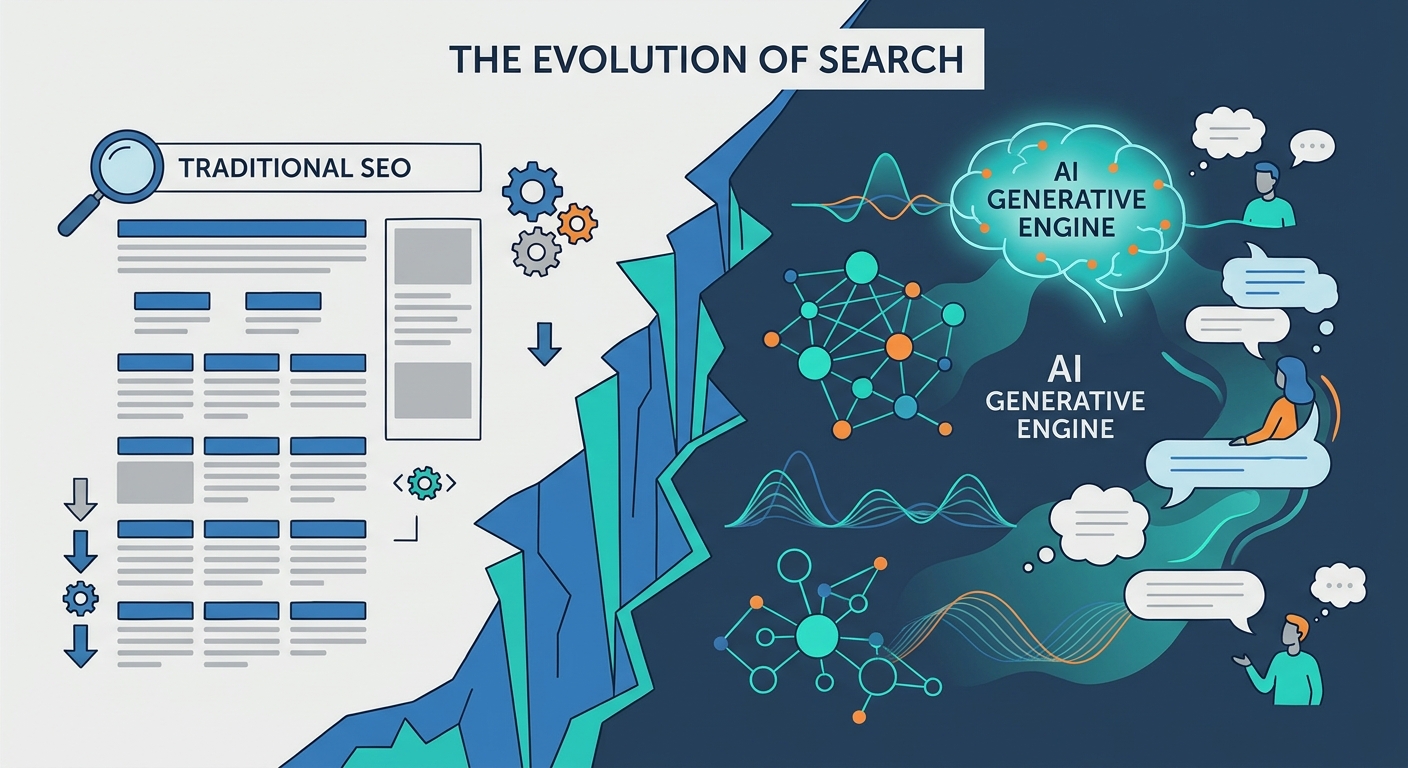
The "10 blue links" era? It’s officially a relic. We’ve moved into a hybrid ecosystem where search isn't a destination anymore—it’s a conversation. In 2026, the gap between traditional SEO and AI SEO has become a canyon. It’s not just a tweak to the old playbook; it’s a fundamental shift in how we discover, process, and serve information. Traditional SEO is still your bedrock, sure. But AI SEO—or Generative Engine Optimization (GEO)—is the new growth engine. If you want to exist in the LLM-powered world, you have to play by these new rules.
The Fundamental Shift: Crawling vs. Ingestion
To get where we are in 2026, you have to separate the mechanics. Traditional SEO was always about "Crawling for Indexing." You built your site like a map, hoping a spider would crawl through, catalog your keywords, and file you away in a static database.
AI SEO? That’s "Ingestion for Inference." Large Language Models (LLMs) don’t care about your site as a list of links. They ingest your content to map entities into a semantic knowledge graph. They’re looking for meaning, not just matches.
In the old days, you tweaked keyword density to tickle a ranking signal. Today, you’re chasing "Entity Authority." You aren't just trying to rank for a term; you’re trying to become the definitive, factual source that the AI cites when it builds an answer.
Why Generative Engine Optimization (GEO) is the New Standard
The internet’s interface has shifted from the search bar to the chat box. When users hit up Perplexity, Gemini, or ChatGPT, they aren't hunting for URLs. They’re hunting for answers. As noted in this Search Engine Land: Guide to GEO, volume-based keyword targeting is effectively dead on arrival.
Think about it. If a user asks, "How do I optimize my site for 2026?", they don't want twenty websites to click on. They want a cohesive, synthesized answer. If your content provides that synthesis, you get the citation. If it’s just keyword-stuffed fluff? The AI will skip you without a second thought.
Navigating the "Zero-Click" Reality
The rise of AI Overviews has created a "zero-click" reality. The answer sits right there on the results page. Some call this a death sentence for traffic. I call it a massive visibility play. As Google's Official AI Overview Guidelines suggest, the goal is to be the source the engine confidently cites.
You have to focus on "Answerability." Can the LLM extract the core utility of your page in a heartbeat? Use direct answer blocks, sharp H-tags, and summary snippets at the top of your articles. Stop chasing the "click" and start chasing the "citation." When you do, you stop being a random link and start being a trusted node in the AI’s knowledge graph.
Is Your Content "AI-Ready"? (A Technical Framework)
Technical health isn't a luxury; it’s a barrier to entry. If your site is bloated, slow, or a mess of broken architecture, the LLM will struggle to parse it. You’ll be invisible.
You need robust Schema.org markup. It’s non-negotiable. By explicitly tagging authors, dates, entity relationships, and FAQs, you’re handing the AI a map. You’re telling it exactly what you are and why you matter. For those who find this technical side of things a headache, tools like SEO Writing Tools can help bring your structure up to the rigorous standards that modern inference engines demand. Without this foundation, you’re just shouting into a void.
The Evolution of Content Strategy
We are done with the "volume at all costs" era. Targeting "high-volume, low-competition keywords" doesn't work when user intent is conversational. You need to pivot to "Intent-based Prompt Analysis."
Stop looking at search volume. Start looking at the prompts. What is the user actually asking the AI? Are they looking for a quick definition, a comparison, or a step-by-step tutorial? Build "Topical Authority" by creating clusters of interconnected, high-quality content. You want to signal to the AI that you own a category. If you’re struggling to keep up with the volume of expert-led content this requires, an AI Content Generator can help you maintain the semantic depth needed to stay competitive.
Redefining Success: Metrics That Matter
If you’re still obsessing over your position in a static rank-tracking tool, you’re looking in the rearview mirror. In 2026, growth is measured by "AI Mentions," "Brand Sentiment," and "Share of Voice" within LLM responses.
As the Semrush State of Search 2026 points out, organic traffic is now a secondary indicator. The real gold? Being the brand the AI recommends when the chips are down. That’s worth more than a top-three ranking ever was.
Case Study: The "Answerability" Pivot
Let’s look at a mid-sized B2B software firm. They spent years grinding out 2,000-word articles, keyword-stuffing their way into oblivion. Traffic was stagnant. Their presence in AI models? Zero.
They changed lanes. They stripped the fluff, moved to a Q&A-first structure, and implemented rigorous schema. Every H2 became a direct answer to a potential user prompt. Six months later, their organic traffic was stable, but their "AI Citation Frequency" had shot up by 40%. They weren't just a link in a list anymore; they were the source material. They were the authority.
Myth-Busting: Will AI Kill SEO?
People love to say AI is killing the SEO profession. They’re wrong. It’s just killing the lazy version of it. The internet is drowning in mediocre, AI-generated noise. That makes actual human expertise, original research, and unique insights infinitely more valuable.
AI models are desperate for high-quality, trustworthy training data. They need you. When you provide that, you aren't fighting for a spot on a page; you’re becoming an essential part of the modern information ecosystem. SEO isn't about gaming the crawler anymore. It’s about being worthy of the citation.
Frequently Asked Questions
Is Traditional SEO dead in 2026?
No. Traditional SEO is the foundation. Without technical health, crawlability, and standard indexing, AI agents cannot access your site to ingest your data. You cannot have AI SEO without a healthy technical SEO baseline.
How do I track if I'm ranking in AI Overviews?
Shift your focus away from traditional rank-tracking spreadsheets. Instead, monitor "Brand Mentions" and "Share of Voice" within AI search interfaces. If you are being cited as a source in answer engines, you are successfully optimizing for the new era.
What is the single most important change for 2026?
Prioritize "Answerability." Stop writing just for keywords and start writing to solve a user's prompt. Content must be concise, structured, and factually dense to be picked up by LLM training and inference engines.
Do I need an AI SEO platform?
While they are powerful for automating entity mapping and prompt research, they are tools to augment human expertise. They cannot replace the need for high-quality, expert-driven content that provides unique value to users.