7 Best Backlink Monitoring Tools for SEO Agencies in 2026

Backlinks do not maintain themselves. A link you earned three months ago from a high-authority publication could have quietly gone dead last week. The domain could have added a noindex tag. The page could have been removed. The anchor text could have been changed. None of these events generate a notification. Without active monitoring, you simply will not know until rankings drop and a client starts asking questions.
In 2026, this problem carries more weight than ever before. Ahrefs measured this directly: "AI assistants send visitors to 404 pages 2.87x more often than Google Search," and "ChatGPT is the greatest offender, with 1.01% of clicked URLs and 2.38% of all cited URLs returning a 404 status" (Ahrefs, How often do AI assistants hallucinate links?, 2 September 2025, retrieved 2026-09-02). SOURCED The two figures come from different tests — the 2.87x multiple is for clicked URLs, the 2.38% for cited URLs — so they should not be collapsed into a single number. That is a signal of how critical link health has become to AI-powered search. Every backlink and every directory listing is now a potential citation source for platforms like ChatGPT, Perplexity, and Google AI Overviews. When those links degrade, your AI search visibility degrades with them.
For SEO agencies, the scale compounds across a client portfolio: links are removed, pages are noindexed, and rel attributes change silently, none of which announces itself. ANALYSIS — an earlier version of this section quoted a specific annual B2B link-loss percentage attributed to "industry data." No published study supports that figure and it has been removed. Ahrefs' link-rot research measures cumulative decay over roughly nine years rather than an annual B2B rate, and the two are not interchangeable. The agencies that catch these changes early protect client results. The agencies that do not lose ranking ground they cannot easily explain.
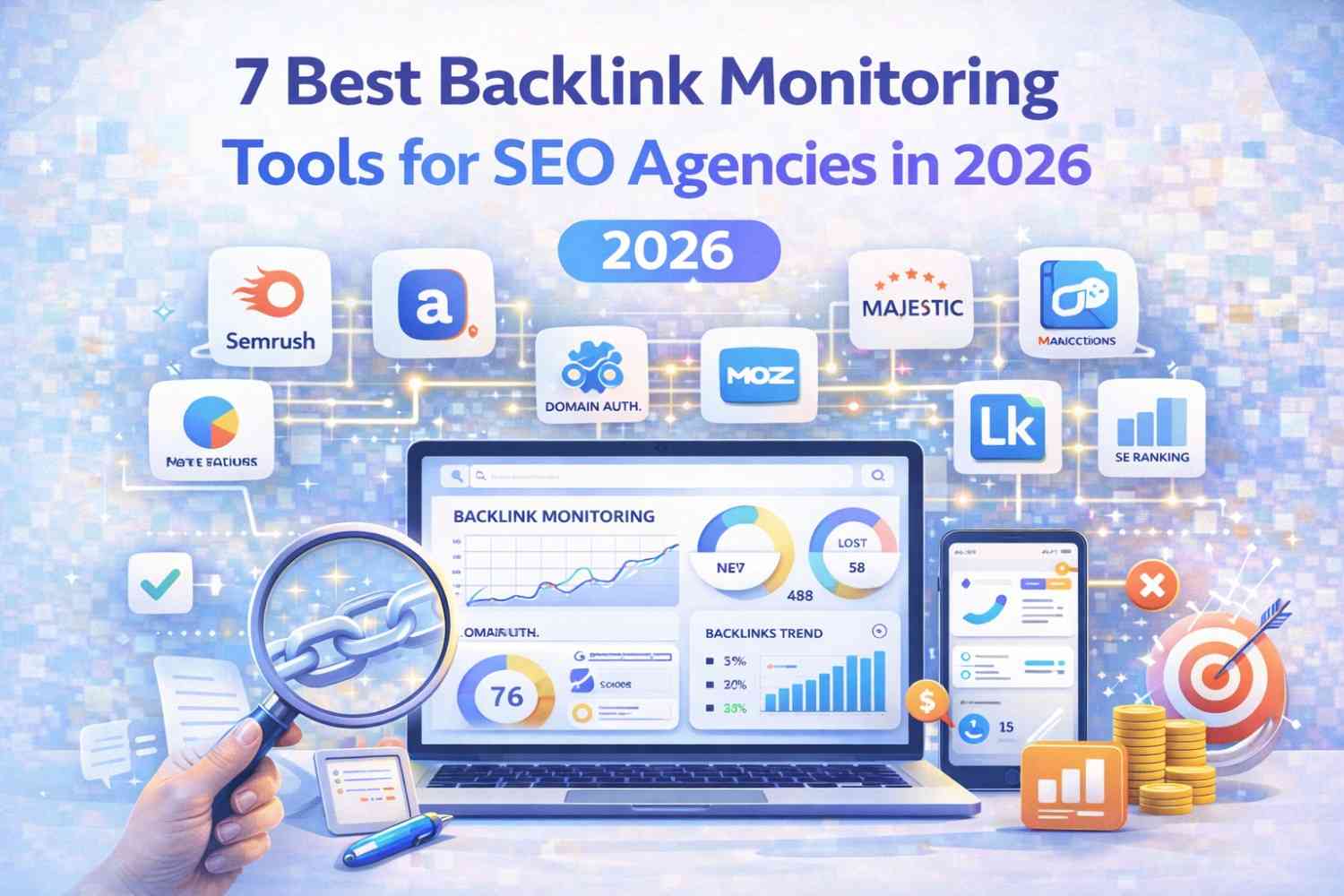
The seven tools below represent the best options available in 2026 for monitoring backlink health. Each has a distinct use case, so the right choice depends on what your agency actually needs.
1. LynkDog
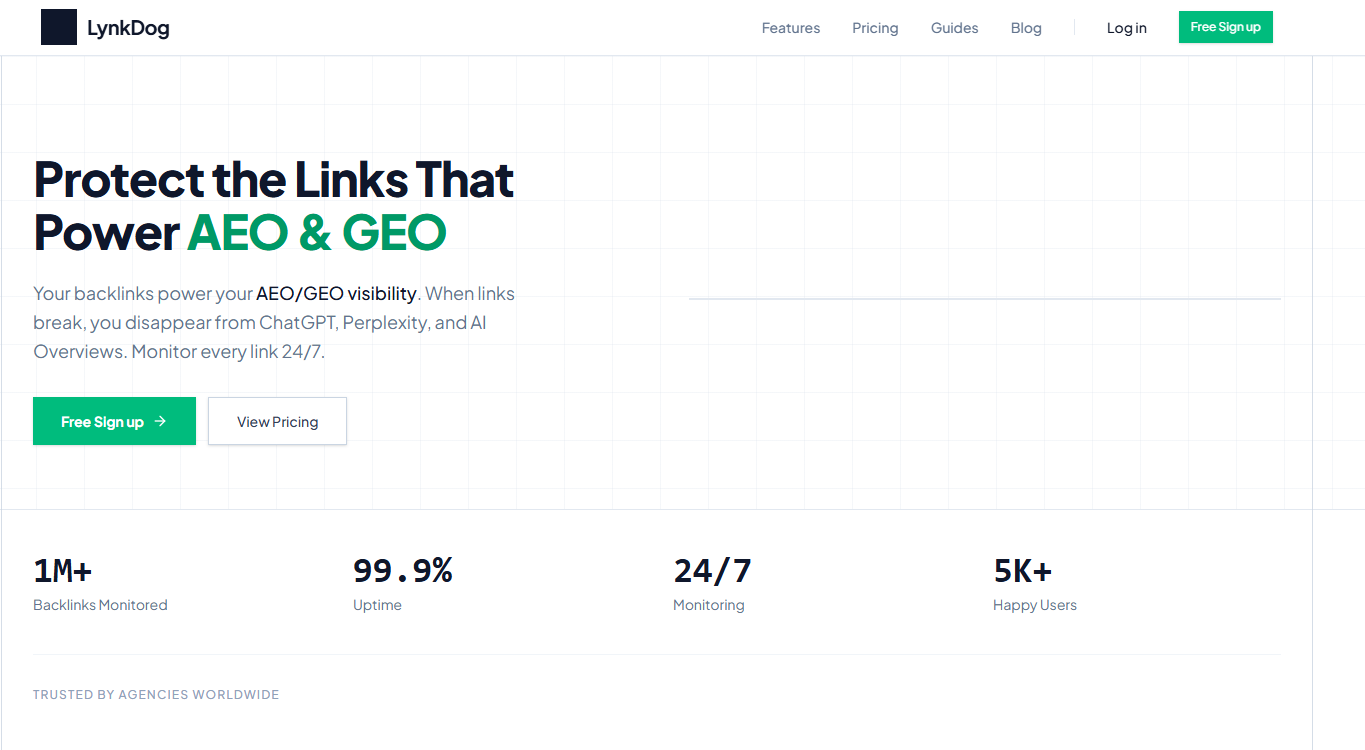
LynkDog is the only dedicated backlink monitoring platform built specifically for the era of AI-powered search. Most legacy tools were designed to check whether a link still returns a 200 status code. LynkDog goes well beyond that, monitoring anchor text changes, dofollow to nofollow attribute shifts, page removals, and directory listing health across more than 200 platforms.
The directory monitoring capability is what separates LynkDog from every other tool on this list. Platforms like G2, Capterra, Product Hunt, GetApp, TrustRadius, and SourceForge are now active citation sources for AI search engines. When these profiles go stale or lose their authority signals, AI search visibility drops. LynkDog monitors all of them inside a single dashboard, with instant alerts sent via Email and Slack whenever anything changes.
For agencies, the project-based structure is practical. The Pro plan supports 10 projects and 1,000 monitored links with daily verification. The Premium plan scales to 100 projects and 100,000 monitored links with API access. The tool integrates with Google Search Console, Ahrefs, and SEMrush, and includes full link audit history for client reporting. SOC2 compliance makes it suitable for agencies serving enterprise clients.
Pricing:
Free: 2 projects, 20 total links, weekly verification, no credit card required
Pro: $20 per month, 10 projects, 1,000 links, daily verification, 5 team members
Premium: $100 per month, 100 projects, 100,000 links, 50 team members, API access (coming soon)
2. Ahrefs
Ahrefs is the most widely trusted name in backlink data. Its index holds 35 trillion external backlinks and is "updated with fresh data every 15 minutes" (Ahrefs, retrieved 2026-09-02). SOURCED In a survey of 518 SEO professionals, 68.1% rated Ahrefs the most accurate and comprehensive backlink data provider (Editorial.link, Link Building Statistics for 2026, retrieved 2026-09-02). SOURCED — note that is a vendor-run survey, not a neutral industry body. Site Explorer remains the core tool, giving agencies detailed views of referring domains, anchor text distribution, lost and found links, and historical backlink trends.
For backlink monitoring specifically, Ahrefs alerts you when new links appear or existing links are lost. The crawl frequency is strong, making it one of the closest options to real-time monitoring available in a general SEO platform. The limitation for agencies is pricing. The Lite plan starts at $129 per month, but most agency use cases require the Standard plan at $249 per month or higher to get full project support. Ahrefs' recent pricing changes have also drawn criticism for reduced value relative to cost.
Best for: Agencies that need the largest and most frequently updated backlink database for competitive research alongside monitoring.
3. Semrush
Semrush is the all-in-one platform that many agencies already use for keyword research, rank tracking, and site auditing. Its backlink monitoring capabilities are integrated into that broader suite through the Backlink Audit tool, which applies a Toxicity Score using over 50 markers to identify links that pose a penalty risk. The Backlink Analytics tool surfaces new and lost links, anchor text breakdowns, and competitor link profiles.
The strength of Semrush for agencies is the integration across functions. You can pull backlink data, keyword rankings, traffic estimates, and content gaps into a unified dashboard and see how they interact. The Backlink Gap feature shows websites linking to your competitors but not to you. Real-time alerts are available on paid plans. The downside is cost. Semrush has since restructured its plans: as of 2026-09-02 its pricing page lists SEO at $117.33/mo, Starter at $165.17/mo, Pro+ at $248.17/mo and Advanced at $455.67/mo, all billed annually (Semrush pricing, retrieved 2026-09-02). SOURCED The former Guru and Business tiers no longer appear. For agencies managing multiple client projects, the investment is substantial.
Best for: Agencies that want backlink monitoring as part of a fully integrated SEO platform rather than a standalone function.
4. SE Ranking
SE Ranking has built a reputation as the best value option in the professional SEO tool market. Its backlink monitoring module tracks new, lost, and broken links with daily status updates and email alerts. The platform integrates directly with Google Search Console for backlink imports and includes a real-time backlink status checker that lets you check individual links on demand.
For agencies, the pricing model is genuinely practical. Starting at $44 per month, SE Ranking offers agency-grade features at a fraction of what Semrush or Ahrefs charges. White-label reporting is available, which matters for client-facing agencies. The backlink database is competitive, and some users report SE Ranking finding more referring domains than rival tools for certain searches. The trade-off is that its database depth and update frequency do not match Ahrefs or Semrush at the highest tiers.
Best for: Small to mid-size agencies that need professional monitoring and white-label reporting without enterprise-level pricing.
5. Moz Pro
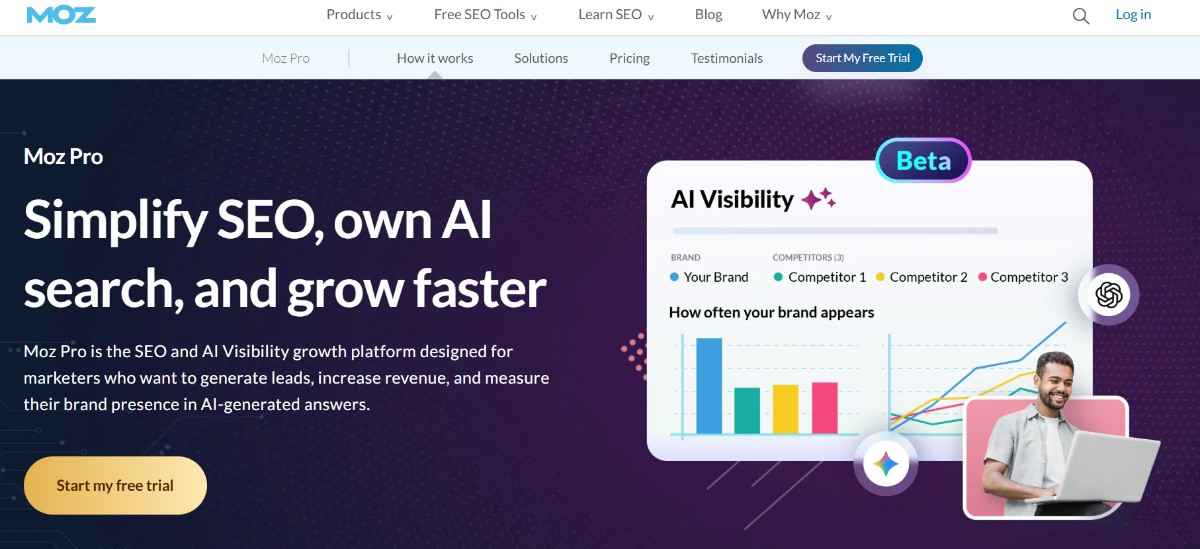
Moz Pro is best known for two things: Domain Authority, the metric that became the industry standard for evaluating link quality, and Link Explorer, its core backlink analysis tool. Moz has grown its backlink index significantly over the past few years and now maintains one of the larger databases available. The Spam Score metric helps identify low-quality links that could pose a risk.
The limitation for pure backlink monitoring is that Moz was not designed with real-time alerting as its primary function. It serves well as an auditing tool and for assessing link quality, but agencies that need fast notification of link changes will find Ahrefs or Semrush more responsive. Moz Pro pricing starts at $99 per month, placing it in a competitive middle tier.
Best for: Agencies that prioritize domain authority metrics and link quality assessment over real-time change monitoring.
6. Linkody
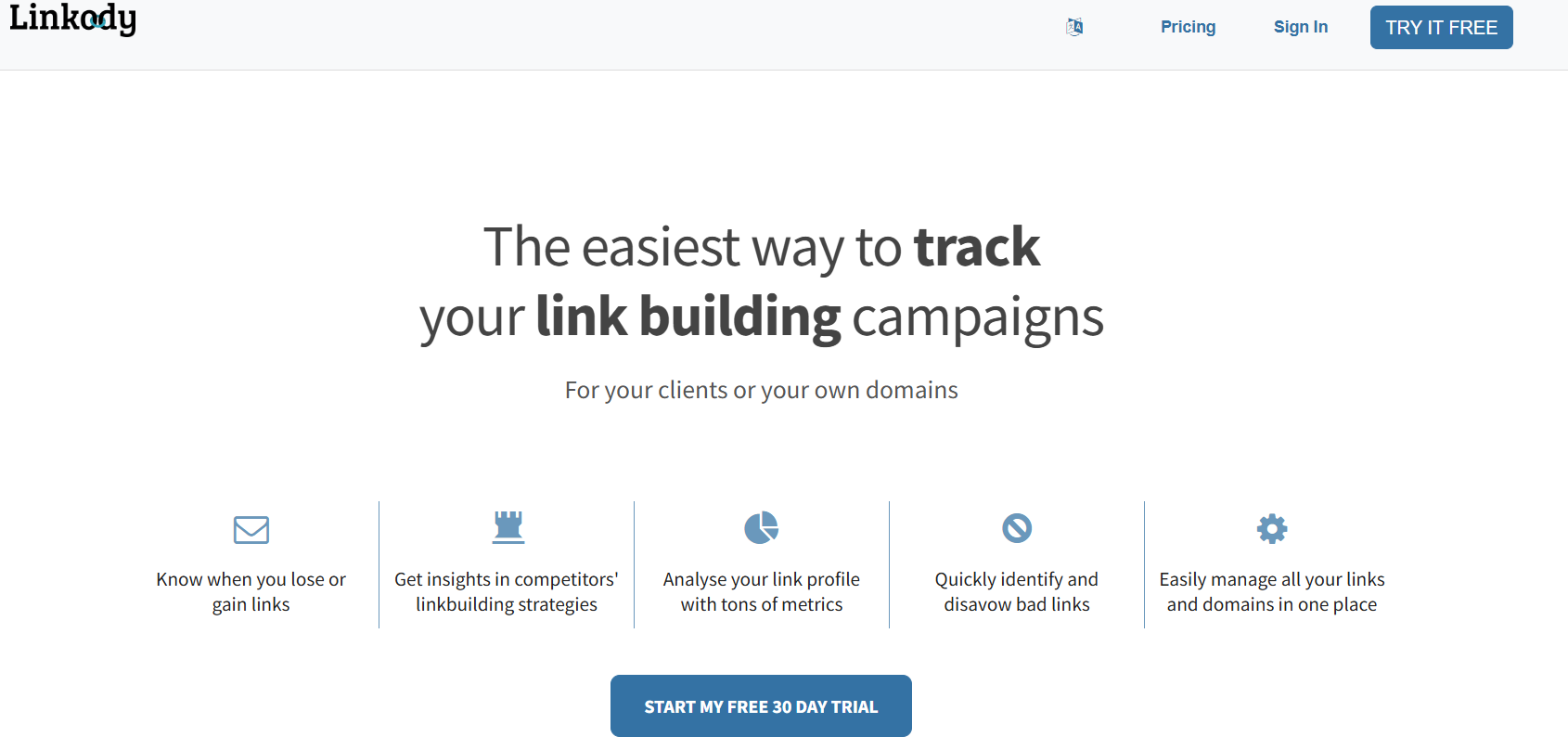
Linkody is a focused, no-frills backlink monitoring tool designed specifically to track links, nothing else. It checks links daily and sends email alerts when links are lost, gained, or experience attribute changes. The dashboard shows dofollow and nofollow status, domain metrics, and link acquisition dates. White-label client reports are available, which makes it functional for agencies that need a straightforward monitoring solution without the overhead of an all-in-one platform.
The pricing is the appeal. Linkody starts at $14.90 per month, with the agency-oriented Pro plan at $49.90 per month. It is not a research tool and does not offer the depth of competitive analysis that Ahrefs or Semrush provides, but for pure link monitoring on a budget, it is one of the most accessible options available.
Best for: Budget-conscious agencies and freelancers who need dedicated link monitoring without paying for broader SEO platform features they do not use.
7. Google Search Console
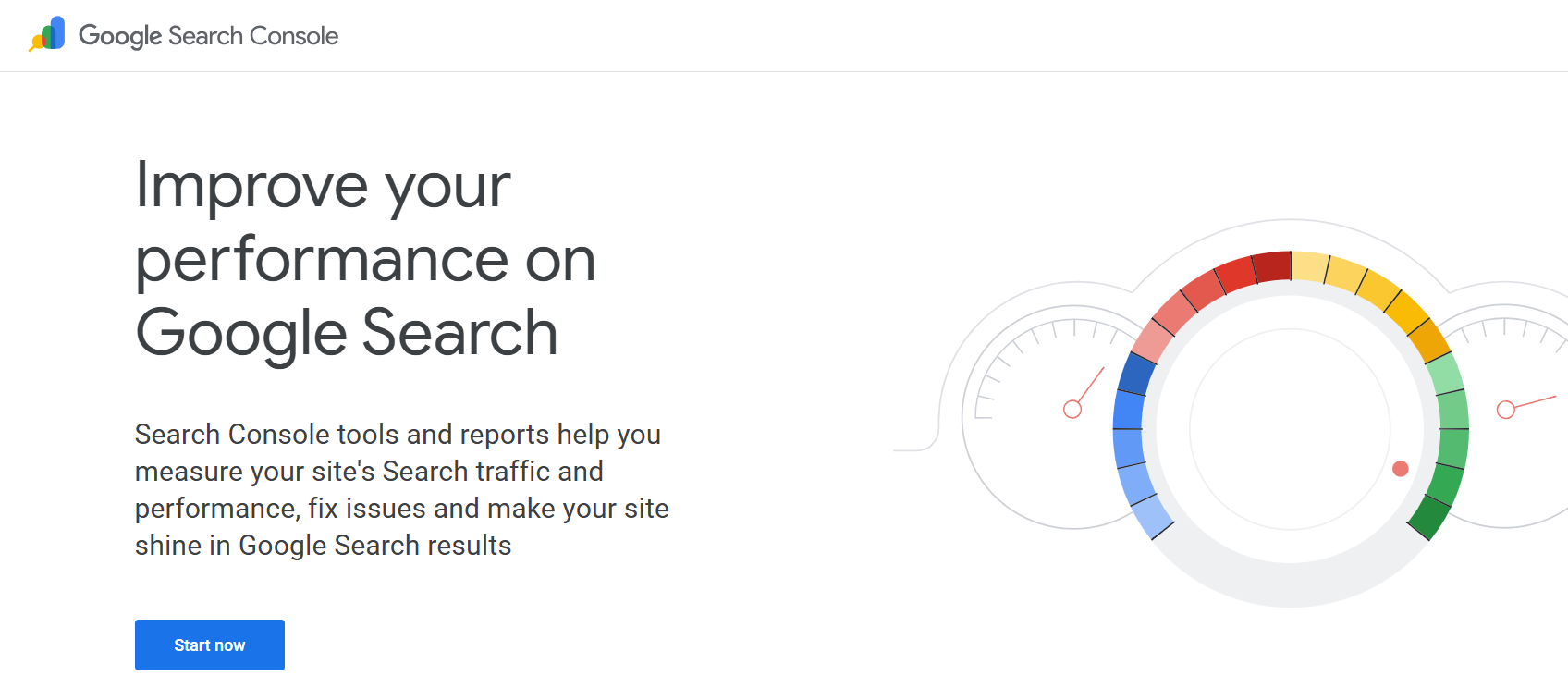
Google Search Console is free, authoritative, and overlooked as a monitoring tool. The Links report inside GSC shows every external page that Google has identified as linking to your site. While it does not offer real-time alerts, change tracking by date, or anchor text attribution at the granular level that paid tools provide, it represents the most credible source of data because it reflects what Google itself sees.
For agencies, GSC should function as the baseline verification layer rather than the primary monitoring system. When a paid tool flags a lost link, cross-checking against GSC confirms whether Google still registers the link. For clients on tight budgets who cannot justify paid monitoring subscriptions, setting up GSC thoroughly is the minimum viable protection.
Best for: A free foundational layer that provides Google's own view of your link profile. Works best in combination with a dedicated monitoring tool rather than as a standalone solution.
Choosing the Right Tool for Your Agency
The right choice depends on what your agency is actually trying to solve. If the priority is raw backlink database size and competitive research, Ahrefs or Semrush are the industry benchmarks despite their pricing. If the priority is practical, affordable monitoring with white-label reporting, SE Ranking and Linkody offer strong value. If you are operating in 2026 and need to protect both traditional link equity and AI search visibility, LynkDog fills a gap that none of the other tools on this list address.
AI citation share is now commercially measurable. Semrush reports that "the average AI search visitor (tracked to a non-Google search source like ChatGPT) is 4.4 times as valuable as the average visit from traditional organic search, based on conversion rate" (Semrush, AI search SEO traffic study, 21 July 2025, retrieved 2026-09-02). SOURCED Read it as value per visit rather than a raw conversion-rate multiple. The backlinks and directory listings that earn those citations are infrastructure, not an afterthought. Monitoring that infrastructure is no longer optional for agencies that want to deliver accountable results.
Related reading
- Top digital marketing agencies helping brands grow
- Social Media Monitoring: Tools, Strategies, and Insights for Digital Growth
- AI Content Writing for Agencies: Scale Your Output by 10x
- 3 Best Nonprofit Donor Management Software: Free to Premium
How This Guide Was Sourced
Written and maintained by the LogicBalls editorial team (logicballs.com).
Disclosure: LogicBalls builds AI writing tools, so it operates in an adjacent market to several platforms reviewed here.
Primary sources, with retrieval dates:
- Ahrefs, How often do AI assistants hallucinate links? — 404 rates for AI-cited URLs. 2 September 2025, retrieved 2026-09-02.
- Ahrefs, Backlink Checker — index size and refresh interval. Retrieved 2026-09-02.
- Semrush, AI search SEO traffic study — relative value of AI search visitors. 21 July 2025, retrieved 2026-09-02.
- Editorial.link, Link Building Statistics for 2026 — survey of 518 SEO professionals. Retrieved 2026-09-02.
- Pricing for Ahrefs and Semrush, both retrieved 2026-09-02.
One figure was removed rather than cited. An earlier version claimed that "industry data suggests roughly 15% of B2B backlinks are lost every year." No published study supports it. It is worth naming why that matters: searching the exact phrasing now returns this article among the results, which is how an unsourced number becomes its own evidence.
Pricing for SE Ranking and Linkody could not be verified at the time of writing — their pricing pages did not return readable content to us. Treat those figures as unconfirmed and check with the vendor. All SaaS pricing here changes frequently.
No LogicBalls telemetry is used in this guide.
Frequently Asked Questions
How often do AI assistants cite broken links?
Ahrefs found AI assistants send visitors to 404 pages 2.87x more often than Google Search, with 1.01% of ChatGPT's clicked URLs and 2.38% of its cited URLs returning a 404 (Ahrefs, 2 September 2025, retrieved 2026-09-02).
Is AI search traffic worth more than organic traffic?
Semrush measured AI search visitors as 4.4 times as valuable as traditional organic visits, based on conversion rate (Semrush, retrieved 2026-09-02). ANALYSIS: that is value per visit, and AI referral volumes remain far smaller than organic, so a higher per-visit value does not mean a larger channel.
How quickly do backlinks actually decay?
ANALYSIS: there is no reliable published annual rate, and this guide no longer quotes one. Ahrefs' link-rot work measures cumulative decay over roughly nine years, which cannot be divided into an annual figure. Measure decay on your own portfolio rather than planning against a borrowed percentage.