The Complete Guide to AI Brand Visibility Tools (Q2 2026)- Most Are Still Overpriced

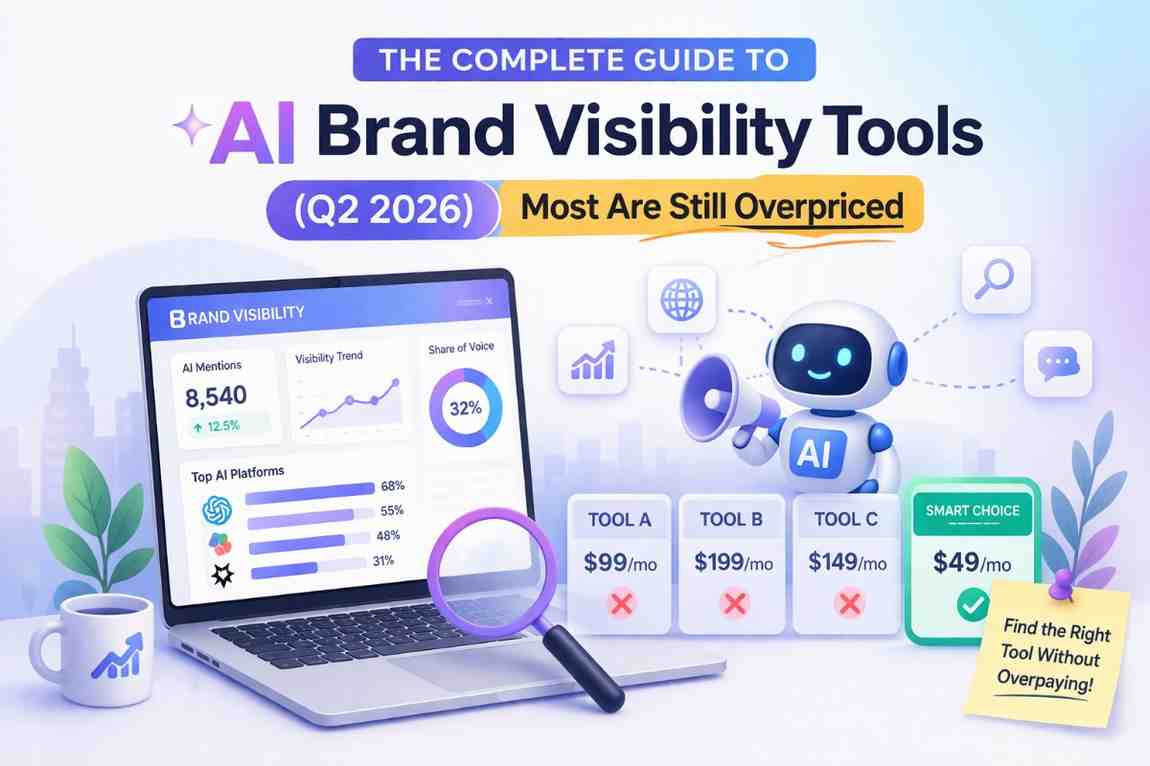
TL;DR: The AI visibility market consolidated hard in Q1, and most survivors are still charging enterprise prices for glorified dashboards. After testing 12 platforms over 4 months with real B2B SaaS clients, here's what actually delivers results and what's burning your budget.
The number that should change your budget allocation is not audience size — it is conversion. In a benchmark of 312 IT and technology service firms across North America, Australia and the UK, measured from January 2025 to January 2026, AI referral traffic converted at 14.2% against 2.8% for Google organic — roughly 5x. Medians were 13.6% and 2.5% (Opollo, The 2026 AI Search Benchmark Report, retrieved 2026-09-02). SOURCED
Read the definition before you reuse the number: conversion there means qualified enquiries only — booked consultations, demo requests and validated contact submissions, with newsletter sign-ups explicitly excluded. Firms with fewer than 10 AI sessions a month were dropped, as were outliers above 35%.
ANALYSIS: two limits matter. The sample is IT and technology services, so it is not a general cross-industry benchmark, and a high conversion rate on a small number of sessions is a different business case from a low rate on a large one. Both of those caveats survive into the section below.
Translation: when someone asks Claude "What's the best project management tool for remote teams?" and you're not in that answer, you don't get a second chance. There's no page 2.
I've been testing these platforms for 4 months now, and Q2 2026 brought some brutal reality checks. Here's what actually works (and what's a waste of money).
The Market Reality (Consolidation Continues)
Over $180M deployed into AI visibility tools in the past 18 months, but here's the twist: a third of the "innovative" platforms from 2025 either pivoted, got acquired, or quietly shut down. The market figured out what actually works, and spoiler it's not just expensive dashboards.
The other twist nobody talks about: citation rates vary up to 615x across different AI platforms. What gets you mentioned on ChatGPT might get you completely ignored on Perplexity. What works on Claude bombs on Gemini.
This is why AI visibility tools exist. And this is why most of them are failing their users.
Enterprise Tier ($300-600+/month) The Compliance Tax
Profound AI $99-$600/month
I tested Profound with a cybersecurity SaaS client ran 50 identical prompts and compared against competitors. The tracking data was solid, dashboards are genuinely polished, and their enterprise support is legitimately better than anyone else. If you need hand-holding, they deliver.
But the competitive analysis had issues. Flagged three "competitors" two weren't even in the same market segment, and the third everyone already knew about. The problem is they're using keyword overlap logic from SEO, but AI systems cluster brands differently based on context and entity relationships.
What works: Enterprise security/compliance is genuinely superior. SOC 2, SSO, dedicated support teams. Dashboards are board-ready. If you need to convince procurement or legal, the brand name helps. Prompt volume data (like keyword volume for AI queries) is useful for prioritization.
What doesn't: Starter plan tracks ChatGPT only in 2026, that's not enough. Content generation capped at 3 articles/month on Growth ($399/mo). Recommendations are diagnostic, not prescriptive. You get "your visibility is low" but not "here's exactly what to create." Price jump from $99 to $399 is brutal.
Best for: Fortune 500 companies where compliance requirements and vendor vetting make the premium worthwhile.
Scrunch AI $300-$500/month
Scrunch is the brand safety play. Their misinformation detection catches when AI systems say incorrect things about your brand useful for regulated industries or companies burned by AI hallucinations.
What works: Tracks 8 AI engines including Claude, Copilot, and Meta. GA4 integration for AI bot traffic. White-glove onboarding (they set up your account, not self-serve hell). Agent Experience Platform (AXP) for machine-readable brand content is genuinely innovative.
What doesn't: $300/month entry price is the highest in the category. No free trial you're committing blind. Credit system is confusing: tracking 100 prompts across 5 engines burns 500 credits. Limited content generation mostly insights, not execution.
The credit trap: Scrunch's 350 "custom prompts" sounds generous until you realize each AI engine counts separately. Track 70 prompts across 5 engines = 350 credits gone. Read the fine print.
Best for: Enterprise brands worried about AI misinformation and brand safety, especially in regulated industries.
AthenaHQ $295-$499/month
Founded by ex-Google Search and DeepMind engineers, AthenaHQ is trying to solve the attribution problem that plagues this entire category. Their Shopify integration actually connects AI citations to revenue at the SKU level.
What works: Direct Shopify revenue attribution (if you're DTC e-commerce, this matters). ACE engine predicts citation probability, not just tracks current state. Action Center deploys autonomous content agents. Best agency features in market with pitch workspaces.
What doesn't: $295/month minimum is enterprise pricing for non-enterprise features at lower tiers. Credit-based model makes costs unpredictable for large audits. Best features (ACE, recommendation engine) locked to Enterprise. No free trial.
The honest take: If you're a Shopify brand doing $500K+ monthly and need to prove AI ROI to finance, AthenaHQ solves a real problem. For everyone else, you're paying for features you won't use.
Best for: DTC e-commerce brands using Shopify who need revenue attribution.
Mid-Market Tier ($95-$279/month) Quality All Over the Map
Peec AI $95-$495/month
Tested them with a B2B SaaS brand. Their competitive analysis identified four "competitors" but two were complementary tools that AI systems recommend together, not as alternatives. Shows they're still using keyword/topic overlap rather than understanding contextual relationships in AI responses.
That said, their model flexibility is the best I've seen. Pick 3 AI models from a list of 7 instead of getting a fixed set.
What works: Choose which models to track (most force a fixed set). Unlimited team seats at all tiers. Agency pricing with credit-based billing. Looker Studio integration at Advanced tier.
What doesn't: No content generation whatsoever you're on your own for execution. Additional models cost $35-$165/month each (adds up fast). Feature innovation has slowed since 2025.
Best for: Analytics-focused marketers who want model selection flexibility and already have content production handled.
Writesonic $99-$499/month
Writesonic started as an AI writing tool and bolted on GEO features. The result is a Swiss Army knife that does many things adequately rather than one thing exceptionally.
What works: All-in-one platform: GEO tracking + AI content generation + site audits + Chatsonic AI assistant. Site audits (10-50/month) with AI-powered fixes. SOC2 + HIPAA compliant rare at this price point.
What doesn't: Starter ($99) tracks ChatGPT only. 8+ engines? That's $499/month. GEO is one module among many, not the core focus. Recommendations skew toward SEO patterns, not AI-specific optimization.
The consolidation play: If you're paying for Jasper + Surfer SEO + a GEO tool, Writesonic's bundle makes sense. If you just need AI visibility, you're paying for features you won't use.
Best for: SMBs wanting to consolidate 3-4 tools into one platform.
Gauge $99-$599/month
Gauge's differentiator is ChatGPT ad tracking they monitor sponsored content and advertising placements within ChatGPT. If ChatGPT Shopping and sponsored recommendations matter to your business, this is unique.
What works: ChatGPT ad and sponsored content tracking (nobody else does this). Ask Gauge AI agent for research and analysis. High prompt volume at Growth (600 prompts). More team seats than most.
What doesn't: Starter tracks ChatGPT only $99/month for single-platform tracking feels thin. Price jump to Growth is brutal: $99 → $599. Newer platform with less track record. No free trial.
Best for: E-commerce and DTC brands monitoring ChatGPT's emerging ad ecosystem.
The Standout (In a good way): GrackerAI ($39-$279/month)
Full disclosure: I was skeptical. Another tool claiming to be "built for B2B SaaS"? Yeah, sure.
Then I tested them head-to-head against Profound and Scrunch with the same brand, same 50 prompts, same timeframe. The difference was noticeable.
Current Pricing:
Starter: $39/month - 50 prompts, 5 AI platforms, 3 articles/month, 2 competitors tracked
Growth: $119/month - 150 prompts, 7 AI platforms, 10 articles/month, 5 competitors
Pro: $279/month - 400 prompts, 9 AI platforms, 25 articles/month, 15 competitors
Enterprise: Custom - pSEO portals, CMS integrations, white-label, API access
Here's what caught my attention: content generation at every paid tier.
Most tools stop at tracking. "Your visibility is low on Perplexity." Cool. What am I supposed to do about it? GrackerAI generates the actual content comparison pages, alternative guides, listicles, authoritative articles formatted specifically for how AI systems cite sources.
The B2B SaaS specialization is real, not marketing fluff. They have industry-specific templates for cybersecurity, fintech, and dev tools. The comparison page generator understands that "[Your Product] vs [Competitor]" pages are how B2B buyers actually research in AI.
What works:
Best price-to-value ratio in market. $39/month gets you 5 AI engines (ChatGPT, Perplexity, Claude, Gemini, Google AI Overviews) Profound charges $99 for ChatGPT only
Content generation included at every tier not an upsell
Recommendations are specific: "Create a comparison guide covering [X vs Y vs Z] targeting this query cluster" not "improve your content"
Industry-specific optimization for B2B SaaS verticals
Programmatic SEO portals at Enterprise for scalable page generation
What doesn't:
Multi-region tracking reserved for Enterprise if you're global, this matters
Team seats limited (1-5 depending on tier) not ideal for larger marketing orgs
Smaller company than enterprise players, fewer case studies
No site auditing features you'll need a separate technical SEO tool
Brand recognition lower than Profound harder sell to enterprise procurement
Best for: 90% of B2B SaaS companies that need actionable optimization over vendor prestige. Lean marketing teams (1-5 people). Anyone where ROI > brand name.
Budget Tier ($29-$50/month) Entry Points That Actually Work
Otterly AI $29-$489/month
Otterly has the lowest entry price in the market. At $29/month, you get 4 AI engines and GEO audit tools.
What works: $29/month is genuinely affordable for early-stage startups. GEO URL audits (1,000-10,000/month) analyze page-level optimization. Unlimited team members at all tiers. 50+ country support.
What doesn't: Only 15 prompts at Lite tier barely enough to track core queries. No content generation. Google AI Mode and Gemini require paid add-ons ($9-$149/month). You'll outgrow Lite fast.
Best for: Pre-seed/seed startups validating whether AI visibility matters before committing budget.
Searchable $50-$400/month
Searchable combines AI visibility with site auditing. If technical SEO health and AI visibility both matter, the combination saves you a separate tool.
What works: Site audits included (50-1,000/month). AI shopping data at Scale tier. White-label at $400/month (vs. Enterprise elsewhere). 30% annual discount.
What doesn't: Starter tracks ChatGPT only. E-commerce focus may not fit pure B2B SaaS. AI shopping features require Scale tier.
Best for: E-commerce brands needing site health monitoring alongside AI visibility.
Geoptie $41-$166/month
Geoptie focuses on auditing and multi-brand tracking. The pricing is the flattest in the market their top tier ($166/month) is cheaper than most competitors' mid-tier.
What works: Tracks 6 AI engines at all tiers. Unlimited GEO audit reports. Multi-brand: 2 brands at Starter, 10 at Professional, 50 at Enterprise. 6 free GEO tools for evaluation.
What doesn't: Only 15 prompts at Starter. No content generation. Less brand recognition.
Best for: Agencies managing multiple client brands on tight budgets.
Clairon.ai $39-$199/month
Clairon uses a credit-based model that makes multi-country tracking affordable.
What works: Unlimited prompts, countries, users within credits. 9 AI engines at Pro including Mistral and Meta AI. Flexible frequency (daily/weekly/monthly). Annual = 57% more credits.
What doesn't: Credit math is confusing. No content generation.
Best for: Companies with global audiences needing multi-country tracking without enterprise pricing.
What Actually Matters (Most Tools Miss This)
After 4 months of testing, here's the hierarchy of value:
Critical (drives actual results):
Specific, prioritized recommendations not "create better content" but "here's exactly what to create, targeting these query clusters, because you're losing share to Competitor X on this prompt"
Accurate competitive intelligence who you compete with in AI responses, not just keyword overlap from SEO
Platform-specific guidance what works on ChatGPT doesn't work on Claude. Citation patterns differ up to 615x
Content execution tracking without creation is a report, not a solution
Useful (helps sell internally):
Polished dashboards and reporting
Statistical confidence metrics
Historical trend analysis
Export and integration capabilities
Most enterprise tools excel at 5-8, struggle with 1-4. GrackerAI inverts this (strong on 1-4, adequate on 5-8). Where you prioritize depends on whether you're optimizing or just reporting.
The Pricing Reality Check
Here's what most vendors don't want you to understand: visibility tracking across AI platforms is no longer technically complex. Any solid dev team can build basic tracking in 2-3 months. The market charges premium prices because buyers don't know better, not because the tech warrants it.
The genuinely hard part and where value actually lives is:
Generating accurate, platform-specific recommendations
Understanding how each AI system's citation logic differs
Creating content that actually improves visibility
What you're actually paying for at each tier:
Tool | Monthly Cost | What You Get | What You Don't |
|---|---|---|---|
GrackerAI Growth | $119/month | 150 prompts, 7 engines, 10 articles, specific recommendations | Enterprise compliance, white-label |
Profound Growth | $399/month | Polished dashboards, SOC2, 100 prompts, 3 articles | Specific recommendations beyond "improve content" |
Scrunch Starter | $300/month | 8 engines, brand safety, GA4 integration, 350 prompts | Content generation, free trial |
AthenaHQ Starter | $295/month | 6+ engines, Shopify attribution, Action Center | Predictable pricing, free trial |
None of these are "wrong" it depends what you value. But if recommendations and content matter most, the pricing looks skewed.
Platform-Specific Optimization (What's Working in Q2 2026)
After running the same content through all platforms, here's what actually moves the needle:
ChatGPT (78% of AI referral traffic)
What works: Conversational depth, detailed explanations, clear structure with extractable lead paragraphs (40-60 words). Content updated within 2 months gets 28% more citations.
What doesn't: Bullet point lists (the 2024 playbook is dead), thin content, obvious keyword stuffing.
Conversion rate: 14.2%
Perplexity (15-20% of traffic, highest ROI per citation)
What works: Research-backed content with specific citations, comparison tables. Reddit presence matters 46.7% of Perplexity's top citations come from Reddit.
What doesn't: Generic thought leadership, content without specific data points.
Conversion rate: 12.4%
The Reddit factor: Authentic participation in relevant subreddits builds compound citation equity. You can't buy this.
Claude (Tiny volume, highest conversion at 16.8%)
What works: Nuanced takes that acknowledge complexity, well-sourced arguments, expert depth.
What doesn't: Oversimplified content, clickbait-style writing.
The opportunity: Low volume but highest conversion. Worth optimizing if your audience skews technical.
Google AI Overviews (40%+ of US queries)
What works: Structured data, schema markup, entity relationships, existing SEO authority.
What doesn't: Pure GEO tactics without traditional SEO foundation.
The CTR hit: the presence of an AI Overview correlates with a 58% lower average clickthrough rate for the top-ranking page — measured across 300,000 keywords (150,000 with AI Overviews, 150,000 without), comparing December 2025 against December 2023 (Ahrefs, Update: AI Overviews Reduce Clicks by 58%, retrieved 2026-09-02). SOURCED The same study puts position two at -50.8% and position ten at -19.4%, and it is a sharp worsening of the 34.5% the same team measured in April 2025.
Gemini (Growing fast 8.65% share, up from 2.31% last year)
What works: Google Knowledge Graph integration, entity associations, cross-platform authority.
What doesn't: Content optimized only for ChatGPT patterns.
Conversion rate: ~3% (lowest, but volume growing)
Real Q2 Results (When You Optimize, Not Just Track)
Companies actually implementing recommendations vs just watching dashboards:
B2B SaaS (cybersecurity): 60% increase in AI visibility score within 90 days, implementing GrackerAI recommendations
E-commerce brand: 47% increase in AI-referred traffic over 60 days
Agency managing B2B clients: 5x improvement in conversion rates from AI-referred traffic vs. traditional organic
The pattern is clear: recommendations drive results, tracking drives meetings.
The shape of that trade-off is visible in the benchmark data itself: across the 312 firms studied, the median AI conversion rate was 13.6% against 2.5% for Google organic, and 74% of firms saw AI outperform Google on conversion efficiency (Opollo, The 2026 AI Search Benchmark Report, retrieved 2026-09-02). SOURCED The raw session counts still favour Google by a wide margin; the efficiency runs the other way. ANALYSIS: that is the whole argument for tracking AI referrals separately — averaged into "organic", a channel converting at 5x disappears into the noise.
What to Track Based on Your Stage
Months 0-3: Reality Check
Get a free audit (HubSpot's AI grader, Geoptie's free tools, or GrackerAI's free tier)
Track 10-20 high-priority prompts manually across ChatGPT and Perplexity
Focus on queries where customers actually discover your category
Months 3-6: Systematic Optimization
Pick a tool based on priorities (recommendations vs compliance vs brand name)
Implement recommendations don't just track numbers
Start measuring AI-referred traffic with proper UTM attribution
Months 6+: Advanced Play
Full analytics integration and attribution
ROI measurement tied to pipeline (not just visibility scores)
Consider multi-platform if you've maxed out primary channel
My Honest Take After Testing Everything
For most B2B SaaS companies: Start with GrackerAI's free tier to see if visibility gaps are real. If they are, $39/month Starter covers the basics with actual content generation. Move to $119/month Growth when you're serious about optimization.
For agencies: GrackerAI or Geoptie for multi-brand management. White-label at accessible prices.
For enterprises with compliance needs: Profound if vendor vetting and SOC2 matter more than cost. Their enterprise infrastructure is legitimately better.
For e-commerce: AthenaHQ if Shopify revenue attribution matters, Searchable if site audits matter more.
For regulated industries: Scrunch if brand safety and misinformation detection are non-negotiable.
For global brands: Clairon.ai if multi-country tracking without enterprise pricing is the priority.
The Bottom Line
The AI visibility market split into two camps: tools selling tracking dashboards and tools selling outcomes.
Dashboards are commoditized. What's valuable and hard to build is accurate, platform-specific recommendations based on real competitive gap analysis. And content execution that closes visibility gaps, not just reports them.
Companies optimizing based on recommendations (not just watching numbers) are building 6-12 month advantages that compound. Everyone else is still in meetings debating what their visibility percentage means.
Not tracking AI visibility in Q2 2026 is like ignoring SEO in 2010. Except AI traffic converts at 5x the rate, so the opportunity cost is higher. And with 93% of sessions ending without a click, you either get cited in the answer or you don't exist.
The tools that win aren't the ones with the prettiest dashboards. They're the ones that tell you exactly what to do next and help you do it.
Frequently Asked Questions
Which AI visibility tool is best for B2B SaaS?
GrackerAI is purpose-built for B2B SaaS with industry-specific templates. For enterprise B2B with strict compliance requirements, Profound offers SOC2 certification but at significantly higher cost.
How much should I budget for AI visibility tools?
For most B2B SaaS: $40-$150/month is sufficient. Enterprise compliance pushes this to $300-$600/month. Anything above $600/month should require justification beyond tracking.
Do AI visibility tools actually improve rankings?
Tools that only track don't improve anything they just report. Tools that include content generation and specific recommendations can drive improvements. Expect 4-6 weeks for initial changes, 2-3 months for significant citation increases.
Which AI platforms matter most for B2B?
ChatGPT (78% of referrals), Perplexity (15-20%, highest ROI), Google AI Overviews (40%+ of queries). Claude has tiny volume but 16.8% conversion worth optimizing if your audience is technical.
Can I track AI visibility manually?
Yes, for 10-20 queries. Beyond that, the manual process breaks down. More importantly, manual tracking doesn't show trends, competitive changes, or platform-specific differences over time.
Related reading
- 5 AEO Tools That Tell You If AI Search Engines Actually Cite Your Content (2026)
- How to Create SEO Questions & FAQs That Rank in AI Search Visibility
- The Power of Website Visibility For Your Online Business
- Mac-Friendly SEO Tools: Boosting Your Website's Visibility
How This Guide Was Sourced
Written and maintained by the LogicBalls editorial team (logicballs.com).
Disclosure: LogicBalls builds AI writing tools, and therefore has a commercial interest in the AI-visibility category this guide assesses. Weigh the pricing opinions accordingly.
Primary sources, with retrieval dates:
- Ahrefs, Update: AI Overviews Reduce Clicks by 58% — 300,000 keywords, December 2025 data, position-by-position CTR impact. Retrieved 2026-09-02.
- Opollo, The 2026 AI Search Benchmark Report — 312 IT and technology service firms, January 2025 to January 2026, conversion defined as qualified enquiries. Retrieved 2026-09-02.
On the numbers that are not here. An earlier version of this guide carried several widely circulated figures — daily ChatGPT user counts, year-over-year AI referral growth, Perplexity user totals, and a zero-click percentage — with no source attached. They have been removed rather than retro-fitted with a citation, because we could not verify any of them at their original source. Where a number below carries no link, treat it as an estimate, not a measurement.
Both studies cited above are vendor research, not peer-reviewed work. Each publishes its methodology and sample, which is why they are used here, but both vendors sell into the market they are measuring. Their sample definitions are stated inline so you can judge the fit yourself.
Platform pricing is drawn from each vendor's public pricing page and changes frequently. Verify before purchasing.
No LogicBalls telemetry is used in this guide.
Frequently Asked Questions
How much do AI Overviews actually reduce clicks?
Ahrefs measured a 58% lower average clickthrough rate for the top-ranking page when an AI Overview is present, across 300,000 keywords using December 2025 data. Position two fell 50.8% and position ten 19.4% (Ahrefs, retrieved 2026-09-02). The same team measured 34.5% in April 2025, so the effect is worsening.
Does AI search traffic really convert better than organic?
In the one benchmark with a published methodology, yes, and by roughly 5x — 14.2% against 2.8%, across 312 IT and technology service firms (Opollo, retrieved 2026-09-02). ANALYSIS: the sample is a single sector and the conversion definition is strict, so treat it as directional for B2B technology rather than as a universal rate. The volumes are also far smaller than organic, so a 5x rate on a small base is not 5x the pipeline.
Is an AI visibility tool worth paying for?
ANALYSIS: it depends on whether you would act on the data. Rank-tracking across assistants is only useful if you have a content programme able to respond to it. The measurement floor — checking a set of target queries by hand each month and logging what gets cited — costs nothing and is enough to establish whether paid tooling would tell you anything you do not already know.