The 2026 Roadmap for Integrated AI in Content Creation & Marketing
The "AI as a fancy autocomplete" era? It’s dead. If you’re still using ChatGPT to churn out generic, soulless blog posts, you’re not just behind—you’re actively eroding your brand’s value. By 2026, the competitive chasm in marketing won’t be about who writes the cleverest prompt. It’ll be about who has built the most resilient, autonomous orchestration systems.
Success today isn't about "cranking out more content." It’s about agentic execution. You need systems that don't just dump text onto a page, but audit, optimize, and distribute based on real-time market signals. It’s time to stop treating AI like a junior intern and start treating it like a digital engine.
Why Your 2024 Strategy is Already a Fossil
Remember the 2024 gold rush? Everyone was flooding the internet with high-volume, low-effort AI "content." It was a race to the bottom. We’ve landed in a "Zero-Click Reality," where up to 65% of user queries die right on the search engine results page (SERP). They get their answer, and they never visit your site.
If you’re still playing the old-school keyword stuffing game, stop. It’s a liability. Search algorithms aren't looking for "SEO-optimized" fluff anymore; they’re looking for signals of authority. The shift is absolute: we’ve moved from Search Engine Optimization (SEO) to Generative Engine Optimization (GEO).
Your goal isn't a blue link. It’s to be the "source of truth"—the specific, authoritative cited resource that AI models pull from when they answer a user’s question. If your content isn't specialized and structurally optimized for AI ingestion, it might as well not exist.
The 2026 Landscape: The Era of Agentic AI
The market is undergoing a structural transformation. According to Gartner Marketing Trends 2026, the winners are moving away from fragmented, manual workflows toward unified AI ecosystems.
This is the rise of the "Agentic Workflow." Unlike a chatbot that just talks to you, an agentic workflow acts like a digital employee. It identifies a content gap, pulls proprietary data from your CRM, drafts a piece that nails your E-E-A-T guidelines, and pushes it out to your channels. The differentiator this year isn't "prompting"—it's "orchestrating." You aren't asking the machine to write; you’re setting the parameters for an agent to deliver business outcomes.
Building the Pipeline: Human-in-the-Loop
Efficiency without oversight is just a faster way to ruin your reputation. To scale, you must keep the human expert at the center. The AI handles the heavy lifting—the data synthesis, the tedious SEO structuring, the formatting—but the human provides the "soul," the nuance, and the final verification of authority.

This pipeline keeps your brand grounded in reality. By integrating AI Writing Tools for Marketers into your stack, you automate the mundane while keeping your team’s cognitive bandwidth focused on the high-level strategy that actually moves the needle.
The 90-Day Implementation Roadmap
Transitioning to an AI-integrated model isn't a weekend project. It requires discipline.
Phase 1: Foundation (Days 1–30)
You cannot automate chaos. Spend the first month auditing your brand assets and building a "Proprietary Data Core." This is your clean, structured repository of unique insights, case studies, and voice guidelines. If you skip this, your AI will just parrot the "average" of the internet. Centralize your data, pick an integrated stack, and stop using a dozen disconnected apps that don't talk to each other.
Phase 2: Implementation (Days 31–60)
Deploy your GEO strategy. As outlined in the Search Engine Journal: GEO Guide, stop optimizing for search volume and start optimizing for "answerability." Does your content answer a specific question? Is it structured so an AI can parse it? Focus on being the expert resource that AI crawlers actually want to cite.
Phase 3: Scale & Optimization (Days 61–90)
Now that your agents are live, use real-time analytics to refine the machine. If you want to maintain volume without sacrificing quality, leverage an Automated Content Generation Strategy to iterate based on what’s actually driving engagement. Stop guessing. Let the feedback loop dictate your next sprint.
Build vs. Buy: The Decision Matrix
Not every task requires a custom-built agent. For standard blog posts or basic tagging, off-the-shelf SaaS is plenty. But if your edge comes from proprietary data or a complex customer journey? You need to build.
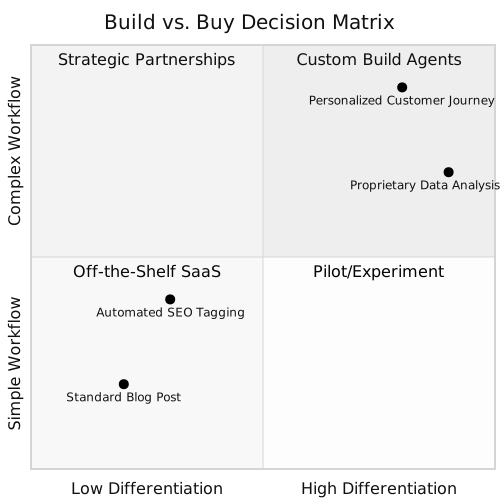
If your workflow is unique and complex, invest in custom development. If you’re just trying to keep the lights on and the blog updated, stick to the well-vetted platforms. Don't over-engineer for the sake of it.
Why E-E-A-T is the Only Currency Left
We are drowning in "Generative Slop." The only way to survive is through radical authenticity. Search engines are getting better at spotting the "machine smell." According to the Adobe Digital Trends Report, the brands winning in 2026 are those that double down on proprietary insights.
You must infuse your AI drafts with expert quotes, internal data, and first-hand experiences. An LLM can't synthesize your unique perspective—it can only mimic it. AI is the engine, but your brand’s specific, weird, human point of view is the fuel.
The New Marketer: Systems Architect
The job description has changed. You aren't a "Content Creator" anymore; you’re a Systems Architect. Your team needs to master three things:
- Systems Engineering: Moving beyond simple prompts to connecting AI agents into cohesive, multi-step workflows.
- Data Literacy: Knowing how to look at an AI’s output and sniff out hallucinations, bias, or just plain laziness.
- AI Ethics: Managing the scale. You need fact-checking layers. If the machine says something wrong, that’s on your brand’s reputation.
Frequently Asked Questions
How does AEO (Answer Engine Optimization) differ from traditional SEO?
Traditional SEO focuses on driving traffic to your domain via blue links. AEO focuses on positioning your brand as the definitive source of information that AI models cite in their conversational responses, prioritizing authority and structured data over keyword density.
What is the biggest risk of relying on AI for content creation in 2026?
The biggest risk is "homogenization"—the tendency for AI to produce the average, uncontroversial opinion of the entire internet. If you don't inject proprietary data and human oversight, your content will become invisible in a sea of identical, machine-generated output.
Do I need a large team to implement an AI-integrated marketing strategy?
No. In fact, a smaller, highly skilled team of "AI Orchestrators" is often more effective than a large, traditional content team. The goal is to leverage agents to perform the work of ten people, allowing your core team to focus on high-level strategy and brand voice.
How can I maintain brand voice when using AI tools?
You maintain brand voice by feeding the model a "Brand Bible" containing your specific tone, vocabulary, and stylistic preferences. Use this data as the primary context for every agentic workflow, and strictly enforce a "Human-in-the-Loop" review process to catch any drifts in the AI’s tone before publication.
Related Questions
- Top 10 AI Content Creation Tools to Scale Your Marketing Strategy This Year
- Top 10 AI Content Creation Tools to Scale Your Marketing Strategy This Year
- Why Your Content Marketing Strategy Needs Industry-Specific AI Solutions
- Writing Assistance vs. AI Content Generation Tools: Which One Do You Really Need?