Top 7 AI Business Automation Tools to Scale Your Workflow in 2026
The era of the "AI chatbot"—those clunky, browser-based windows where you paste a prompt and pray for something usable—is officially dead.
In 2026, the competitive edge isn't about who writes the cleverest prompt. It’s about who has built the most resilient, autonomous systems. We’ve entered the age of the "Silent Worker." These aren't just productivity boosters; they are Agentic AI systems. They initiate, monitor, and execute complex, multi-step workflows across your entire tech stack while you sleep. If you’re still relying on manual data entry or fragile, linear scripts, you aren’t just behind—you’re bleeding efficiency.
The Shift: From Passive Tools to Agentic Execution
For years, "automation" meant rigid, binary rules. You’d trigger an action, the system would perform a task, and if the data format shifted by even a single character, the whole chain shattered like glass. That was the era of static Robotic Process Automation (RPA).
Today, it’s all about context. An Agentic AI doesn't just follow a path; it understands the intent behind an email, checks your CRM, cross-references your internal knowledge base, and drafts a response—all while knowing exactly when to pause and ask for your approval.

The Top 7 AI Automation Tools for 2026
1. Zapier (The Agentic Orchestrator)
Zapier has shed its skin. It's no longer just an "if this, then that" connector; it’s a powerhouse for Zapier AI Agents. If you need to orchestrate complex chaos across thousands of apps, this is your go-to. Its superpower in 2026? Ingesting messy, unstructured data—like a furious client email—routing it to the right person, updating the CRM, and pinging Slack. No developer required.
- Scale Use Case: Total customer onboarding. Connect your payment gateway, CRM, and project management tools into one seamless, automated flow.
- Best For: Operations Managers who hate code but love results.
2. HubSpot (The Revenue Engine)
When your sales pipeline evolves from a trickle to a flood, HubSpot AI becomes the backbone. It does more than store contacts; it predicts churn, automates personalized outreach, and scrubs your data clean in real-time. By leveraging predictive lead scoring, your team stops chasing ghosts and starts closing deals.
- Scale Use Case: Automated lead qualification. The AI pulls firmographic data to score prospects before they even touch your sales rep’s calendar.
- Best For: Sales and Marketing leaders hungry for pipeline integrity.
3. Notion (The Knowledge Brain)
Scaling is impossible if your SOPs are buried in PDFs that no one reads. Notion AI acts as your team’s second brain. It automates documentation by synthesizing messy meeting notes and project updates into actionable tasks. It stops the "knowledge transfer" bottleneck that kills growth in mid-sized firms.
- Scale Use Case: Auto-generating project documentation and updating statuses based on internal team Slack chatter or meeting transcripts.
- Best For: Content Leads and Project Managers drowning in documents.
4. UiPath (The Enterprise Backbone)
For those in the trenches of finance, healthcare, or logistics, UiPath remains the heavy hitter. Unlike the lighter, web-based tools, UiPath excels at wrestling with complex, legacy systems. It’s the tool you deploy when you need an audit-ready, ironclad AI agent that handles sensitive data without breaking a sweat.
- Scale Use Case: Automating invoice reconciliation across crusty ERP systems that haven't seen an API update in a decade.
- Best For: Enterprise IT and Security teams who prioritize governance.
5. LogicBalls (The Content Engine)
Scaling marketing output while maintaining quality is the ultimate paradox. Using an AI Content Generator turns your content team into strategists rather than writers. It maintains your brand voice across blogs, ads, and newsletters, effectively doubling your output without doubling your headcount.
- Scale Use Case: Generating SEO-optimized content clusters that strictly adhere to your brand guidelines, cutting production time by 80%.
- Best For: Marketing Agencies and scale-up content teams.
6. Make.com (The Visual Architect)
If Zapier is the plug-and-play solution, Make.com is the architect’s studio. It allows for granular, deep-logic customization. If you need complex routing, multiple conditional branches, and custom API calls, you build it here. It's the ultimate canvas for businesses that have outgrown simple automations and need bespoke, multi-app ecosystems.
- Scale Use Case: Building intricate, multi-step data pipelines that trigger actions across five or more distinct SaaS platforms simultaneously.
- Best For: Technical Founders and low-code wizards.
7. Clay (The Outbound Specialist)
Cold outreach is usually a "spray and pray" disaster. Clay flips the script. It scrapes data from disparate sources, enriches it with context—like reading a prospect's recent LinkedIn post—and drafts hyper-personalized emails at scale. It replaces a team of lead researchers by automating the entire "prospecting to first touch" journey.
- Scale Use Case: Launching personalized outbound campaigns that reference specific company news, boosting response rates through the roof.
- Best For: SDRs and Growth Marketers tired of low reply rates.
How to Build Your First "Agentic" Workflow
Stop thinking in "tasks." Start thinking in "goals." Take the content calendar, for example. Instead of manually updating a spreadsheet every time a client pings you, build a system where the AI does the heavy lifting.
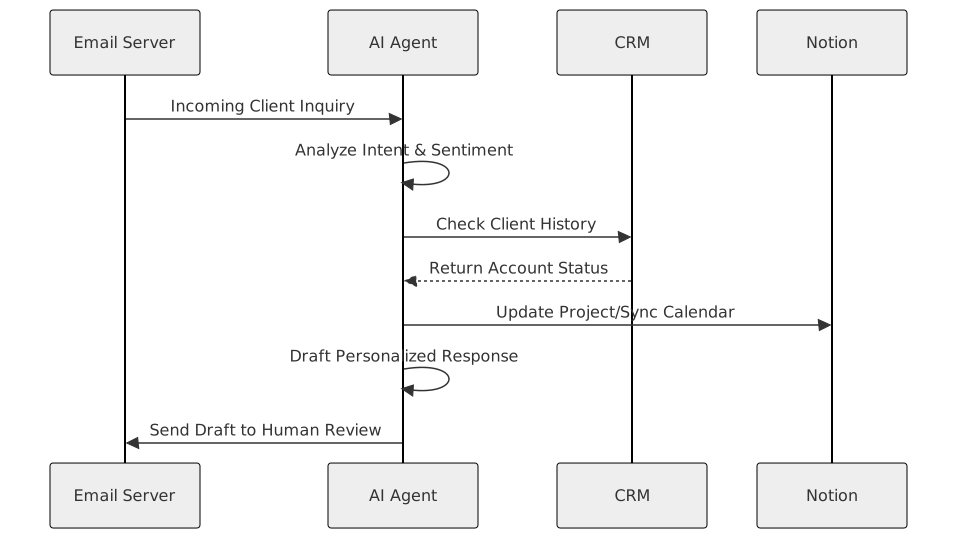
The secret sauce is the "Human-in-the-Loop" (HITL) requirement. Your AI agent should handle the data retrieval, sentiment analysis, and drafting, but it should never hit "Send" on a client-facing email without a human eye on it. By setting up these workflows, you shrink the time from "inquiry" to "action" from hours to seconds, all while keeping that vital human quality control.
Avoiding the "Tool Sprawl" Trap
The biggest mistake companies make in 2026? Buying a new, shiny AI tool for every minor annoyance. This leads to "tool sprawl," where your data is scattered across a dozen subscriptions that don't talk to each other. Before adding a new tool, ask yourself: Does this integrate natively with the stack I already have?
If you’re already using HubSpot or Notion, lean into their native AI features first. Only migrate to a point solution like Clay or Make.com if the functionality is so mission-critical that it justifies the headache of another integration. For broader strategies on streamlining your tech stack, explore more Business Productivity Tools to ensure your growth is sustainable, not just fast.
Frequently Asked Questions
What is the biggest difference between automation in 2025 vs. 2026?
In 2025, AI was a fancy way to write a blog post or summarize a meeting. In 2026, it’s about "Agentic" workflows—autonomous systems that reason, monitor, and execute complex, multi-step processes across your software stack without you hovering over the keyboard.
Do I need to be a coder to implement these AI automation tools?
Hardly. Most of these tools are "no-code" or "low-code." They’re built for business users. If you can draw a flowchart, you can build a workflow.
How do I ensure my data stays secure when using AI automation?
Prioritize tools with enterprise-grade security, data encryption, and clear opt-out settings for public model training. Always restrict your AI agents to the minimum permissions needed to perform their task.
How do I know which AI tool is right for my business size?
Identify your most painful, repetitive bottleneck. If you're a small team, look for "all-in-one" platforms. If you're an enterprise, prioritize tools with deep audit trails and strict security compliance. Always integrate, don't just add.