Best AI Social Media Management Tools: Automate Your Strategy for Maximum ROI
Let’s be real: the "always-on" grind is a lie. If you’re waking up at 6 AM to manually post, staring at a stopwatch waiting for the "perfect" engagement window, and babysitting your comment section like a nervous parent, you aren’t a strategist. You’re an administrative assistant to an algorithm.
By 2026, the social media landscape has shifted under our feet. AI isn't some shiny, futuristic experiment anymore—it’s the baseline for survival. If you’re still doing everything by hand, you’re losing. The goal isn't to let a robot steal your brand’s personality; it’s about building a "Human-in-the-Loop" workflow that scales your output without burning you out.
Escaping the Content Hamster Wheel
We’ve all seen the results of the "more is better" trap. It’s those robotic, soulless posts that read like a machine trying to pass a Turing test. It’s noise. It’s clutter. It’s the content hamster wheel, and it’s killing your engagement.
In 2026, we don’t care about vanity "likes." We care about cold, hard ROI. We want conversions, lead quality, and genuine brand sentiment. Successful automation requires a total mindset shift. You aren't automating your voice; you’re automating the logistics of your voice. When you use industry-leading insights on AI tools to build your tech stack, you stop throwing spaghetti at the wall and start executing with actual purpose.
What Defines an "AI-First" Social Media Tool in 2026?
Not every app with a "Chat" button is built for strategy. If a tool is just a wrapper for a chatbot, drop it. In the current landscape, an "AI-First" platform needs to nail three things: predictive analytics, high-fidelity generative text, and sentiment-aware community management.
Predictive analytics shouldn't just tell you when your audience is awake; it should tell you when they are ready to buy. Generative text engines? They need to be able to handle nuance, not just spit out generic corporate speak. And sentiment analysis is your insurance policy. It flags the trolls and the PR disasters before they spiral. If your toolset doesn't provide these, you’re flying blind.
How Do You Build a "Human-in-the-Loop" Workflow?
The secret is the 80/20 rule. Let the AI handle the heavy lifting—the trend spotting, the data crunching, and the initial drafting. You? You handle the final 20%. That’s where the magic happens: the emotional intelligence, the controversial takes, and the big-picture strategy that no algorithm can replicate.
Before you touch a single automation button, you need a solid content planning foundation. Otherwise, you’re just automating noise. Here’s what a winning workflow looks like:

By keeping a human in the mix, you keep your brand's unique cadence. When you use a high-quality AI writing assistant to get the first draft down, you aren't outsourcing your creativity. You're clearing the desk so you can focus on the stuff that actually moves the needle.
Which AI Tools Are Best for Your Specific Use Case?
Don't buy a tool just because it’s trending. Buy what fixes your specific bottleneck.
- For Brand Voice: You need tools that learn. If the AI can’t tell the difference between your "expert" persona and your "community" persona, it’s a paperweight. Look for tools that let you upload your own style guide and past winning posts as training data.
- For ROI: These are your heavy hitters. They don't just schedule; they optimize. They analyze engagement windows to hit the feed when your audience is most likely to click.
- For Community Management: If your DMs are a disaster, you need an AI agent that understands sentiment. It filters the spam and bubbles up the high-value leads so your human team only talks to the people who matter.
For a deeper dive into the technical capabilities of these systems, refer to this comprehensive testing methodology to see how your chosen tools measure up against industry benchmarks.
How Do You Maintain Your Brand Voice While Scaling?
Here’s the paradox: the easier it is to create content, the harder it is to sound like you.
"Training" your AI is the new "hiring." You don't just type a prompt and walk away. You build a library. You create tone-of-voice identifiers. You keep a "do-not-use" list of buzzwords that make your skin crawl.
Audiences are smart. They can smell a bot from a mile away. To keep your edge, use AI to build the skeleton, then inject your own soul. If your brand is punchy and opinionated, kill the passive voice. If you don't define these boundaries, the AI will default to the "average" of the internet—and nobody wants to be average.
What Is the Reality of Social Media Automation?
There’s a massive difference between "smart automation" and "lazy automation."
Smart automation uses data to predict outcomes and reclaim your time. Lazy automation is that annoying auto-reply that hits your DMs two seconds after you connect with someone. Don't be that person. Always have a "kill switch" for your automations. If a global crisis happens, you need to be able to pause everything in one click. You can find foundational advice on what to automate to ensure you are adding value rather than creating digital landfill.
How to Calculate the ROI of Your AI Stack?
Stop viewing your AI tools as just another monthly bill. View them as a tax on your time that you’re finally getting a refund on.
The math is simple: (Time Saved per Week x Hourly Rate of your Social Manager) + (Incremental Revenue from Optimized Posting Times) = Total ROI.
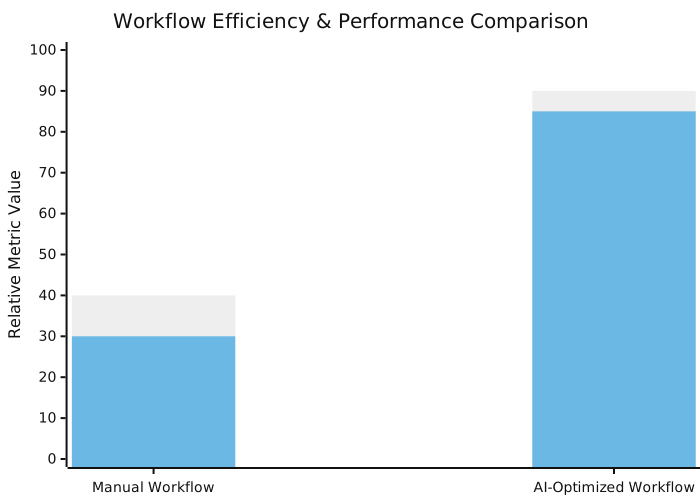
If your team saves 10 hours a week, that’s 10 hours they can spend on partnership development or creative brainstorming. Pair that with the reach you get from AI-optimized scheduling, and the numbers speak for themselves.
Frequently Asked Questions
Is AI-generated social media content penalized by algorithms in 2026?
No. Algorithms don't care who wrote the post; they care about engagement and value. If your AI-assisted content solves a problem or entertains your audience, it will win. If it reads like fluff, it will be ignored—just like human-written fluff.
How do I maintain my unique brand voice when using AI tools?
Treat your AI like a junior copywriter. Give it your guidelines, your best-performing posts, and a list of things you never say. The more context you provide, the less "generic" the result will be.
What is the biggest risk of automating social media?
"Autopilot blindness." You have to keep an eye on the social climate. Automating posts during a global crisis or a trending PR issue without checking the room makes a brand look tone-deaf. Keep a human in the loop during volatile periods.
Can AI tools actually help increase my direct revenue?
Yes, by shifting focus from "visibility" to "conversion." AI tools that analyze predictive engagement windows ensure your content appears when your audience is ready to buy, increasing your conversion rate without needing to dump more money into ads.